

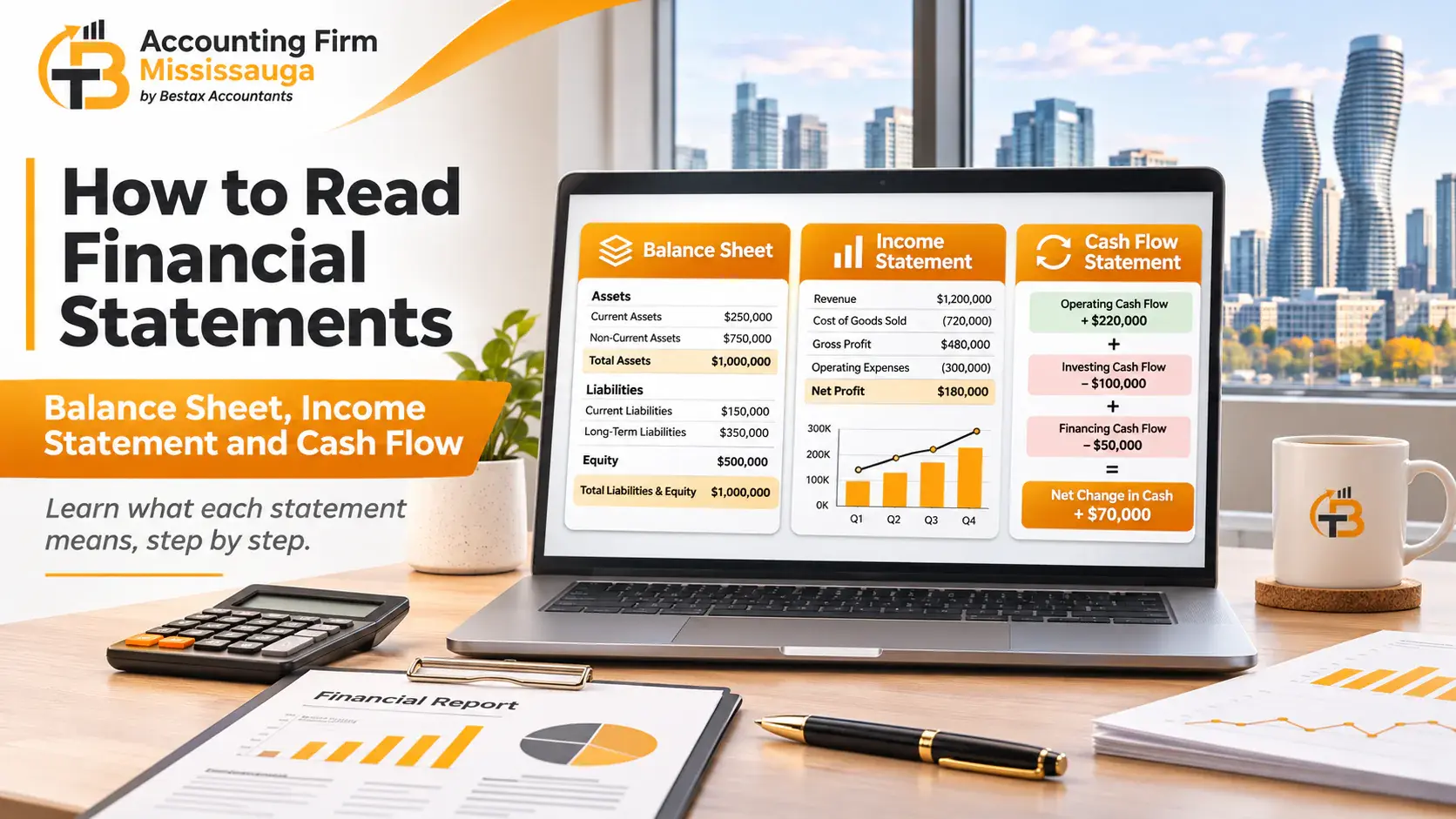
Do financial statements give you a headache? You are not alone. Your accountant sends the year-end reports, and all the numbers just blur together.
Learning how to read financial statements is easier than it looks. Each statement answers one simple question. Once you know that question, the numbers start to click.
Below, we explain the balance sheet, income statement and cash flow statement with simple tables.
What Are the Three Main Financial Statements?
Financial statements for small business usually come as a set of three reports. Each one shows a different part of your finances.
Balance sheet
What It ShowsWhat your business owns and owesIncome statement
What It ShowsHow much your business earns and spendsCash flow statement
What It ShowsHow cash moves in and out of your business
| Financial Statement | What It Shows |
|---|---|
| Balance sheet | What your business owns and owes |
| Income statement | How much your business earns and spends |
| Cash flow statement | How cash moves in and out of your business |
Together, they give you a full picture of your business. If you run a corporation, the same figures are also reported to the CRA with your T2 return, using GIFI codes.
How to Read a Balance Sheet
A balance sheet shows your business's financial position on one specific date, such as December 31. Think of it as a snapshot of everything you own and owe on that day. To read a balance sheet, work through its three sections in order.
Step 1. Read the Assets Section
Assets are what your business owns. They are split into two groups:
- Current assets: Items you expect to use or turn into cash within a year. Examples include cash, accounts receivable and inventory. Accounts receivable is money your customers still owe you.
- Non-current assets: Items you keep for longer than a year, such as equipment, vehicles and buildings.
At the bottom of this section, you will see total assets. That figure is the value of everything your business owns.
Step 2. Read the Liabilities Section
Liabilities are what your business owes to others. They are also split into two groups:
- Current liabilities: Amounts due within a year. These include accounts payable, which is money you owe suppliers, and unpaid bills.
- Long-term liabilities: Amounts due after a year, such as a business loan.
Add these together and you get total liabilities.
Step 3. Read the Equity Section
Equity is the part of the business that belongs to you, the owner. In a corporation, the same section is called shareholders' equity.
Equity is what is left after you subtract liabilities from assets. Every balance sheet follows one formula:
The balance sheet formula
Assets = Liabilities + Equity
Both sides must always match. That is why the statement is called a balance sheet.
Step 4. Understand a Balance Sheet Example
Here is the balance sheet for Maple Leaf Cleaning Inc. on December 31, 2025:
Cash
Amount (CAD)$20,000Accounts receivable
Amount (CAD)$15,000Equipment
Amount (CAD)$25,000Total assets
Amount (CAD)$60,000Accounts payable
Amount (CAD)$10,000Business loan
Amount (CAD)$20,000Total liabilities
Amount (CAD)$30,000Owner's equity
Amount (CAD)$30,000Total liabilities and equity
Amount (CAD)$60,000
| Balance Sheet | Amount (CAD) |
|---|---|
| Cash | $20,000 |
| Accounts receivable | $15,000 |
| Equipment | $25,000 |
| Total assets | $60,000 |
| Accounts payable | $10,000 |
| Business loan | $20,000 |
| Total liabilities | $30,000 |
| Owner's equity | $30,000 |
| Total liabilities and equity | $60,000 |
The business owns $60,000 in total. Cash, money owed by customers and equipment make up that amount.
On the other side, the business owes $30,000 to suppliers and the bank. The remaining $30,000 belongs to the owner.
Now check the formula: $60,000 in assets equals $30,000 in liabilities plus $30,000 in equity. The two sides balance.
How to Read an Income Statement
An income statement is also called a profit and loss statement, or P&L. Unlike the balance sheet, it covers a period of time, such as a month, a quarter or a year.
Here is the income statement explained in five steps.
Step 1. Find the Total Revenue
Revenue appears at the top of the statement. Revenue is the money your business earned from sales, before any costs are taken out. Some statements also list other revenue, such as interest earned, on a separate line.
When we prepare your income statement, we split revenue by service line or client type. You can then see which work brings in the most money.
Step 2. Subtract the Cost of Sales
The cost of sales covers the direct costs of providing your products or services. For a cleaning company, examples include cleaning supplies and the wages of cleaning staff.
Revenue minus the cost of sales gives you gross profit. Gross profit shows how much is left to cover your other costs.
Costs often end up in the wrong category when books are rushed. Our bookkeepers place each cost on the right line, so your gross profit shows true job costs.
Step 3. Read the Operating Expenses
Operating expenses are the costs of running the business day to day. Common examples include:
- Rent
- Office salaries
- Utilities
- Marketing
These costs are subtracted from gross profit.
Step 4. Find the Net Profit or Loss
Net profit is the final line, often called the bottom line. You reach it after all recognized expenses are taken out, including any interest and taxes.
A positive figure means the business made a profit for the period. A negative figure, usually shown in brackets, means it made a loss.
A single figure rarely tells the full story. Each time we prepare your statements, our accountants add a short note explaining why profit rose or fell.
Step 5. Understand an Income Statement Example
Here is the income statement for Maple Leaf Cleaning Inc. for the year ending December 31, 2025:
Revenue
Amount (CAD)$100,000Cost of sales
Amount (CAD)($40,000)Gross profit
Amount (CAD)$60,000Operating expenses
Amount (CAD)($35,000)Interest and tax expenses
Amount (CAD)($5,000)Net profit
Amount (CAD)$20,000
| Income Statement | Amount (CAD) |
|---|---|
| Revenue | $100,000 |
| Cost of sales | ($40,000) |
| Gross profit | $60,000 |
| Operating expenses | ($35,000) |
| Interest and tax expenses | ($5,000) |
| Net profit | $20,000 |
The business earned $100,000 in revenue during the year. Direct costs of $40,000 are subtracted, leaving $60,000 in gross profit.
Next, $35,000 in operating expenses is taken out, which leaves $25,000. Finally, $5,000 in interest and taxes is subtracted. The result is a net profit of $20,000 for the year.
Amounts in brackets are costs. They reduce the total as you move down the statement.
How to Read a Cash Flow Statement
A cash flow statement shows the actual cash that came in and went out over a period. Profit and cash are not the same, so this statement fills a gap the other two leave. You do not need to build it yourself to understand it. Each of its sections answers one question about where your cash went.
Step 1. Read Cash Flow From Operating Activities
The first section covers cash from your daily business operations. Cash in includes payments you collect from customers. Cash out includes payments to suppliers, staff and your landlord.
A positive figure means your day-to-day work brought in more cash than it used.
Step 2. Read Cash Flow From Investing Activities
The second section shows cash spent on, or received from, long-term assets. Buying equipment or a vehicle appears here as cash out. Selling an old asset appears as cash in.
Step 3. Read Cash Flow From Financing Activities
The third section covers how the business is funded. Cash in includes new loans and money the owner puts into the business. Cash out includes loan repayments and money paid out to owners.
Step 4. Find the Net Change in Cash
The net change in cash is the total of all three sections. A positive figure means the business gained cash during the period. A negative figure means more cash went out than came in.
The statement then adds this change to the opening cash balance. The result is the closing cash balance at the end of the period.
Step 5. Understand a Cash Flow Statement Example
Here is the cash flow statement for Maple Leaf Cleaning Inc. for the year ending December 31, 2025:
Cash from operating activities
Amount (CAD)$12,000Cash used in investing activities
Amount (CAD)($8,000)Cash used in financing activities
Amount (CAD)($4,000)Net change in cash
Amount (CAD)$0Opening cash balance
Amount (CAD)$20,000Closing cash balance
Amount (CAD)$20,000
| Cash Flow Statement | Amount (CAD) |
|---|---|
| Cash from operating activities | $12,000 |
| Cash used in investing activities | ($8,000) |
| Cash used in financing activities | ($4,000) |
| Net change in cash | $0 |
| Opening cash balance | $20,000 |
| Closing cash balance | $20,000 |
Daily operations brought in $12,000 in cash. The business then spent $8,000 on new equipment and repaid $4,000 of its loan.
The net change in cash is $12,000 minus $8,000 minus $4,000, which equals $0. The business started the year with $20,000 in cash, so it also ended with $20,000.
The closing balance of $20,000 matches the cash figure on the balance sheet. The two statements always agree on this number.
Preparing a cash flow statement takes far more work than reading one. Every payment must be sorted into the right section. The closing balance also has to match your bank account and balance sheet.
Our accountants can prepare it for you through our financial reporting service. Your balance sheet and income statement are prepared at the same time. Every figure reconciles, so you only need to read the results.
How to Read All Three Financial Statements Together
The three statements make the most sense when you read them side by side. One simple transaction shows how they connect.
Example
Maple Leaf Cleaning Inc. finishes a $10,000 office cleaning contract and sends the invoice. The customer agrees to pay in 30 days.
Income statement
How the $10,000 Sale AppearsRecorded as $10,000 in revenue once the applicable recognition requirements are metBalance sheet
How the $10,000 Sale AppearsRecorded as $10,000 in accounts receivable until the customer paysCash flow statement
How the $10,000 Sale AppearsNo cash receipt from the sale until the payment arrives
| Statement | How the $10,000 Sale Appears |
|---|---|
| Income statement | Recorded as $10,000 in revenue once the applicable recognition requirements are met |
| Balance sheet | Recorded as $10,000 in accounts receivable until the customer pays |
| Cash flow statement | No cash receipt from the sale until the payment arrives |
The sale counts toward your profit right away. Your bank balance, however, only grows when the customer pays.
That is why a business can report a profit without receiving the cash yet. Maple Leaf Cleaning Inc. shows the same pattern. Its net profit was $20,000, but operating activities brought in only $12,000 in cash. Part of the gap is the $15,000 customers still owe, shown as accounts receivable.
Start Reading Your Own Statements With Confidence
The balance sheet tells you what your business owns and owes on one date. The income statement shows whether you made a profit over a period. The cash flow statement shows where your cash actually went.
Each statement answers a different question. The numbers become much easier to understand when you read all three together.
Want statements you can read at a glance? Our financial reporting service prepares monthly or quarterly reports with plain-language notes on what changed. If your books are not up to date yet, we can also set up your bookkeeping first. Book a free consultation to talk through your numbers with an accountant.
Frequently Asked Questions
Which financial statement should you read first?
Many owners start with the income statement to see whether the business made a profit. Next, read the balance sheet to see what you own and owe. Finish with the cash flow statement to check whether your profit turned into cash.
What is the difference between a balance sheet and an income statement?
A balance sheet shows what your business owns and owes on one date. An income statement shows what you earned and spent over a period, such as a year.
How do you know if a business made a profit?
Look at the net profit line at the bottom of the income statement. A positive figure is a profit. A figure in brackets, or with a minus sign, is a loss.
Where can you find the cash balance in financial statements?
You can find it in two places. The balance sheet lists cash under current assets. The cash flow statement shows the same amount as the closing cash balance.
Why is net profit different from cash flow?
Profit counts sales and expenses when they are earned or owed, not when cash moves. Sales on credit, equipment purchases and loan repayments all create a gap between the two numbers.
Disclaimer: The information provided in this blog is for general informational purposes only. For professional assistance and advice, please contact experts.
Author Profile
Written by
Bookkeeping & Financial Reporting Team
Our expert-reviewed bookkeeping team runs monthly closes, cleans up backlogs and sets up QuickBooks Online, Xero and Wave files for Mississauga businesses.
Reviewed by
Corporate & Small Business Tax Team
Our expert-supervised corporate tax team handles T2 filing, small business deduction planning and instalments for Mississauga corporations.