
The HST Quick Method: When It Saves Ontario Businesses Money (and When It Doesn't)
Most Ontario service businesses under $400,000 can remit 8.8% instead of tracking every input tax credit. Here's the real math, the election deadlines, and the income-tax catch nobody mentions.
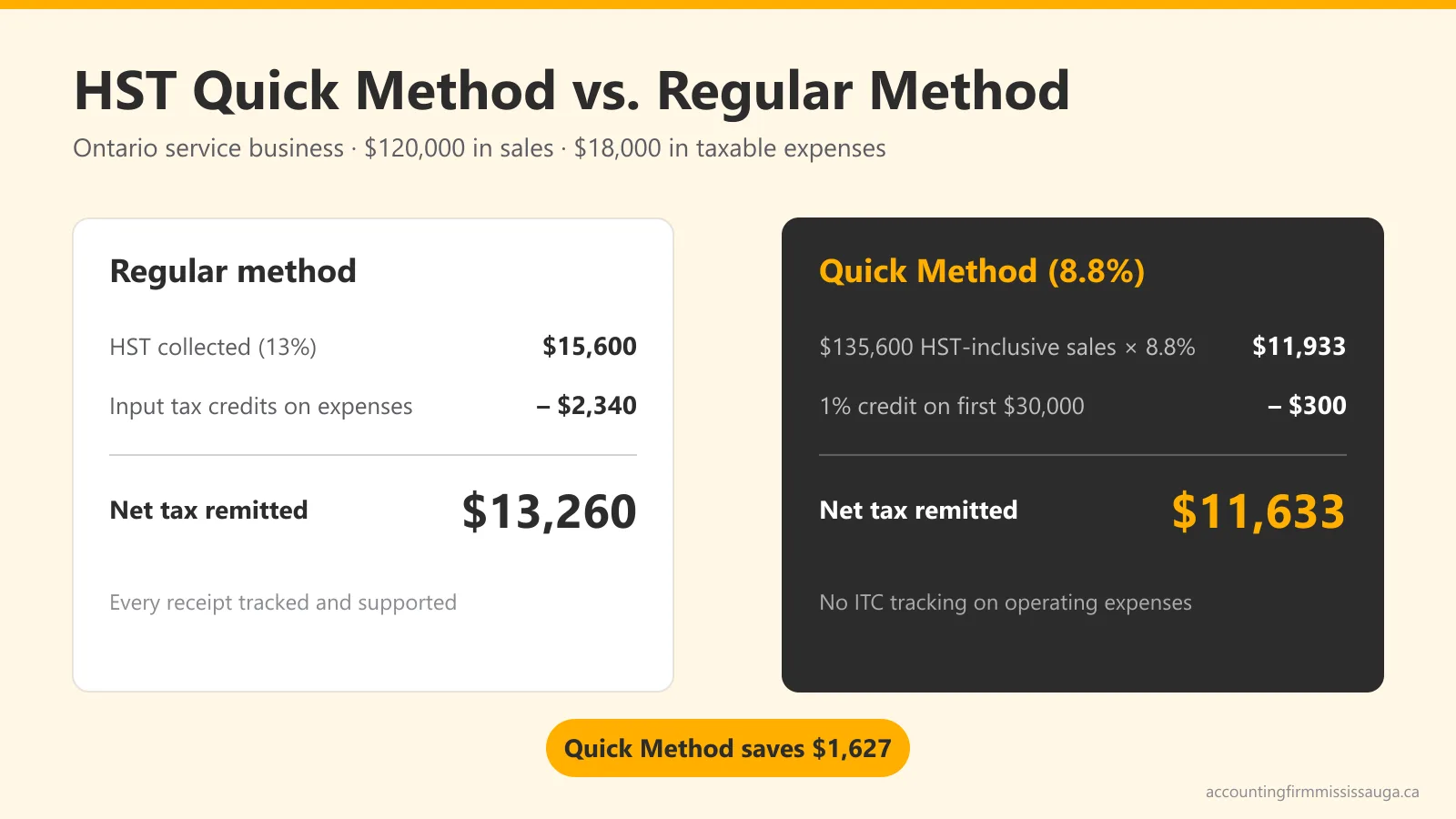
The HST Quick Method lets an eligible Ontario business skip tracking input tax credits on day-to-day expenses and instead remit a flat 8.8 percent (service businesses) or 4.4 percent (retailers and wholesalers) of its HST-inclusive sales, while still charging customers the full 13 percent. For a typical service business with modest expenses, that gap between 13 percent collected and 8.8 percent remitted is real money, often a thousand dollars or more a year. For a business with heavy taxable expenses, the same election quietly costs money instead.
Our guide to the $30,000 registration threshold covered when you have to register. This one picks up the day after: how the regular method actually calculates what you owe, how the Quick Method changes that math, a worked comparison using real 2026 CRA rates, the election deadlines that competitor guides get vague about, and a tax consequence of the Quick Method that almost nobody writes down.
What Actually Changes the Day You Register
Registration attaches an RT program account to your business number, and from your effective date forward, every taxable sale you make in Ontario carries 13 percent HST whether or not you've updated your invoices yet. The CRA assigns you an annual reporting period by default unless your revenue is high enough to require quarterly or monthly filing, and your first return covers the stretch from your effective date to the end of that period.
Two decisions sit in front of you at that point. The first is how often you file, which you can change from the default. The second is how you calculate what you owe, and the choice is between the regular method that every registrant starts on and the Quick Method that most small businesses can opt into. The second decision is the one with money attached, so it gets most of this article.
The Regular Method: Tax Collected Minus Input Tax Credits
Under the regular method, your net tax for a reporting period is the HST you collected or that became collectible on sales, minus the HST you paid or that became payable on business purchases. That second number is your input tax credits, or ITCs. The word "collectible" matters: tax is reported in the period you invoiced it, not the period the client finally paid, so a slow-paying customer doesn't push the HST into a later return.
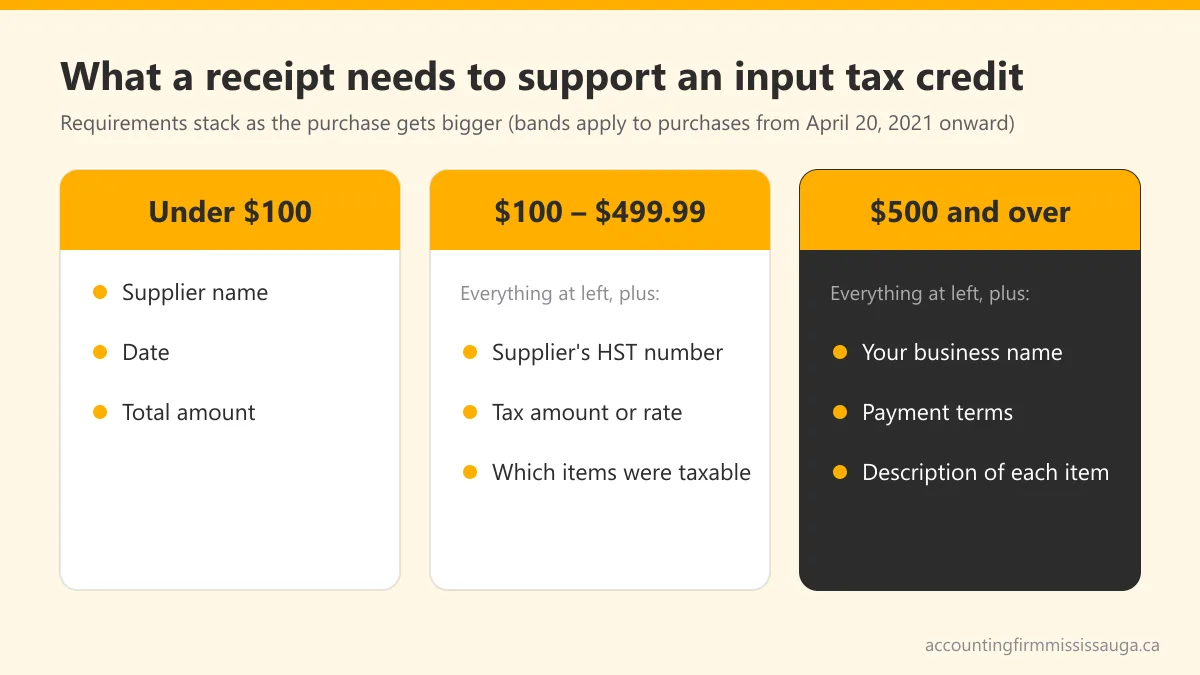
The regular method is precise and it rewards businesses that spend a lot on taxable inputs, because every dollar of HST paid comes straight off the remittance. The cost is bookkeeping. Every ITC has to be supported by a document that meets the CRA's information requirements, and those requirements step up with the size of the purchase.
Under $100
Required on the Invoice or ReceiptSupplier name, date, total amount$100 to $499.99
Required on the Invoice or ReceiptAll of the above, plus supplier's HST number, tax amount or rate, and which items were taxable$500 and over
Required on the Invoice or ReceiptAll of the above, plus your business name, payment terms, and a description of each item
| Purchase Total | Required on the Invoice or Receipt |
|---|---|
| Under $100 | Supplier name, date, total amount |
| $100 to $499.99 | All of the above, plus supplier's HST number, tax amount or rate, and which items were taxable |
| $500 and over | All of the above, plus your business name, payment terms, and a description of each item |
The ITC limits that catch small businesses
- Meals and entertainment: only 50 percent of the HST paid is claimable, matching the income-tax deduction limit.
- Passenger vehicles: the ITC is capped at the tax on the capital cost ceiling, which the Department of Finance set at $39,000 before tax for vehicles bought in 2026. In Ontario that caps the ITC at $5,070 no matter what the vehicle cost.
- Mixed-use purchases: an operating expense used 90 percent or more for business gets a full ITC; 10 percent or less gets nothing; anything in between is prorated.
- Time limit: most businesses have four years from the period an ITC first became claimable to actually claim it. Missed receipts aren't lost forever, but they aren't open-ended either.
- Never claimable: club memberships for dining, recreation, or sport, personal purchases, and anything bought to make exempt supplies.
The Quick Method: A Flat Rate Instead of Receipts
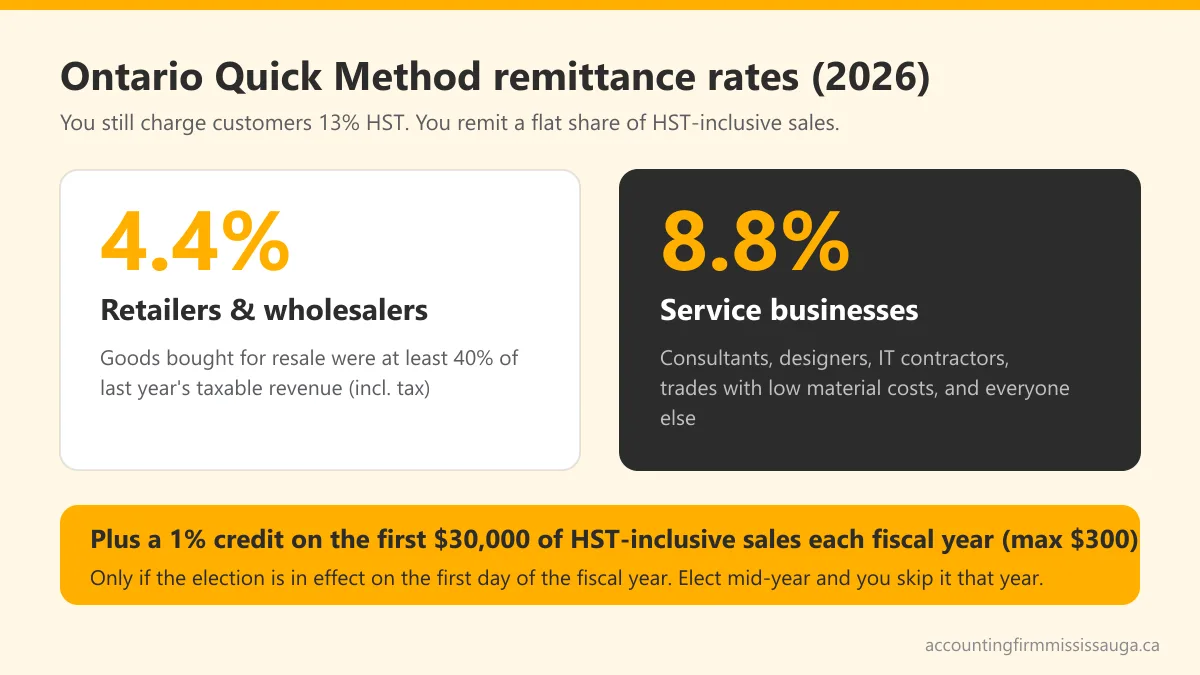
The Quick Method replaces the ITC side of the calculation with a formula. You still charge customers 13 percent, but you remit a fixed percentage of your HST-inclusive sales and keep the difference, which is meant to approximate the ITCs you would have claimed on operating expenses. Because the rate already assumes some input spending, you cannot claim ITCs on day-to-day purchases. You can still claim them on capital assets like computers, equipment, and vehicles, and on real property, which is a distinction that matters for the worked example below.
Retailers and wholesalers
Remittance Rate4.4% of HST-inclusive salesHow the CRA DecidesGoods bought for resale (incl. tax) were at least 40% of last year's taxable revenueService businesses and everyone else
Remittance Rate8.8% of HST-inclusive salesHow the CRA DecidesDefault rate when the 40% goods test isn't met1% bonus credit (all types)
Remittance Rate1% of the first $30,000 of HST-inclusive sales each yearHow the CRA DecidesOnly if the election is in effect on the first day of the fiscal year
| Business Type | Remittance Rate | How the CRA Decides |
|---|---|---|
| Retailers and wholesalers | 4.4% of HST-inclusive sales | Goods bought for resale (incl. tax) were at least 40% of last year's taxable revenue |
| Service businesses and everyone else | 8.8% of HST-inclusive sales | Default rate when the 40% goods test isn't met |
| 1% bonus credit (all types) | 1% of the first $30,000 of HST-inclusive sales each year | Only if the election is in effect on the first day of the fiscal year |
Who can use it
The election is open to registrants whose worldwide taxable revenue, including HST and including any associated businesses, was not more than $400,000 across the last four fiscal quarters or the first four of the last five. You also need to have been in business continuously for the 365 days before the reporting period in which you start, and you can't have revoked a Quick Method election in that same window.
A specific list of businesses is shut out regardless of revenue: anyone providing bookkeeping, financial consulting, tax consulting, or tax return preparation, plus legal, accounting, and actuarial services. Charities, public institutions, municipalities, listed financial institutions, and non-profits with at least 40 percent government funding are excluded too. The irony that accountants can't use the method they recommend is not lost on us.
The Quick Method doesn't change what your customers pay. It changes what you keep. That's why it's an election and not a rate cut.
Priya's Numbers: Regular Method vs. Quick Method
Priya, the Mississauga designer we've followed since our self-employed tax guide, now runs her business through a corporation that billed $120,000 last year, all to Ontario clients, with a December 31 year-end. She files annually. Her HST-taxable operating expenses, meaning software, a coworking desk, her phone plan, and a subcontractor, came to $18,000 before tax. Design is a service, so her Quick Method rate is 8.8 percent.
HST charged to clients (13% of $120,000)
Regular Method$15,600Quick Method$15,600Remittance base
Regular Method$15,600 collectedQuick Method$135,600 HST-inclusive sales x 8.8% = $11,933ITCs on $18,000 of operating expenses
Regular Methodminus $2,340Quick Methodnot claimable1% credit on first $30,000
Regular Methodn/aQuick Methodminus $300Net tax remitted to CRA
Regular Method$13,260Quick Method$11,633
| Line | Regular Method | Quick Method |
|---|---|---|
| HST charged to clients (13% of $120,000) | $15,600 | $15,600 |
| Remittance base | $15,600 collected | $135,600 HST-inclusive sales x 8.8% = $11,933 |
| ITCs on $18,000 of operating expenses | minus $2,340 | not claimable |
| 1% credit on first $30,000 | n/a | minus $300 |
| Net tax remitted to CRA | $13,260 | $11,633 |
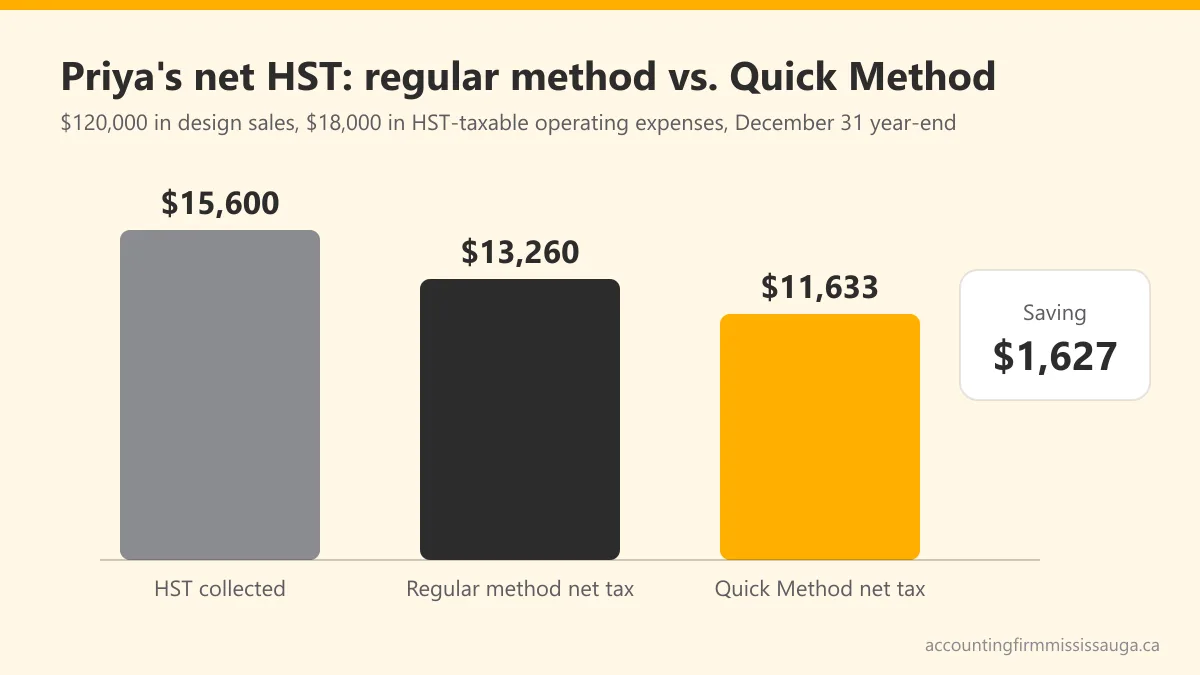
The Quick Method leaves Priya $1,627 better off for the year, and her bookkeeper stops chasing receipts for $18,000 worth of small expenses. If she also bought a $3,000 laptop that year, she'd claim the $390 ITC on it under either method, because capital purchases stay claimable under the Quick Method. The gap between the two methods doesn't move.
Where the break-even sits
For an Ontario service business, the Quick Method wins until ITCs on operating expenses exceed the gap between 13 percent collected and the 8.8 percent remitted. At Priya's $120,000 in sales, that gap is $3,967 after the $300 credit, which corresponds to about $30,500 of HST-taxable operating expenses. Spend less than that on taxable inputs and the Quick Method is ahead; spend more and the regular method is. The ratio is what matters, not the revenue figure, and for most consultants, designers, trades with low material costs, and IT contractors, expenses land well under a quarter of sales.
When the Quick Method Costs You Money
The election is not a universal win, and a business that elects without running its own ratio can lock itself into a worse outcome for at least a year. Three situations reliably favour the regular method.
- High input costs: a contractor buying materials that run 40 to 60 percent of sales, a caterer, or an agency subcontracting most of its work. Their ITCs under the regular method dwarf the Quick Method spread.
- Mostly zero-rated sales: exports and other zero-rated supplies are excluded from the Quick Method base, so you remit nothing on them either way, but you also give up ITCs on the expenses behind them. A business that normally receives HST refunds should never elect.
- Early-stage losses: a startup spending more than it bills is in a refund position under the regular method. The Quick Method turns that refund into a remittance.
A subtler trap is the 1 percent credit's timing. The credit only applies if your election is in effect on the first day of your fiscal year, so a business that elects mid-year gets no credit for that first partial year. On $30,000 of sales that's $300, which is small, but it changes the break-even in year one and it's the kind of detail that decides whether the election is worth making in October or waiting until January.
The Part Nobody Mentions: The Savings Are Taxable
Every competitor guide we reviewed stops at the HST savings. None of them explain what happens on the income tax return, and the answer changes the real value of the election. The CRA treats the difference between the HST you collect and the smaller amount you remit under the Quick Method as government assistance, which is included in business income. Priya's corporation adds $3,967 to its income for the year, the gap between the $15,600 charged and the $11,633 remitted.
The offset is that, because she claimed no ITCs on operating expenses, those expenses are deductible with the HST still on them. Her $18,000 of expenses becomes $20,340 for income-tax purposes, an extra $2,340 of deductions. Net the two together and taxable income rises by exactly $1,627, the same figure as her HST saving. At the combined Ontario small business rate of 11.2 percent that applies since July 1, 2026, the corporation keeps roughly $1,445 of the $1,627 after tax. Still worthwhile, but not the headline number.
For a sole proprietor the same mechanics run through Form T2125, where amount 3D records the HST collected on eligible sales, 3E records the Quick Method remittance, and the difference at 3F flows into gross income. At a personal marginal rate of 30 or 40 percent the after-tax benefit shrinks further, which is one more reason the decision to incorporate and the decision to elect the Quick Method are worth looking at together rather than in isolation.
How to Elect, When It Takes Effect, and How to Get Out
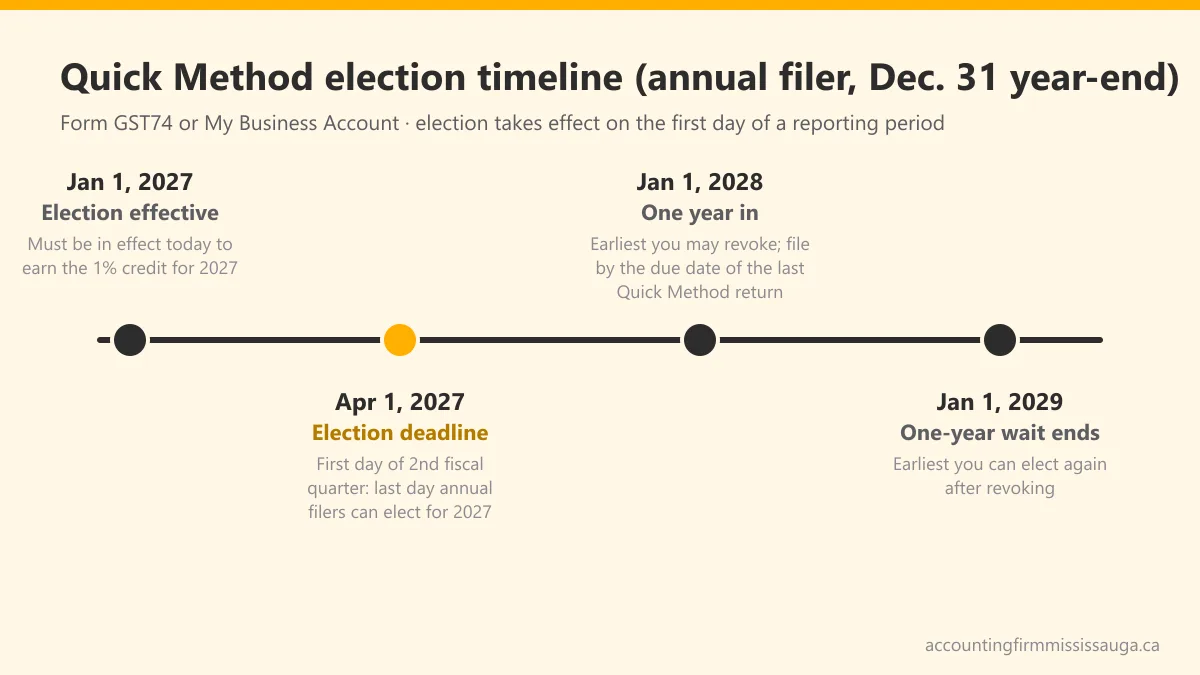
You elect through My Business Account or by filing Form GST74, and the election takes effect on the first day of a reporting period you choose. The filing deadline depends on how often you file. Annual filers have until the first day of their second fiscal quarter to elect for the current year, so a December 31 corporation wanting the Quick Method for all of 2027 has until April 1, 2027 to file. Monthly and quarterly filers must elect by the due date of the return for the first period they want to use it.
Once in, you stay in for at least a year. Revocation uses the same form and must be filed by the due date of the return for the last period you want the Quick Method to apply, and after revoking you wait a full year before you can elect again. Both directions of that lock-in are why the break-even calculation above is worth doing with real figures, not estimates, before filing anything.
What happens when you outgrow it
Cross $400,000 in HST-inclusive taxable revenue and the election stops on its own, though not overnight. An annual filer who exceeds the threshold in a fiscal year switches back to the regular method at the start of the next fiscal year. Quarterly and monthly filers switch at the start of the second fiscal quarter after the year in which the test was failed, or at the next quarter, depending on which of the two revenue tests tripped. The CRA's own example is a clothing store that sold $416,000 in one year and had to be back on the regular method by the following April 1. Businesses approaching that line should already be re-checking whether the regular method would have been better anyway, because at that revenue level the ITCs usually are.
Filing Frequency and the Deadlines That Come With It
The CRA assigns your reporting period from annual taxable supplies, but you can elect a shorter one through My Business Account. Businesses that regularly receive refunds under the regular method often move to quarterly filing on purpose, because a refund you get back in four instalments is worth more than one you wait fifteen months for. Our 2026 tax deadline calendar lists every date in sequence; the summary that matters for a new registrant is below.
Monthly
Assigned When Annual Taxable Supplies AreOver $6 millionReturn and Payment Due1 month after the period endsQuarterly
Assigned When Annual Taxable Supplies Are$1.5 million to $6 millionReturn and Payment Due1 month after the period endsAnnual (corporation or partnership)
Assigned When Annual Taxable Supplies Are$1.5 million or lessReturn and Payment Due3 months after fiscal year-endAnnual (sole proprietor, Dec. 31 year-end)
Assigned When Annual Taxable Supplies Are$1.5 million or lessReturn and Payment DuePayment April 30, return June 15
| Filer Type | Assigned When Annual Taxable Supplies Are | Return and Payment Due |
|---|---|---|
| Monthly | Over $6 million | 1 month after the period ends |
| Quarterly | $1.5 million to $6 million | 1 month after the period ends |
| Annual (corporation or partnership) | $1.5 million or less | 3 months after fiscal year-end |
| Annual (sole proprietor, Dec. 31 year-end) | $1.5 million or less | Payment April 30, return June 15 |
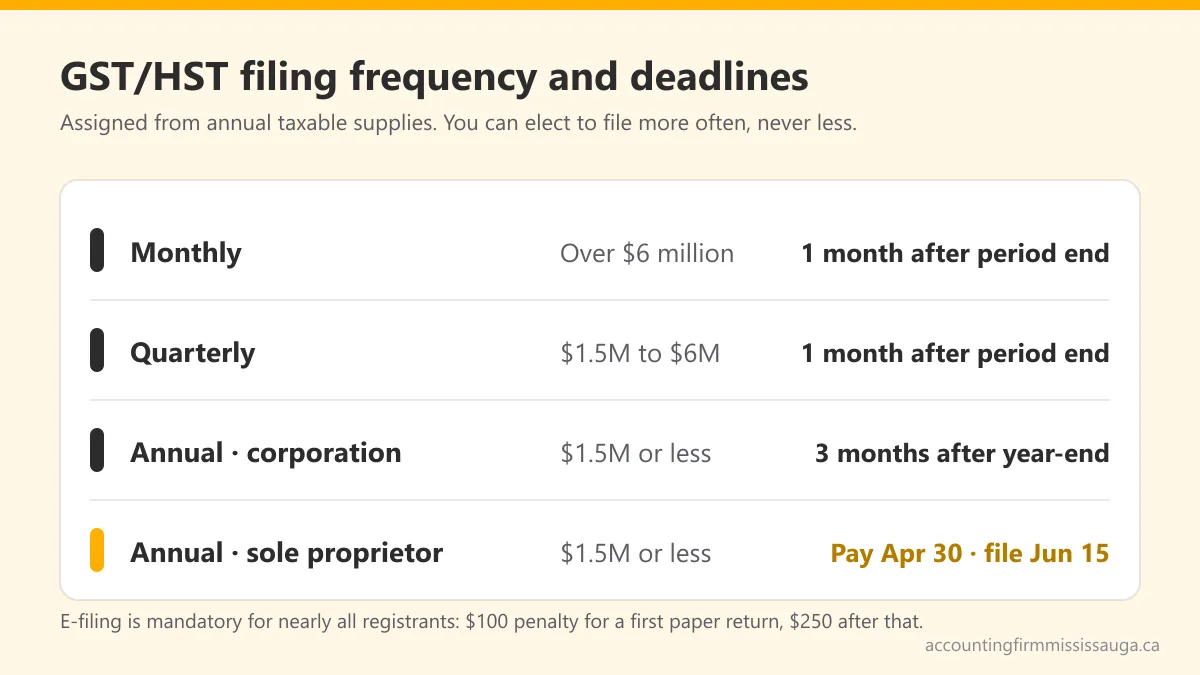
The sole-proprietor split trips people up every year. The return isn't due until June 15, but any balance owing was due April 30, and interest runs from May 1 on whatever's unpaid. Filing in June without having paid in April means you were already six weeks into interest charges by the time the return was submitted.
Paper returns are effectively finished. Since reporting periods beginning January 1, 2024, all registrants other than charities and selected financial institutions have to file electronically, through GST/HST NETFILE, My Business Account, or accounting software, and the penalty for a paper return is $100 the first time and $250 for each one after that, even on a nil return.
The Second-Year Surprise: Quarterly Instalments
Priya's first Quick Method year ends with $11,633 owing on a single annual return. Because that net tax is $3,000 or more, she becomes an instalment payer the following year: the CRA expects four quarterly payments, each normally a quarter of the previous year's net tax, due one month after each fiscal quarter ends. For her December year-end that means roughly $2,908 on April 30, July 31, October 31, and January 31, with the annual return reconciling the difference by March 31.
You can base instalments on a lower current-year estimate instead, but if the estimate falls short of what you actually should have paid, instalment interest is charged on the shortfall. The CRA's prescribed rate on overdue GST/HST amounts sits at 7 percent for the fourth quarter of 2026, compounded daily. The instalment mechanic is the same one that surprises new employers with payroll remittance schedules: the year you first cross the line is the year you find out.
What Filing Late Actually Costs
The late-filing penalty on a GST/HST return is 1 percent of the amount owing, plus 0.25 percent of that amount for each complete month the return is late, to a maximum of 12 months. If Priya filed her $11,633 return three complete months late, the penalty would be $116 plus $87, or about $204, before interest at 7 percent compounded daily adds roughly another $200 over the same stretch. No penalty applies to a nil or refund return that's late, though an ignored demand to file carries a flat $250 on top of everything else.
Several guides we reviewed quote the income-tax late-filing penalty (5 percent plus 1 percent a month) for GST/HST returns. That's the wrong formula. The GST/HST penalty is smaller, but the interest clock is what does the damage over time, especially on an annual return where a full year of net tax is owing at once. Businesses that are already behind on multiple returns are usually better served by a backlog catch-up that files everything in sequence than by tackling the oldest one alone.
Filling In the Return Under the Quick Method
The return itself doesn't change shape; three lines are filled differently. Line 101 takes your total sales including the HST charged, not the pre-tax figure most people enter by habit. Line 103 is line 101 multiplied by your remittance rate. Line 107 is where the 1 percent credit goes, as an adjustment reducing net tax. ITCs on capital purchases still go on line 106 as usual. Enter pre-tax sales on line 101 by mistake and you under-remit by the rate applied to the HST portion, which on Priya's numbers is $1,373 the CRA will eventually assess with interest.
What This Looks Like for Mississauga Businesses
Most of the newly registered businesses we see in Mississauga are service-based, billing clients across the GTA from a home office or a coworking desk near Square One, with taxable expenses well under a fifth of revenue. For that profile the Quick Method is usually the right default and the only real question is timing the election to catch the 1 percent credit from the start of the fiscal year. The businesses where we recommend the regular method are the ones with real inventory or subcontracting costs, the trades buying materials through Dixie Road supply yards, restaurants, and anyone selling into the United States with zero-rated exports and a refund position.
Either way the decision is a calculation, not a preference, and it's one that should be revisited each year as the expense ratio shifts. If you registered recently and haven't decided which method to use, or you elected years ago and never re-checked, our GST/HST return filing service runs both methods against your actual numbers before every annual return. Book a free call and we'll show you which one your business should be on.
Frequently Asked Questions
Do I still charge 13% HST if I use the Quick Method?
Yes. The Quick Method changes only what you remit to the CRA, not what you charge. Your invoices show 13% HST as usual, and you remit 8.8% (services) or 4.4% (goods for resale) of your HST-inclusive sales, keeping the difference in place of input tax credits on operating expenses.
Can I claim any input tax credits under the Quick Method?
Only on capital purchases such as computers, equipment, and vehicles, on real property and improvements to it, and on purchases where the tax became payable before your election took effect. ITCs on operating expenses like rent, software, supplies, and subcontractors are not claimable because the remittance rate already accounts for them.
Who is not allowed to use the Quick Method?
Businesses providing bookkeeping, financial consulting, tax consulting, tax return preparation, legal, accounting, or actuarial services are excluded regardless of revenue, along with charities, public institutions, municipalities, listed financial institutions, and non-profits with at least 40% government funding. Everyone else needs worldwide taxable revenue of $400,000 or less including HST and associated businesses.
Is the money I save with the Quick Method taxable?
Yes. The CRA treats the gap between HST collected and the amount remitted under the Quick Method as government assistance included in business income. The offset is that operating expenses are deductible with HST included, since no ITCs were claimed. The net effect is that your HST saving is added to taxable income, so the after-tax benefit is smaller than the HST figure alone.
When is the deadline to elect the Quick Method?
Annual filers must elect by the first day of their second fiscal quarter for the election to cover the current fiscal year. Monthly and quarterly filers must elect by the due date of the return for the first period they want to use it. The election takes effect on the first day of a reporting period, and the 1% credit applies only if the election is in effect on the first day of the fiscal year.
How long do I have to stay on the Quick Method?
At least one year. You can revoke the election after it has been in effect for a year, by filing by the due date of the return for the last period you want to use it. After revoking, you must wait at least one year before electing the Quick Method again.
When do I have to pay GST/HST instalments?
If you file annually and your net tax for the previous fiscal year was $3,000 or more, you must make quarterly instalments, each normally one-quarter of last year's net tax, due one month after the end of each fiscal quarter. For a December 31 year-end that means April 30, July 31, October 31, and January 31, with any balance settled on the annual return.
Disclaimer: The information provided in this blog is for general informational purposes only. For professional assistance and advice, please contact experts.
On this page
Never miss a deadline again
We track every filing date for our clients. Let us watch yours.
Book a free callAccounting Firm Mississauga Team
A practice of expert accountants filing returns for Mississauga businesses and individuals for close to a decade. We write these to answer the questions clients actually ask.
Recent posts
View all → Personal Tax
Real Estate Accountant Mississauga: Tax, Bookkeeping and Property Accounting
Settle three things before the next rental year closes: how the property is owned, whether CCA is worth claiming, and what the sale will cost in tax. This guide covers rental income accounting, HST on property, the 2026 capital gains rules and the bookkeeping behind all three.
 Bookkeeping
Best Accounting Software for Small Businesses in Mississauga: QuickBooks vs Xero vs Wave
Match the software to how you file HST and run payroll, not to the price list. This guide compares QuickBooks Online, Xero and Wave on what a Mississauga business pays, what each does with GST/HST and payroll, and which fits a sole proprietor, a service firm and a company with staff.
 Bookkeeping
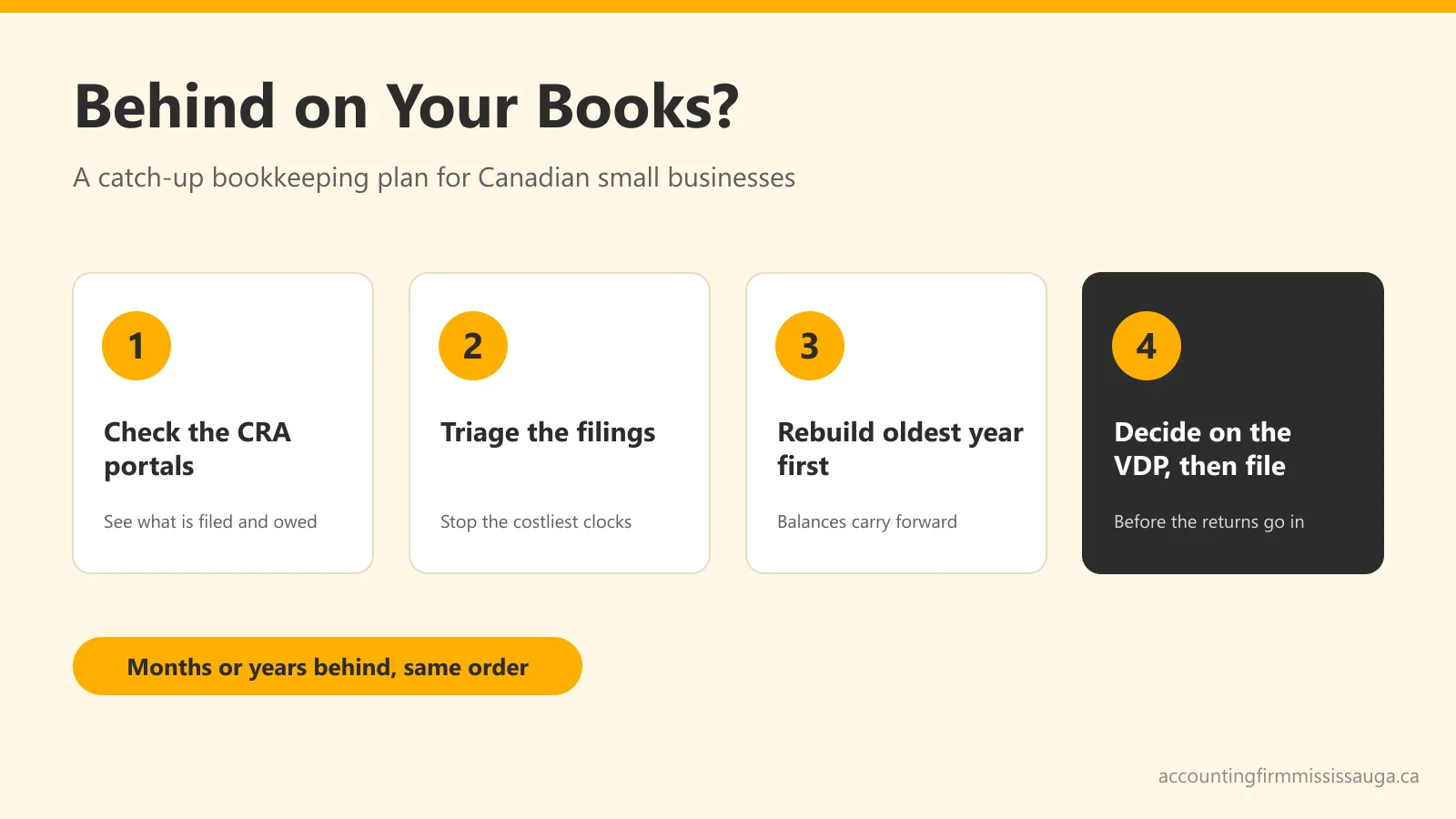
Catch-Up Bookkeeping: What to Do When You're Months (or Years) Behind
Behind on your books and your filings? Here's the order to catch up in, where missing records actually come from, what the delay really costs in CRA penalties, and how the Voluntary Disclosures Program changed in October 2025.
Free Consultation
Tell Us What You Need. Get a Real Answer Back.
No sales script, no obligation. Describe your situation once and an accounting specialist will follow up with a straight answer and a flat quote.
- Flat-fee quote before any work starts
- Response within one business day
- Reviewed by an expert accountant, not just a bookkeeper