
Catch-Up Bookkeeping: What to Do When You're Months (or Years) Behind
Behind on your books and your filings? Here's the order to catch up in, where missing records actually come from, what the delay really costs in CRA penalties, and how the Voluntary Disclosures Program changed in October 2025.
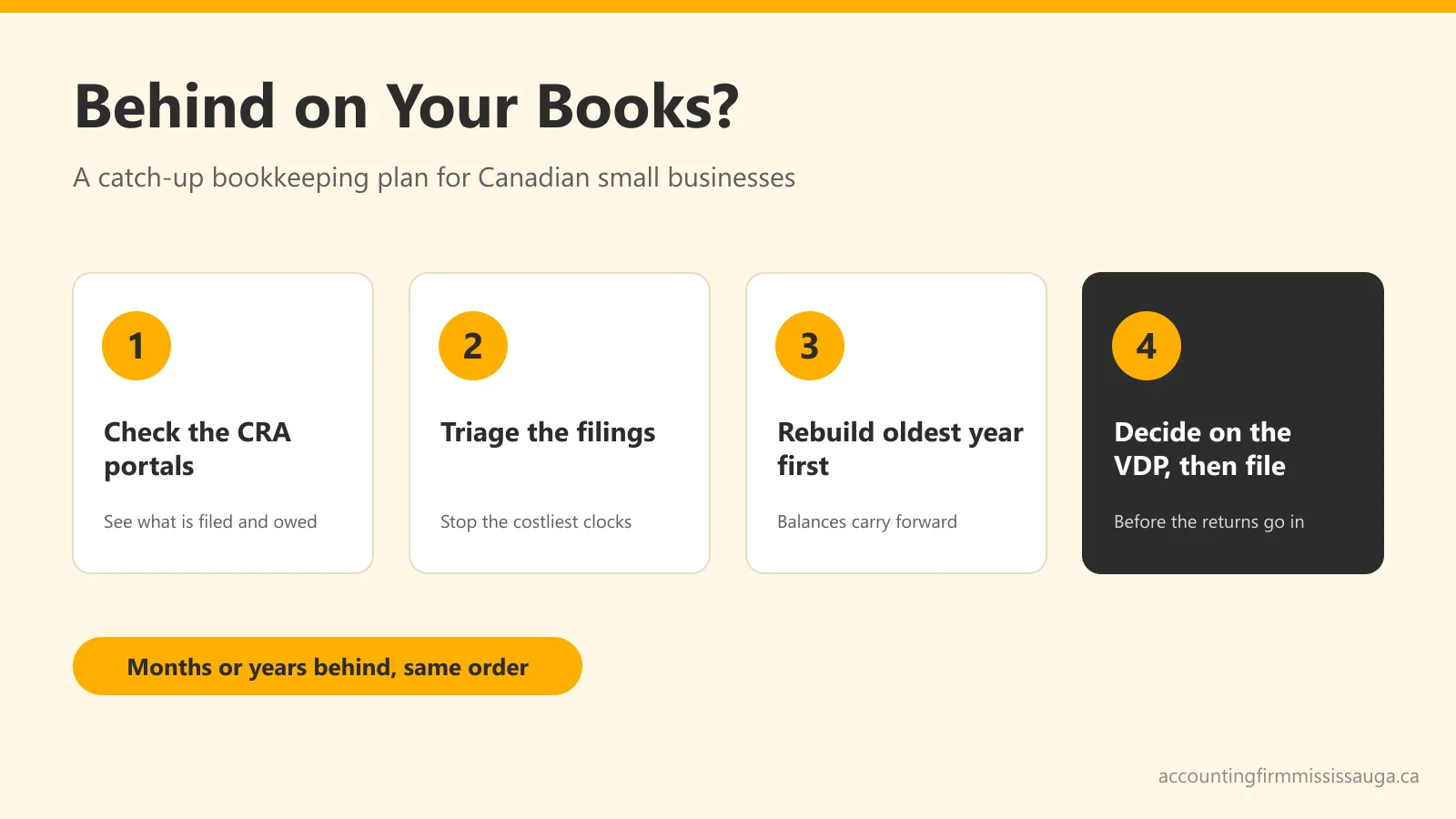
Catch-up bookkeeping means rebuilding the months or years of transactions that never made it into your books, reconciling them against bank and card statements, and then using those clean numbers to file whatever returns fell behind with them. The data entry is routine. The order you do it in is not, and neither is what you should do if the CRA has already noticed. Getting those two decisions right is often worth more than the bookkeeping itself.
We covered what catch-up work costs in our Mississauga bookkeeping pricing guide. This guide covers everything around the price: how to tell overdue returns apart from merely messy books, what to file first, where missing records actually come from, what staying behind costs in real penalty dollars, and how the Voluntary Disclosures Program changed on October 1, 2025.
Two Different Problems: Unfiled Returns and Unreconciled Books
Most owners who say they're behind on their bookkeeping are describing two separate problems under one label. The first is the books: bank accounts nobody reconciled, sales never entered, receipts sitting in a shoebox or a Gmail folder. The second is filings, meaning returns the CRA and the Province expected by a specific date that never arrived. Books have no deadline of their own. Returns do, and every one of them runs its own penalty clock.
Separating the two changes the conversation. A business with two years of messy books but every return filed on time from reasonable figures has a cleanup job. A business with six months of messy books and three missed HST returns has a compliance problem that happens to need bookkeeping to fix. The second one is more urgent, even though the backlog is smaller.
T1 personal return with T2125
Who Files ItSole proprietorsNormal DeadlineJune 15 filing; any balance owing due April 30T2 corporate return
Who Files ItEvery corporation, even with no incomeNormal Deadline6 months after year-end; balance due 2 or 3 months after year-endGST/HST return
Who Files ItHST registrantsNormal Deadline1 month after each monthly or quarterly period; 3 months after year-end for annual filers (June 15 for sole proprietors)Payroll remittances
Who Files ItEmployers, including owner-managers paying themselves a salaryNormal DeadlineUsually the 15th of the following monthT4 slips and summary
Who Files ItEmployersNormal DeadlineLast day of February (next business day if it falls on a weekend)Ontario annual return
Who Files ItOntario corporationsNormal DeadlineWithin 6 months of year-end, through the Ontario Business Registry
| Filing | Who Files It | Normal Deadline |
|---|---|---|
| T1 personal return with T2125 | Sole proprietors | June 15 filing; any balance owing due April 30 |
| T2 corporate return | Every corporation, even with no income | 6 months after year-end; balance due 2 or 3 months after year-end |
| GST/HST return | HST registrants | 1 month after each monthly or quarterly period; 3 months after year-end for annual filers (June 15 for sole proprietors) |
| Payroll remittances | Employers, including owner-managers paying themselves a salary | Usually the 15th of the following month |
| T4 slips and summary | Employers | Last day of February (next business day if it falls on a weekend) |
| Ontario annual return | Ontario corporations | Within 6 months of year-end, through the Ontario Business Registry |
Step One: Log In to the CRA Before You Open a Spreadsheet
Before anyone reconciles a single bank statement, log in to My Account for your personal returns and My Business Account for the corporation, HST, and payroll accounts. Those two portals show which returns the CRA has on file, which ones it's still waiting for, the balances it believes you owe, and every letter it has sent, including the ones that went to an old address. Five minutes there tells you whether you have a quiet backlog or one the CRA is already chasing, and that distinction shapes almost everything that follows.
If an accountant is doing the catch-up, authorize them through Represent a Client rather than sharing your login. They see the same history, can pull prior-year slips and HST filing records directly, and can speak to the CRA for you, which matters if a collections officer calls halfway through the project. Worried that late returns will draw attention? Filing late is not the same as being selected for review, and our breakdown of what actually triggers a CRA audit covers what the CRA does and doesn't publish about how it picks files.
What to File First: A Triage Order That Saves Money
Overdue returns don't all cost the same to leave sitting. Late-filing penalties on income tax returns are a percentage of the balance owing, so a year where you owe nothing carries no late-filing penalty at all, while a year with $10,000 owing gets more expensive every month. We work backlogs in this order.
- Anything the CRA has formally demanded. A demand to file sets its own deadline, and ignoring it opens the door to larger penalties and, in rare cases, prosecution.
- Payroll source deductions. Income tax, CPP, and EI withheld from employees are held in trust, late remittances draw penalties of 3 to 10 percent, and directors can be held personally liable for amounts that were never sent in.
- Income tax years with a balance owing. The 5 percent penalty lands the day after the filing deadline and grows by 1 percent for each full month late, up to 12 months.
- GST/HST returns. The penalty formula is gentler, but input tax credits on old purchases expire after roughly four years, so the oldest periods are quietly losing money.
- The Ontario annual return, for corporations. A small filing, but chronic non-compliance can end with the Province dissolving the company.
- Refund and nil years. No penalty, but not free either: corporate refunds disappear after three years, and a missing personal return can hold up benefit and credit payments.
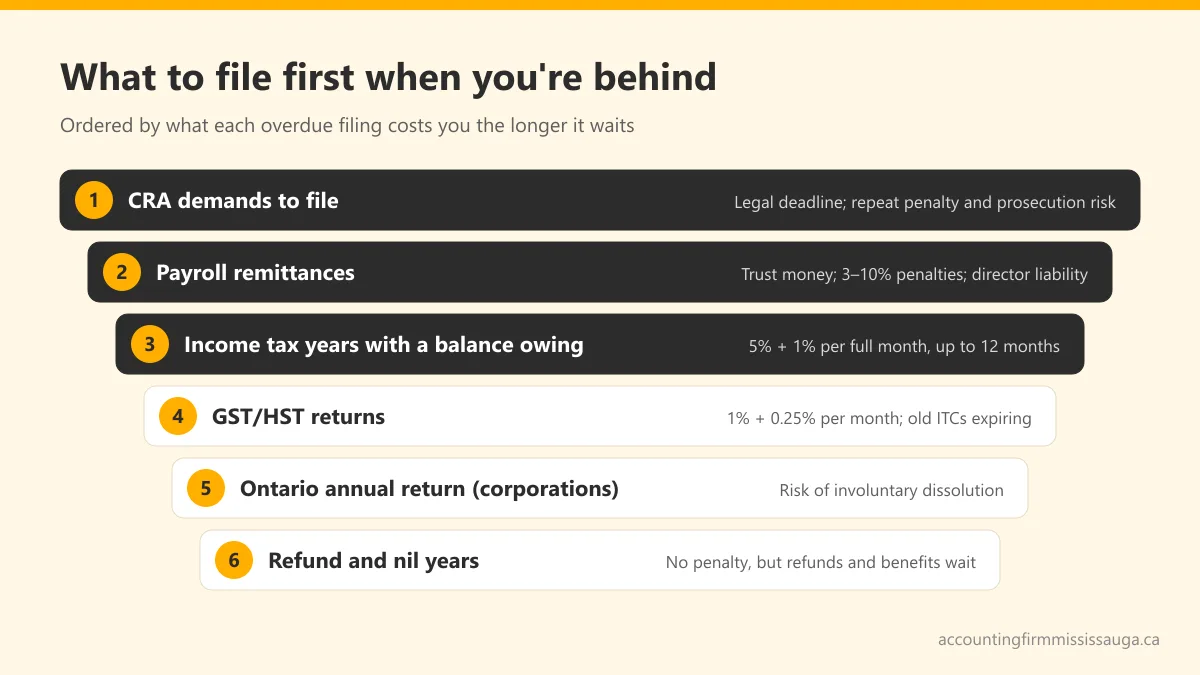
Two notes on that order. Triage decides which returns you file first, not which year you reconstruct first, and those are different questions. And if the list includes years with real money owing while the CRA hasn't contacted you yet, read the Voluntary Disclosures section below before filing anything, because the order in which you file and apply matters.
Why You Rebuild the Oldest Year First
Every year of books ends with a balance sheet, and that balance sheet is the next year's starting point. Cash, receivables, what you owe suppliers, the undepreciated cost of your equipment, HST collected but not yet remitted, and, for a corporation, the shareholder loan balance all carry forward. Reconstruct 2025 before 2024 and you're building on opening numbers you guessed, which means reworking 2025 once 2024 is finished. We've taken over DIY catch-ups done newest-first that had to be redone entirely for exactly that reason.
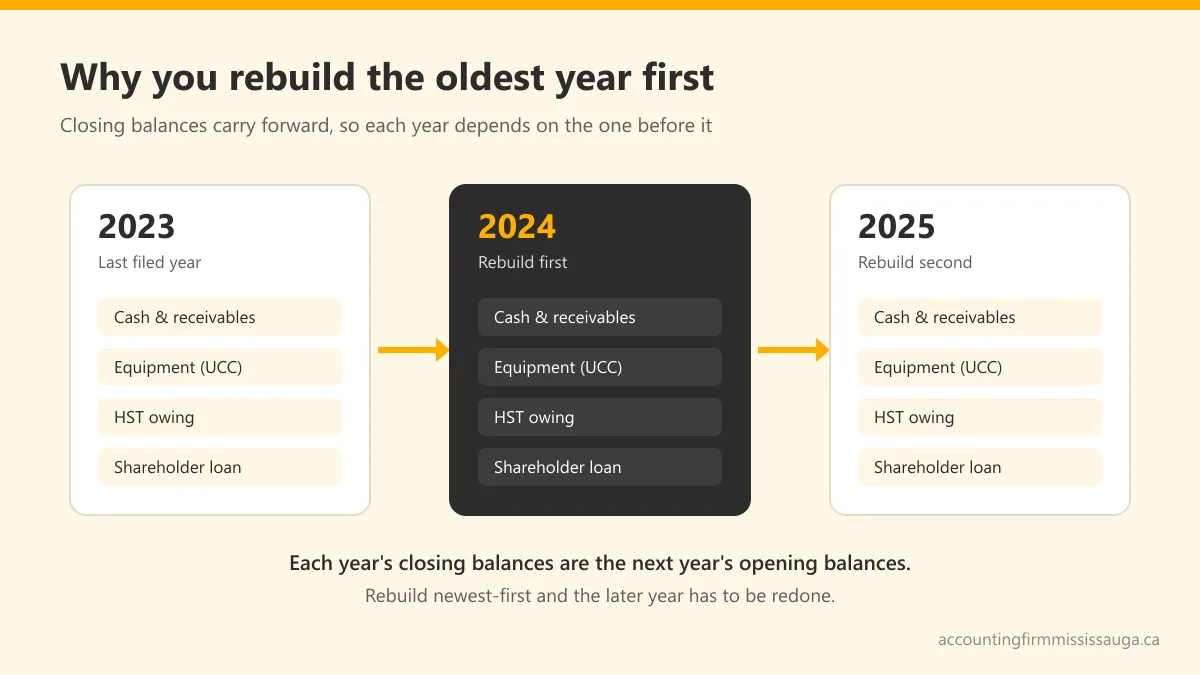
The exception is a CRA request about a specific year. If a demand covers 2023, the 2023 return gets prepared first, even if that means estimating an opening balance and adjusting it later. The deadline beats the tidiness.
Catch-up vs. clean-up
Firms use the two terms loosely. Catch-up usually means periods that were never recorded at all. Clean-up means periods recorded wrong: duplicate transactions from a bank feed imported twice, personal spending coded as business, loan payments booked entirely as expenses. Most backlogs past six months need both, and the clean-up half is often slower, because every wrong entry has to be found before it can be fixed.
Rebuilding the Records When Half of Them Are Missing
Most guides say to rebuild from your bank statements and stop there. The catch is that accounting-software bank feeds typically pull only about 90 days of history when you first connect them, so anything older has to come from somewhere else. Here's where we actually find the data on a multi-year backlog.
Bank and credit card statements
What It RecoversEvery deposit and payment; the backbone of the rebuildWatch ForOlder statements may need to be ordered from the bank, sometimes for a feePayment processors (Stripe, Square, Shopify, PayPal)
What It RecoversGross sales, refunds, and payout timingWatch ForDeposits arrive net of fees, so the fees need their own entriesCustomer and supplier statements
What It RecoversInvoices you issued or received but never savedWatch ForAsk suppliers for a statement of account covering the whole gapEmail and cloud storage
What It RecoversDigital receipts, subscriptions, and online ordersWatch ForSearch by vendor name and by the words receipt and invoiceCRA My Business Account
What It RecoversHST and payroll filing history, payments, and balancesWatch ForShows what you filed, not what you should have filedPayroll provider reports
What It RecoversGross pay, deductions, and remittances by pay periodWatch ForConfirm each remittance actually cleared the bank
| Source | What It Recovers | Watch For |
|---|---|---|
| Bank and credit card statements | Every deposit and payment; the backbone of the rebuild | Older statements may need to be ordered from the bank, sometimes for a fee |
| Payment processors (Stripe, Square, Shopify, PayPal) | Gross sales, refunds, and payout timing | Deposits arrive net of fees, so the fees need their own entries |
| Customer and supplier statements | Invoices you issued or received but never saved | Ask suppliers for a statement of account covering the whole gap |
| Email and cloud storage | Digital receipts, subscriptions, and online orders | Search by vendor name and by the words receipt and invoice |
| CRA My Business Account | HST and payroll filing history, payments, and balances | Shows what you filed, not what you should have filed |
| Payroll provider reports | Gross pay, deductions, and remittances by pay period | Confirm each remittance actually cleared the bank |
What the CRA accepts when a receipt is gone
Bank statements prove money moved. They don't prove what it bought. The CRA lists bank statements and cancelled cheques among acceptable supporting records, but it also tells businesses to always get receipts, and it can disallow claims your records don't support. When a supplier never issued a receipt, the CRA's own guidance is to write the seller's name and address, the amount, the date, and the details of the purchase in your expense journal, and keep the bank or card record that matches it.
HST is stricter. The CRA states plainly that a monthly credit card statement is not sufficient evidence to claim an input tax credit; you need the underlying receipt or invoice, and the detail required steps up at $100 and again at $500. On a catch-up, that makes chasing supplier invoices worth the effort for larger purchases, while a $14 parking charge with a matching card line usually isn't worth a phone call. Records that were lost, damaged, or destroyed should be reported to the CRA at 1-800-959-5525 and recreated within a reasonable time.
Daniel's Backlog: What Two Years Behind Actually Costs
Daniel runs a small renovation business in Mississauga as a sole proprietor. He's registered for HST, files annually, and had an accountant through his 2023 return. Then the business got busy, the accountant retired, and nothing was filed after that. By the fall of 2026 he has four overdue returns and close to three years of unreconciled books. Using estimates from his bank activity, here's what the penalties look like if everything is filed on November 30, 2026.
2024 T1 (due June 15, 2025)
Balance Owing$6,000Full Months Late17, capped at 12Late-Filing Penalty$1,0202025 T1 (due June 15, 2026)
Balance Owing$5,500Full Months Late5Late-Filing Penalty$5502024 GST/HST annual (due June 15, 2025)
Balance Owing$4,000Full Months Late17, capped at 12Late-Filing Penalty$1602025 GST/HST annual (due June 15, 2026)
Balance Owing$3,800Full Months Late5Late-Filing Penalty$86Total
Balance Owing$19,300Full Months LateLate-Filing Penalty$1,816
| Return | Balance Owing | Full Months Late | Late-Filing Penalty |
|---|---|---|---|
| 2024 T1 (due June 15, 2025) | $6,000 | 17, capped at 12 | $1,020 |
| 2025 T1 (due June 15, 2026) | $5,500 | 5 | $550 |
| 2024 GST/HST annual (due June 15, 2025) | $4,000 | 17, capped at 12 | $160 |
| 2025 GST/HST annual (due June 15, 2026) | $3,800 | 5 | $86 |
| Total | $19,300 | $1,816 |
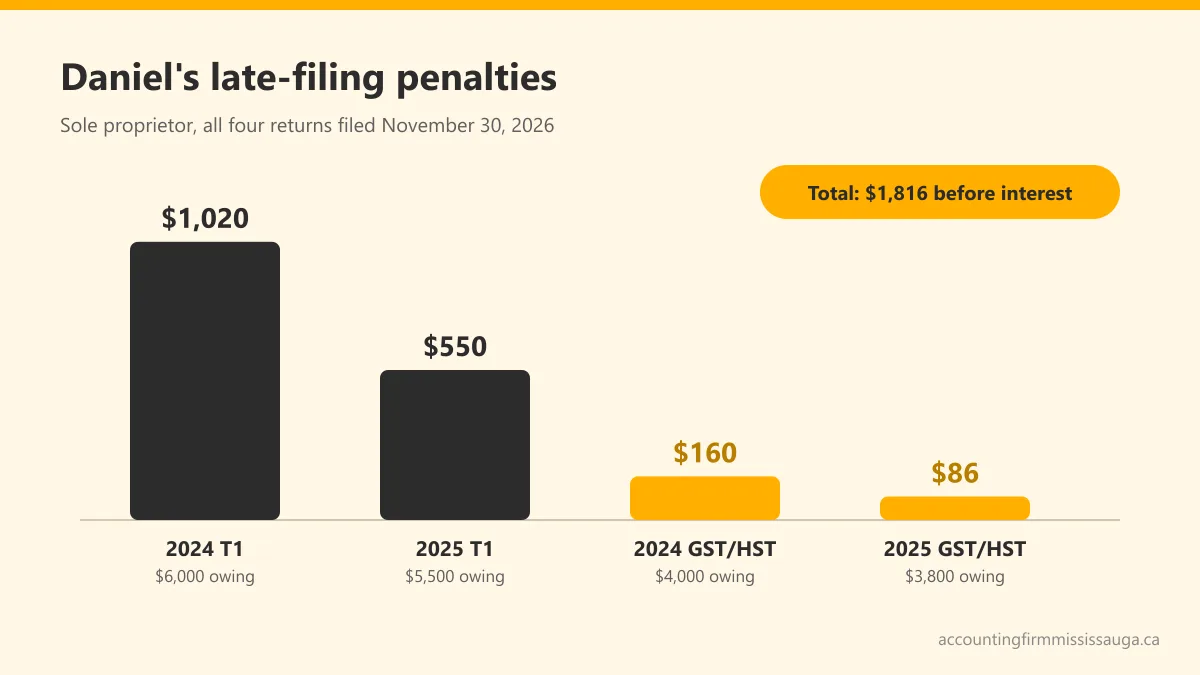
Two things stand out. The income tax penalties are more than six times the HST penalties, even though the HST balances are about two-thirds as large, because the GST/HST formula starts at 1 percent of the amount owing rather than 5 percent and adds a quarter-point per month instead of a full point. And none of it includes interest. The CRA charges daily compound interest on overdue balances from the day after they were due, at a prescribed rate of 7 percent for the second half of 2026, and on these four balances that adds well over a thousand dollars more.
One more line never made it onto Daniel's radar. His net HST was over $3,000 a year, which made him a quarterly instalment payer. He made no instalments, so instalment interest applies on top of the late-filing penalty. Nobody warned him because nobody was looking at the account.
What Staying Behind Costs Beyond Penalties
Penalties get the attention, but a backlog also costs money in quieter ways that tend to surface only when it's too late to recover them.
- Expiring input tax credits. Most businesses must claim an ITC by the due date of the return for the last period ending within four years of when it could first be claimed. For a sole proprietor filing annually, ITCs on 2022 purchases have to be claimed by June 15, 2027. Anything from 2021 is already gone.
- Statute-barred corporate refunds. When a corporation files its T2 more than three years after year-end, any overpayment is statute-barred and can't be refunded. A company that overpaid instalments in a year it never filed can simply lose that money.
- Delayed personal benefits. Individuals generally have ten years to file and still receive a refund, but benefits and credits calculated from your return, such as the GST/HST credit and the Canada child benefit, can be held up while returns are missing.
- Assessments that ignore your expenses. If the CRA assesses a year for you, it won't include deductions you'd have claimed and it estimates business expenses from past filings. Your real expenses only count once you file your own return.
- Financing that stalls. Lenders, landlords, and franchisors ask for financial statements and notices of assessment. A business with no filed returns for two years usually can't produce either.
- A longer record-keeping obligation. Records normally have to be kept six years from the end of the tax year, but for a return filed late, the six years run from the date you file it. A 2022 return filed in 2026 keeps its records in the drawer until 2032.
If the CRA Has Already Contacted You
CRA contact about unfiled returns usually escalates in stages. A request to file comes first, often by letter or a call from the Non-Filer Program. A formal demand under subsection 150(2) of the Income Tax Act comes next, and from that point filing is a legal requirement with its own deadline, not just an overdue chore. If that goes unanswered, the CRA can assess the year itself under subsection 152(7), estimating your income from the information it has. For GST/HST, the Excise Tax Act gives the CRA the same power whether or not a return was ever filed.
An arbitrary assessment is not a filed return, and it's rarely a generous one. The CRA's estimate leaves out voluntary deductions, and business expenses are estimated from your past filings rather than what you actually spent. The fix is the same catch-up work described above: prepare the real return and file it, and the CRA issues a reassessment based on it. The difference is that you're now working to the CRA's timeline instead of your own.
A demand also changes the penalty math. The repeat late-filing penalty of 10 percent of the balance owing, plus 2 percent per full month for up to 20 months, applies only when the CRA has issued a formal demand and you were also charged a late-filing penalty in any of the three previous years. Being late twice doesn't trigger it by itself, but a demand is exactly the ingredient that makes it possible. Prosecution for failing to file exists, with fines and possible jail time, and it's aimed at people who ignore demands, not people working through a backlog in good faith.
The Voluntary Disclosures Program After October 1, 2025
The Voluntary Disclosures Program lets you come forward with unfiled returns or unreported income in exchange for relief from penalties and part of the interest. The CRA rebuilt it for applications received from October 1, 2025, and much of what's online still describes the old version. The new program has two tiers.
General relief
Who Normally Gets ItUnprompted: no CRA communication about the issue, or only general educational lettersPenalty Relief100%Interest Relief75%Partial relief
Who Normally Gets ItPrompted: the CRA has already contacted you about a specific compliance issuePenalty ReliefUp to 100%Interest Relief25%
| Relief Tier | Who Normally Gets It | Penalty Relief | Interest Relief |
|---|---|---|---|
| General relief | Unprompted: no CRA communication about the issue, or only general educational letters | 100% | 75% |
| Partial relief | Prompted: the CRA has already contacted you about a specific compliance issue | Up to 100% | 25% |
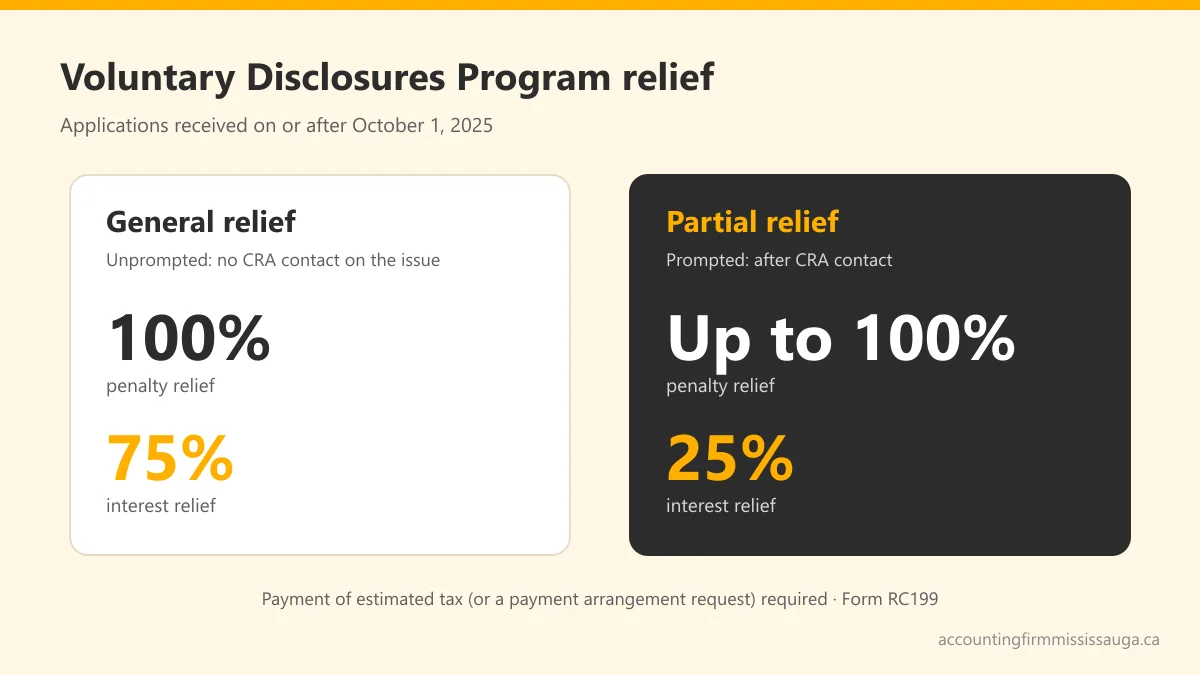
The change that matters most for backlogs is the second row. Under the old rules, a CRA letter about your unfiled returns generally closed the door on the program. Now a prompted application can still qualify for partial relief, and on penalty-heavy years the penalty relief is most of the value. Taxpayers already under audit or investigation remain restricted.
The conditions are specific. The disclosure has to involve information at least one year, or for GST/HST one reporting period, past its due date. It has to be complete. It must come with payment of the estimated tax owing or a request for a payment arrangement, which catches out applicants who assume relief means they can pay later. And it goes in on the redesigned Form RC199, through My Account, My Business Account, Represent a Client, or by mail or fax. The look-back is generally six years for Canadian-source income and four years for GST/HST.
If you owe money on years the CRA hasn't asked about yet, decide on a voluntary disclosure before you file. Once the returns are in, that choice is usually gone.
Our view differs from the usual "just file everything" advice. With unfiled years carrying real balances and no CRA contact yet, evaluate the VDP first. Once returns go in the normal way, penalties are assessed and your remaining route to relief is generally the discretionary taxpayer relief process. For Daniel, an accepted unprompted application on his 2024 returns could take the $1,180 in penalties on those two returns and three-quarters of their interest off the table. For a backlog made up of refund years or nil returns, the VDP adds nothing, and filing directly is faster.
Already penalized? Taxpayer relief
If penalties and interest have already been assessed, Form RC4288 asks the CRA to cancel or waive them. Relief is discretionary and limited to three grounds: extraordinary circumstances such as serious illness, a natural disaster, or a death in the family; actions of the CRA itself, such as processing delays or incorrect information; and inability to pay or financial hardship. Requests can reach back ten calendar years. Being busy doesn't qualify, which is the honest reason the VDP is usually the better route while it's still open to you.
Sole Proprietor or Corporation: Two Different Catch-Ups
The bookkeeping process looks similar either way. What you produce at the end doesn't. A sole proprietor's catch-up ends with a T2125 statement of business activities for each year, filed with a personal return, and our self-employed tax guide walks through what goes on it. A corporation's catch-up has more moving parts.
Year-end financials
Sole ProprietorT2125 figures for each yearCorporationBalance sheet and income statement mapped to GIFI schedules 100 and 125Tax return
Sole ProprietorOne T1 per yearCorporationOne T2 per year, even with no incomeOwner money in and out
Sole ProprietorDraws and contributions, no tax effect on their ownCorporationShareholder loan, salary, or dividends, each taxed differentlySlips
Sole ProprietorNone for the ownerCorporationT4 or T5 for whatever the owner took outProvincial filing
Sole ProprietorNoneCorporationOntario annual return through the Ontario Business RegistryPersonal exposure
Sole ProprietorThe owner is the taxpayerCorporationDirectors can be personally liable for unremitted payroll deductions and HST
| Item | Sole Proprietor | Corporation |
|---|---|---|
| Year-end financials | T2125 figures for each year | Balance sheet and income statement mapped to GIFI schedules 100 and 125 |
| Tax return | One T1 per year | One T2 per year, even with no income |
| Owner money in and out | Draws and contributions, no tax effect on their own | Shareholder loan, salary, or dividends, each taxed differently |
| Slips | None for the owner | T4 or T5 for whatever the owner took out |
| Provincial filing | None | Ontario annual return through the Ontario Business Registry |
| Personal exposure | The owner is the taxpayer | Directors can be personally liable for unremitted payroll deductions and HST |
The shareholder loan is where corporate catch-ups get expensive. Money an owner took out during the backlog years has to be classified as salary, dividends, repayment of money they put in, or a loan, and some of those classifications carry deadlines of their own. Getting that right needs the full history, which is one more reason to rebuild in order. Our guide on whether to incorporate explains why the two structures treat owner pay so differently.
Ontario corporations also owe the Province an annual return, filed through the Ontario Business Registry within six months of each year-end since the CRA stopped accepting them in 2021. The return takes minutes, but a corporation that doesn't comply with its Corporations Information Act filings can be dissolved after notice in The Ontario Gazette. Revival is possible, but it's paperwork nobody needs on top of a catch-up.
Doing It Yourself vs. Getting Help
A light backlog, a few months of unreconciled but otherwise orderly books with every return filed, is a reasonable DIY job for an owner comfortable in their accounting software. Past that, the math usually favours help, not because the data entry is hard but because the judgement calls are: which year to file first, whether to apply to the VDP, how to classify owner withdrawals, and which missing receipts are worth chasing. Our catch-up pricing breakdown shows typical fees by months behind, from a few hundred dollars for a short gap to project quotes for multi-year backlogs.
Timelines depend more on the state of the records than on the calendar. With statements and processor reports in hand, a year of small-business books generally takes a few weeks to rebuild and review. Waiting on a bank to produce old statements, or on suppliers to reissue invoices, is what usually stretches it. The accounting fees themselves are deductible as a business expense in the year you pay them.
Staying Caught Up Once You Are
Backlogs almost never start with a decision to stop. They start with one skipped month-end in a busy season that quietly becomes six. The routine that prevents it is dull and effective.
- Reconcile every bank and credit card account monthly, within two weeks of month-end, while the details are still fresh.
- Photograph or forward receipts the day you get them, into one folder or app rather than wherever they happen to land.
- Keep a separate business bank account and card, and never pay personal expenses from them.
- Move the HST you collect, plus an estimate of income tax, into a separate savings account each month so filing never waits on having the money.
- Put every filing date in a calendar with a reminder two weeks ahead.
Our 2026 tax deadline calendar lists every date a small business needs in one place. If the catch-up turned up HST or payroll issues along the way, our guides to the $30,000 HST registration threshold and payroll remittance deadlines cover both in depth.
Catching Up in Mississauga
Most of the backlogs we see in Mississauga follow a pattern: a trades business or consultancy that grew faster than its admin, an owner who lost their bookkeeper or accountant, or a corporation incorporated with good intentions and then neglected on paper while the owner kept operating. The fix is almost always the same sequence. Check the CRA portals, triage the filings, decide on the VDP before filing anything, then rebuild the books oldest year first and file in the order that stops the most expensive clocks.
If you're behind and not sure how far, our backlog accounting service starts with a records review and a written plan covering which returns are outstanding, what they're likely to cost, and whether a voluntary disclosure makes sense, before any rebuilding begins. From there we prepare the GST/HST returns, the corporate or personal tax returns, and a monthly routine so the backlog doesn't come back. Book a free call, bring whatever records you have, and we'll tell you exactly where you stand.
Frequently Asked Questions
How far back do I need to catch up my bookkeeping?
Back to the last period with accurate, filed returns, because each year's closing balances become the next year's opening balances. The CRA can ask for any unfiled year, but the Voluntary Disclosures Program generally looks back six years for Canadian-source income and four years for GST/HST, which is a practical guide for most backlogs.
Will filing several years of late returns trigger a CRA audit?
The CRA doesn't publish late filing as an audit selection criterion, and late returns are assessed like any other. What matters more is accuracy: returns built from reconciled books and supported expenses hold up if the CRA does review them. Estimates with no records behind them are what create problems.
What if I can't find my receipts?
For income tax, the CRA says to record the supplier's name and address, the amount, the date, and what was bought in your expense journal, and keep the matching bank or card record. For GST/HST input tax credits the standard is stricter: a monthly credit card statement alone is not sufficient, so request copies of invoices from suppliers for larger purchases.
Can I still apply for voluntary disclosure if the CRA already sent me a letter?
Often, yes. Since October 1, 2025, prompted applications made after CRA contact can qualify for partial relief: up to 100% of penalties and 25% of interest. Unprompted applications get 75% interest relief and full penalty relief. Taxpayers already under audit or investigation remain restricted, and every application needs payment of the estimated tax or a payment arrangement request.
Should I file all my outstanding years at once?
Prepare them oldest year first so the balances flow correctly, but decide the filing order by cost: CRA demands, payroll, and years with a balance owing come before refund or nil years. If the CRA hasn't contacted you and you owe money, consider a voluntary disclosure before filing any of them.
What's the difference between catch-up and clean-up bookkeeping?
Catch-up bookkeeping records periods that were never entered at all. Clean-up bookkeeping fixes periods that were entered incorrectly, such as duplicate bank-feed transactions or personal spending coded as business. Most backlogs longer than six months need both.
How long does catch-up bookkeeping take?
With bank statements and processor reports available, one year of small-business books generally takes a few weeks to rebuild and review. Multi-year backlogs, corporations with shareholder loan activity, and gaps where statements must be ordered from the bank take longer.
Disclaimer: The information provided in this blog is for general informational purposes only. For professional assistance and advice, please contact experts.
On this page
Never miss a deadline again
We track every filing date for our clients. Let us watch yours.
Book a free callAccounting Firm Mississauga Team
A practice of expert accountants filing returns for Mississauga businesses and individuals for close to a decade. We write these to answer the questions clients actually ask.
Recent posts
View all → Personal Tax
Real Estate Accountant Mississauga: Tax, Bookkeeping and Property Accounting
Settle three things before the next rental year closes: how the property is owned, whether CCA is worth claiming, and what the sale will cost in tax. This guide covers rental income accounting, HST on property, the 2026 capital gains rules and the bookkeeping behind all three.
 Bookkeeping
Best Accounting Software for Small Businesses in Mississauga: QuickBooks vs Xero vs Wave
Match the software to how you file HST and run payroll, not to the price list. This guide compares QuickBooks Online, Xero and Wave on what a Mississauga business pays, what each does with GST/HST and payroll, and which fits a sole proprietor, a service firm and a company with staff.
 HST/GST
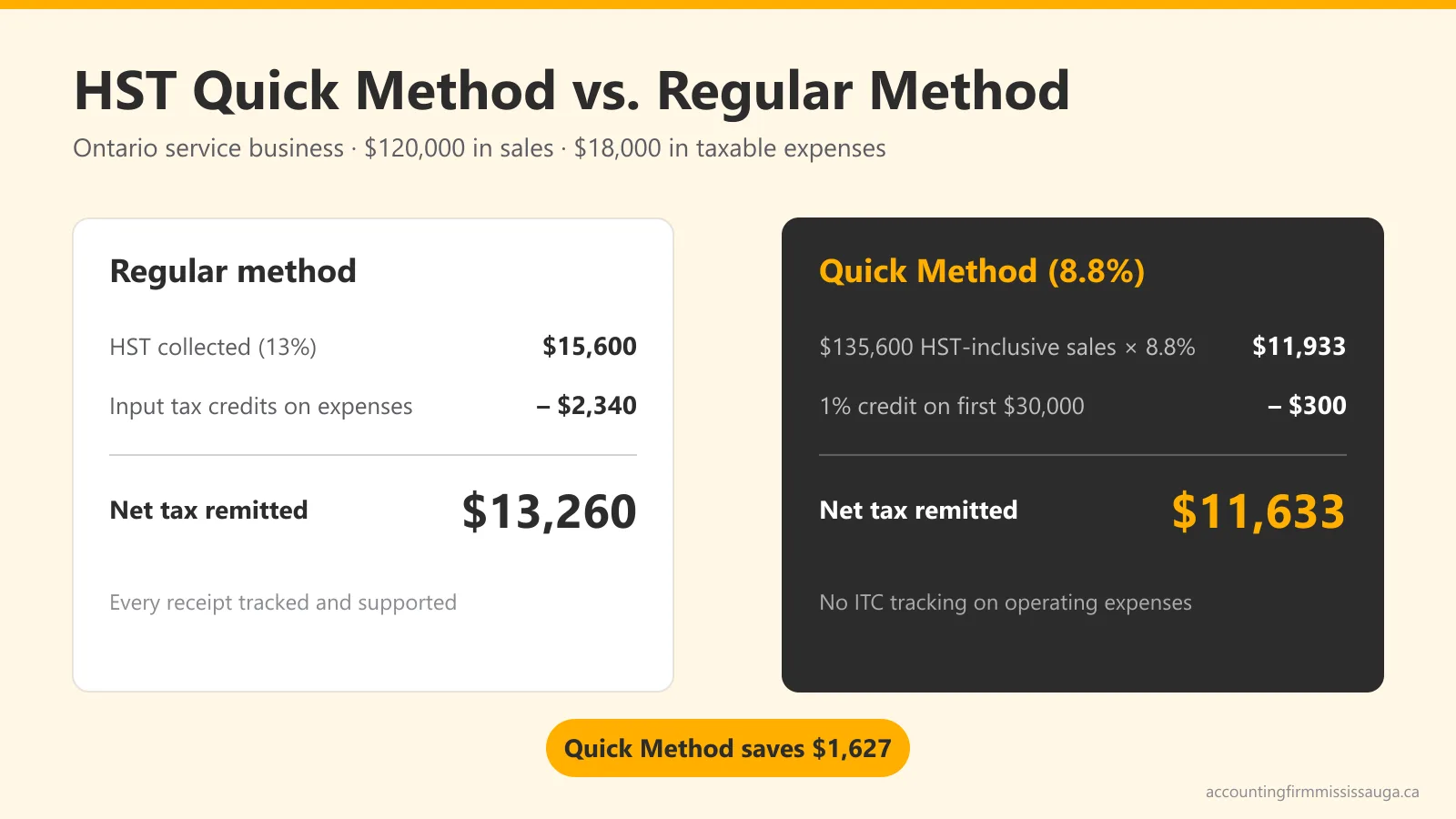
The HST Quick Method: When It Saves Ontario Businesses Money (and When It Doesn't)
Most Ontario service businesses under $400,000 can remit 8.8% instead of tracking every input tax credit. Here's the real math, the election deadlines, and the income-tax catch nobody mentions.
Free Consultation
Tell Us What You Need. Get a Real Answer Back.
No sales script, no obligation. Describe your situation once and an accounting specialist will follow up with a straight answer and a flat quote.
- Flat-fee quote before any work starts
- Response within one business day
- Reviewed by an expert accountant, not just a bookkeeper