
Audit vs. Review vs. Compilation: What Your Business Actually Needs
A bank, franchisor, or investor just asked for "reviewed" or "audited" statements. Here's what each assurance level actually means, what it costs in the GTA, and how to know which one applies to you.
Somebody just asked your business for "reviewed financial statements," or maybe "audited" ones, and the request came with no explanation of what that actually means or what it's going to cost. It happens constantly: a bank renewing a credit facility, a franchisor's annual reporting requirement, an investor doing diligence before writing a cheque, a not-for-profit's own bylaws. Nobody hands over a glossary with the request.
There are three levels here, not two, and they aren't interchangeable. A compilation, a review, and an audit each give a different amount of confidence in a set of financial statements, cost a different amount, and involve genuinely different work. This guide covers what each one actually is, what drives the cost, who typically asks for which level, and what happens if you need to move between them.
The Short Answer: Three Levels, Compared
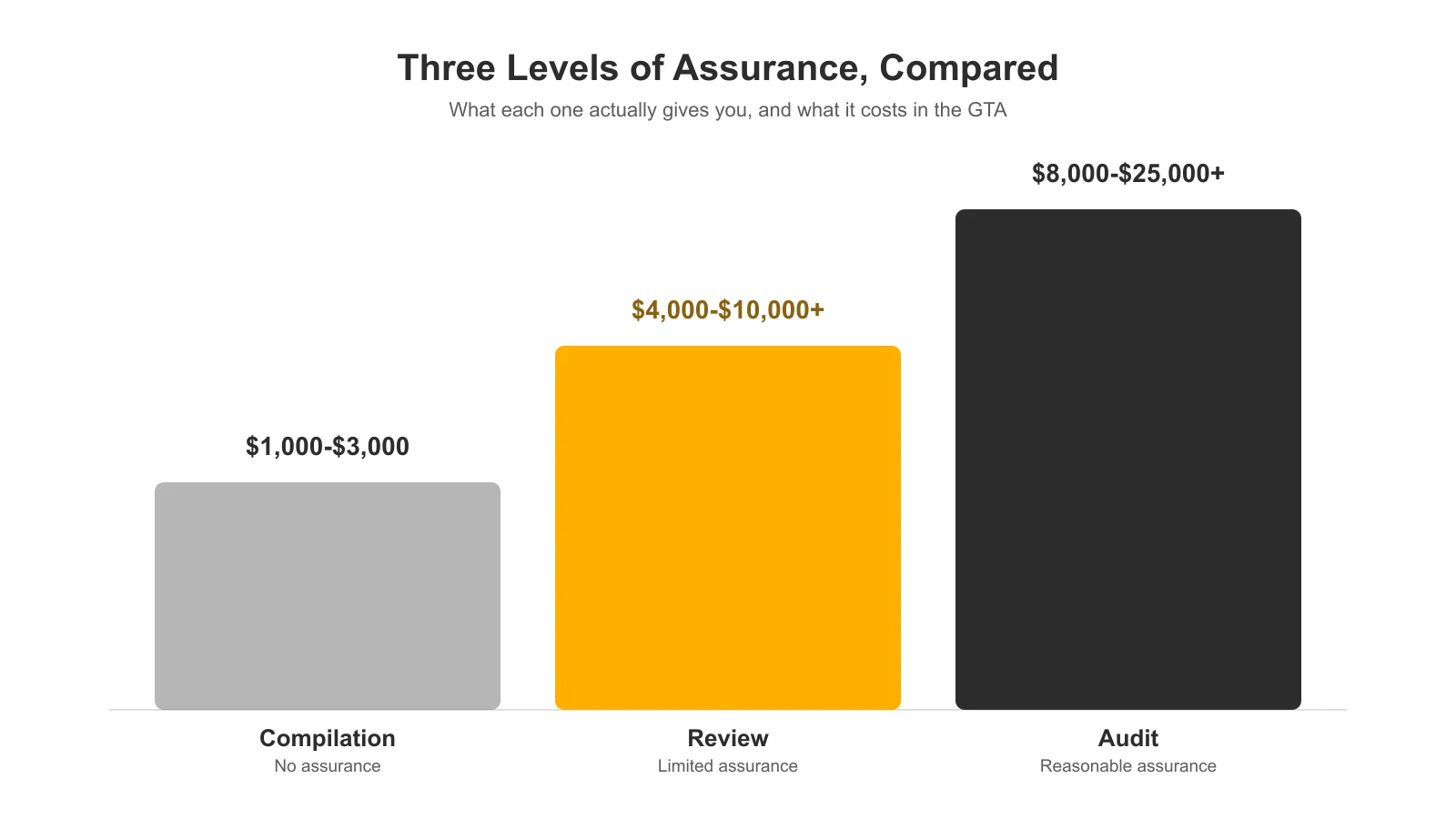
Each level answers a different question with a different amount of certainty. A compilation says "here's what management told us." A review says "nothing we looked at contradicts what management told us." An audit says "we tested this, and in our opinion, it's fairly presented." Here's how the three stack up.
Assurance provided
CompilationNoneReviewLimited (negative)AuditReasonable (positive)What the accountant does
CompilationCompiles statements from management's own figuresReviewInquiry + analytical proceduresAuditSubstantive testing, confirmations, control testingTypical GTA cost
Compilation$1,000 to $3,000Review$4,000 to $10,000+Audit$8,000 to $25,000+Governing standard
CompilationCSRS 4200ReviewCSRE 2400AuditCanadian Auditing Standards
| Compilation | Review | Audit | |
|---|---|---|---|
| Assurance provided | None | Limited (negative) | Reasonable (positive) |
| What the accountant does | Compiles statements from management's own figures | Inquiry + analytical procedures | Substantive testing, confirmations, control testing |
| Typical GTA cost | $1,000 to $3,000 | $4,000 to $10,000+ | $8,000 to $25,000+ |
| Governing standard | CSRS 4200 | CSRE 2400 | Canadian Auditing Standards |
The cost ranges above are directional, not a quote, and vary meaningfully by business size, record quality, and industry complexity, covered in more detail further down. What matters more than the exact dollar figure right now is understanding why a party would ask for one level over another in the first place, since that's usually the actual question underneath "what does this cost."
What Each Level Actually Involves
Compilation Engagement (formerly "Notice to Reader")
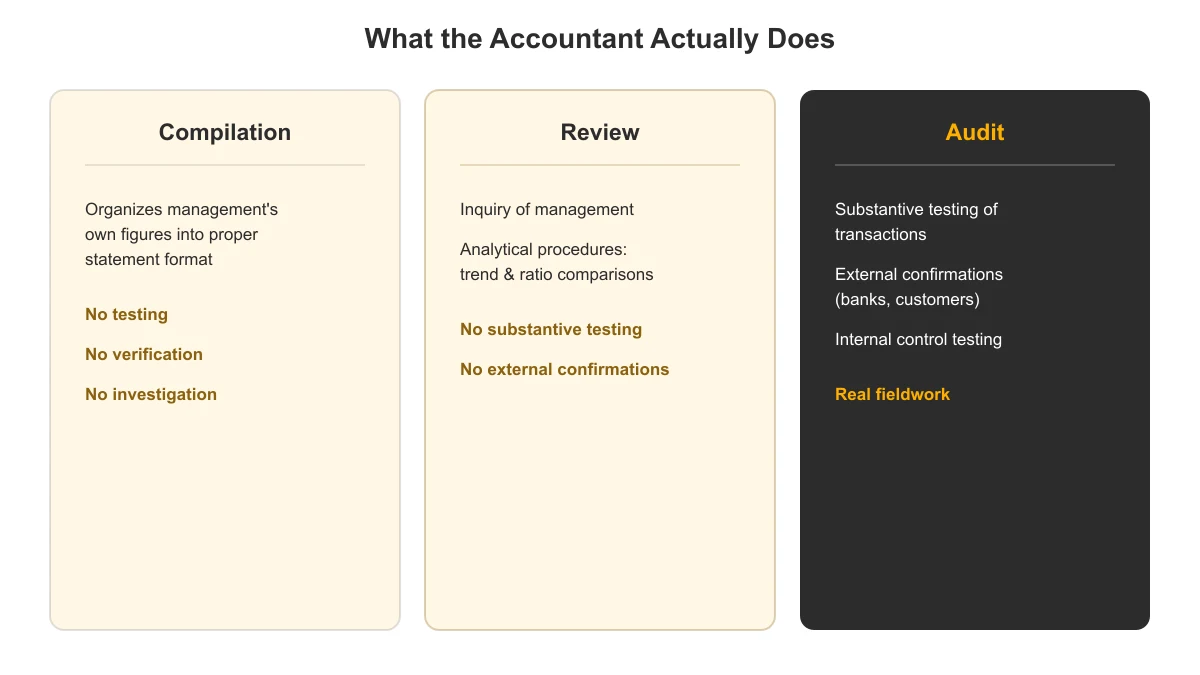
A compilation, governed by CSRS 4200, provides no assurance at all. The accountant takes management's own figures and records, organizes them into proper financial statement format, and applies the accounting knowledge to present them correctly, without testing, verifying, or investigating whether the underlying numbers are accurate. If you've heard this called a "Notice to Reader," that's the older name; CPA Canada renamed it to "Compilation Engagement Report" under CSRS 4200, effective for periods ending on or after December 14, 2021. The assurance level didn't change, only the report language and some documentation requirements did.
Review Engagement
A review, governed by CSRE 2400, provides limited assurance, expressed as a negative-form conclusion: "nothing has come to our attention that causes us to believe these statements are materially misstated," rather than a positive statement that they're accurate. The accountant performs inquiry of management and analytical procedures, comparing figures against expectations, prior periods, and industry norms, but doesn't perform the substantive transaction testing or external confirmations an audit requires.
Audit
An audit, governed by Canadian Auditing Standards, provides reasonable assurance, the highest level available, expressed positively: "in our opinion, these financial statements present fairly, in all material respects." That opinion is backed by substantive testing of transactions, external confirmations from banks and customers, and testing of internal controls, real fieldwork rather than a desk review of what management reports.
Why a Bank Asks for One Level and Not Another
Almost nobody requesting a specific assurance level explains their reasoning, but the logic underneath it is consistent: the level requested scales with how much the requester is trusting your numbers with their own money. A small term loan is a modest bet a bank can absorb if it's wrong, so a compilation, or even nothing at all, is often fine. A larger credit facility, an equity investor writing a real cheque, or a buyer acquiring the business outright is a much bigger bet, and the party making it wants independent testing behind the numbers, not just management's word, before they commit.
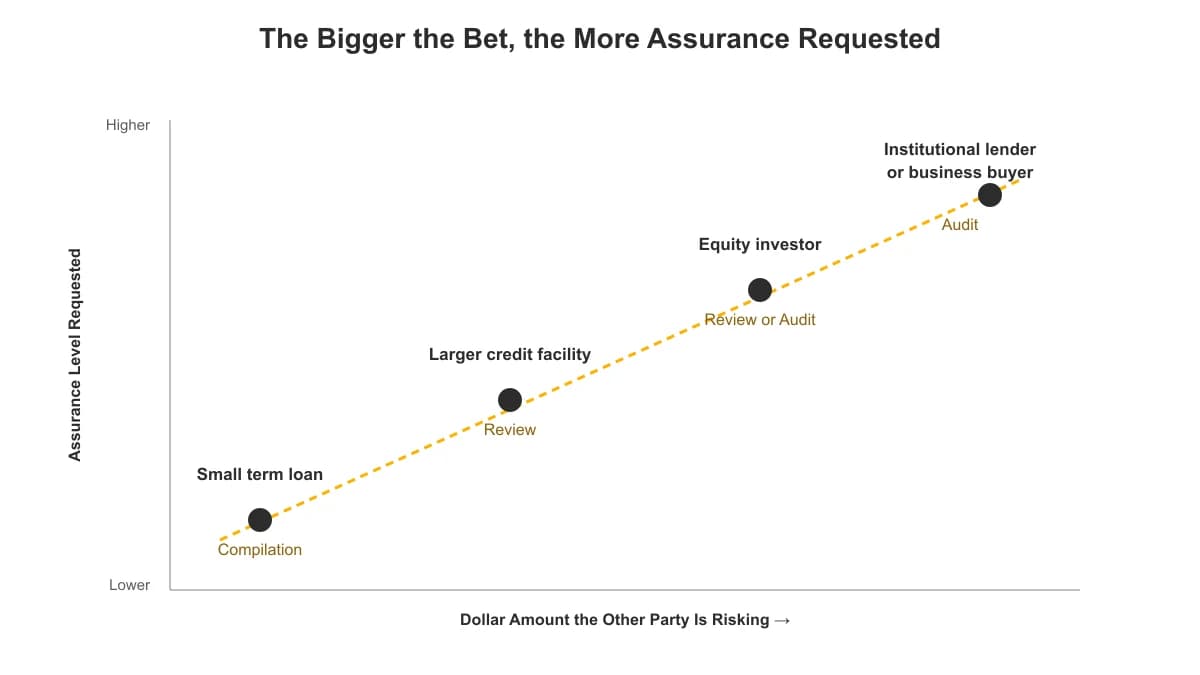
That's a pattern, not a rule written anywhere. Individual banks and lenders set their own internal credit policy, and the actual threshold for requiring a review versus an audit varies by lender and by how the rest of the loan application looks, so treat any specific dollar cutoff as a rough guide rather than a fixed line. If a lender has asked for a specific level, that request itself is the most reliable answer for your situation, more reliable than any general guideline including this one.
Who Actually Requires Each Level
Beyond lender discretion, a few situations come with real, citable requirements. A corporation's own shareholder agreement sometimes specifies a minimum assurance level directly, something worth checking once a business incorporates and brings on outside shareholders, since it's a common place this requirement first shows up.
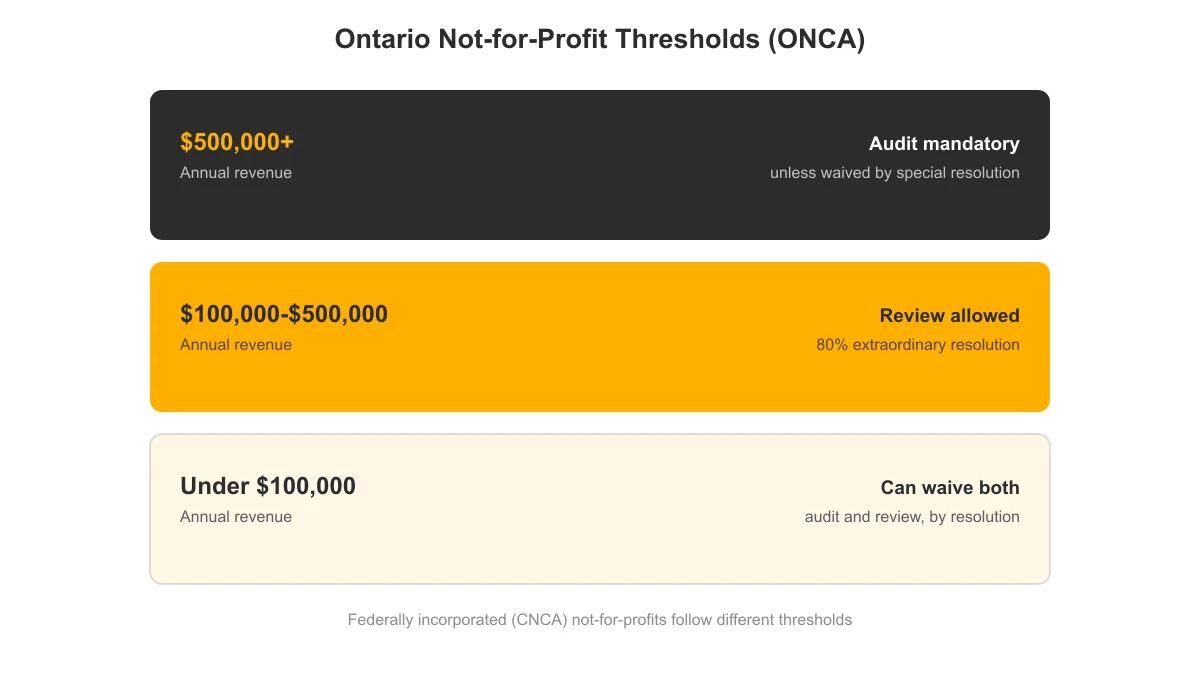
Ontario not-for-profit corporations face a genuine statutory threshold under ONCA, tied to annual revenue. Below $100,000, a not-for-profit can waive both audit and review entirely by extraordinary resolution of its members. Between $100,000 and $500,000, members can elect a review engagement instead of an audit, also by extraordinary resolution, typically requiring 80 percent approval, though a public accountant must still be appointed. At $500,000 and above, an audit is mandatory unless waived by special resolution. Federally incorporated not-for-profits (CNCA) run on different thresholds entirely, so a not-for-profit's incorporating jurisdiction matters before assuming either set of numbers applies.
Franchise agreements are the other concrete trigger most guides skip. Under Ontario's Arthur Wishart Act, a franchisor must provide audited or reviewed financial statements in the disclosure document given to a prospective franchisee at least 14 days before signing. Separately, many franchise operating agreements require the franchisee to deliver their own financial statements, compiled, reviewed, or audited depending on what the specific agreement calls for, within roughly 90 to 120 days of year-end, often specifically to verify royalty calculations.
Selling a business raises the same question from a different direction. A buyer doing due diligence before an acquisition is making the largest possible bet on a set of numbers, so compiled statements alone are rarely enough to satisfy them; smaller deals often move forward on reviewed statements plus the buyer's own diligence work, while larger or institutionally financed acquisitions frequently expect audited statements, sometimes alongside a separate quality-of-earnings analysis the buyer commissions independently. A business planning to sell within the next few years is often better off arranging a review or audit before a buyer forces the timeline, rather than scrambling to produce two or three years of audited comparatives on short notice mid-negotiation.
What Drives the Cost, Beyond the Level Itself
Ask three firms for a review engagement quote and it's common to get three genuinely different numbers, not because anyone's overcharging, but because the level alone doesn't determine the price. A review costing $4,000 and one costing $10,000 can both be accurate quotes for real businesses, just very different businesses.
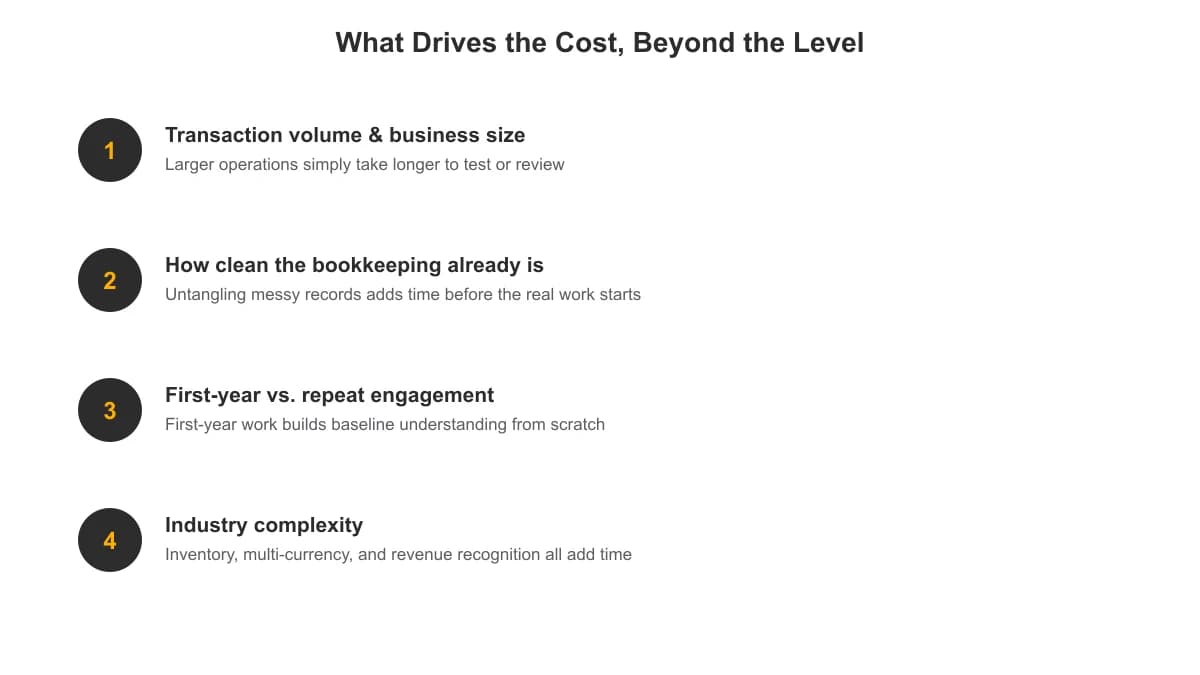
Transaction volume and business size matter most, larger operations simply take longer to test or review. How clean the underlying bookkeeping already is matters almost as much, since reconstructing or untangling messy records adds real time before the actual review or audit work can even start. A first-year engagement at a given level typically costs more than a repeat engagement, since the accountant is building baseline understanding of the business for the first time rather than updating familiar working papers. Industry complexity, inventory, multi-currency transactions, revenue recognition questions, adds further time regardless of which level applies.
Moving Between Levels: Upgrading and Downgrading
Almost nothing is written about what happens when a business needs to change levels, and it comes up constantly: a loan grows past a threshold, a new investor comes in, or a not-for-profit's revenue crosses an ONCA line. Moving up, compilation to review, or review to audit, is straightforward in principle but rarely cheap the first time. A first-time audit in particular sometimes requires extra work on opening balances and prior-year comparative figures if those were only ever compiled or reviewed before, since audited statements need appropriately supported comparatives, not just a stamp of approval on last year's numbers.
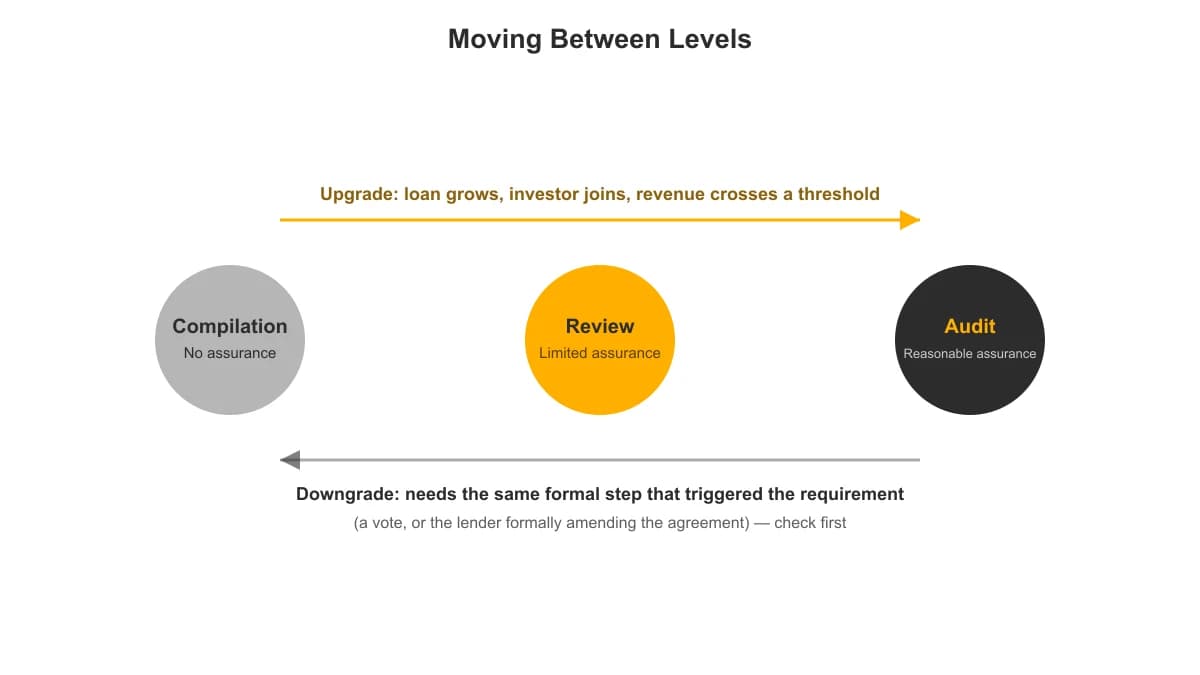
Downgrading gets even less attention, but it's a real question once a loan is paid off or an investor exits. Nothing legally prevents moving back down to a lower assurance level, but it usually requires the same kind of formal step that triggered the original requirement, an ONCA members' vote, or a lender's loan agreement being formally amended or discharged, not just a quiet decision to stop paying for the higher level. Many loan agreements specify the required assurance level for the life of the loan, not just at signing, so downgrading without checking the actual agreement first can put a business offside a covenant it didn't realize was still active.
For a business that can see an upgrade coming, a financing round in a couple of years, a planned sale, a not-for-profit's revenue trending toward the next ONCA tier, moving early is usually cheaper than moving under pressure. Getting a review engagement done a year or two before a lender or buyer actually requires one means the eventual audit inherits reviewed comparative figures instead of compiled ones, which is a meaningfully smoother, less expensive first-time audit than jumping straight from a compilation.
The assurance level isn't really about your business. It's about how much confidence someone else needs before they'll risk their own money on your numbers.
Getting the Right Level the First Time
Guessing at the wrong assurance level costs twice: once for the engagement itself, and again if it turns out to be the wrong one and has to be redone at a higher level. Our audit and assurance team starts by confirming what's actually being requested and why, whether that's a lender's covenant, a franchise agreement, or an ONCA threshold, before scoping any engagement, and handles external audits directly for businesses that do need one.
Book a free call and we'll tell you which level actually applies to your situation before anything gets quoted.
On this page
Never miss a deadline again
We track every filing date for our clients. Let us watch yours.
Book a free callAccounting Firm Mississauga Team
A practice of expert accountants filing returns for Mississauga businesses and individuals for close to a decade. We write these to answer the questions clients actually ask.
Frequently Asked Questions
What's the difference between a review engagement and a compilation?
A compilation provides no assurance at all; the accountant organizes management's own figures into financial statement format without testing them. A review provides limited assurance through inquiry and analytical procedures, enough for the accountant to state that nothing came to their attention suggesting the statements are materially misstated.
Is "Notice to Reader" still a real term in Canada?
It's the older name for what's now officially called a Compilation Engagement Report under CSRS 4200, a rename effective for periods ending on or after December 14, 2021. The assurance level is unchanged, still none, so a Notice to Reader and a modern Compilation Engagement Report mean essentially the same thing, just under different report language.
Does the CRA require an audit to file a corporate tax return?
No. A compilation is sufficient for T2 corporate tax filing. Audit and review requirements come from lenders, investors, franchise agreements, or specific statutes like Ontario's Not-for-Profit Corporations Act, not from CRA filing requirements themselves.
How much does an audit cost compared to a review engagement in the GTA?
Directionally, a review engagement typically runs $4,000 to $10,000 or more, while an audit typically runs $8,000 to $25,000 or more, roughly double to several times the cost of a review, depending heavily on business size, record quality, and whether it's a first-year or repeat engagement.
Does my not-for-profit need an audit in Ontario?
Under ONCA, it depends on annual revenue: under $100,000 can waive both audit and review by extraordinary resolution, $100,000 to $500,000 can elect a review instead of an audit by extraordinary resolution, and $500,000 or more requires an audit unless waived by special resolution. Federally incorporated not-for-profits follow different CNCA thresholds instead.
Can I switch from a review engagement to a compilation later?
Usually, but not automatically. Downgrading typically requires the same kind of formal step that triggered the original requirement, such as a members' vote or a lender formally amending the loan agreement, since many agreements specify the required assurance level for the life of the arrangement rather than just at signing.
Recent posts
View all →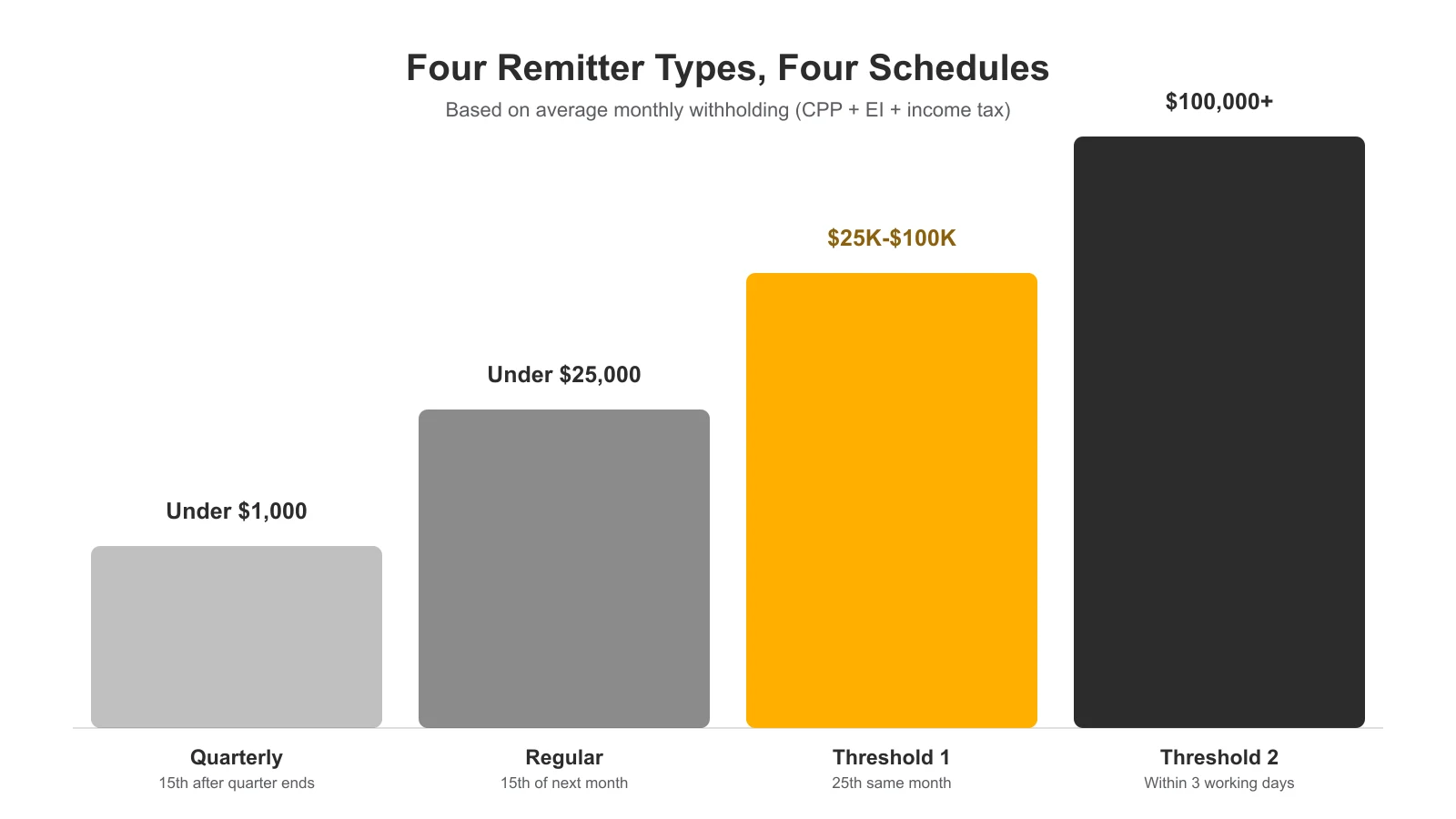 Payroll
Payroll Remittance Deadlines: What New Employers Actually Need to Know
Priya's corporation just became a remitter for the first time. Real 2026 numbers on remitter types, due dates, and the penalty rule most guides get wrong.
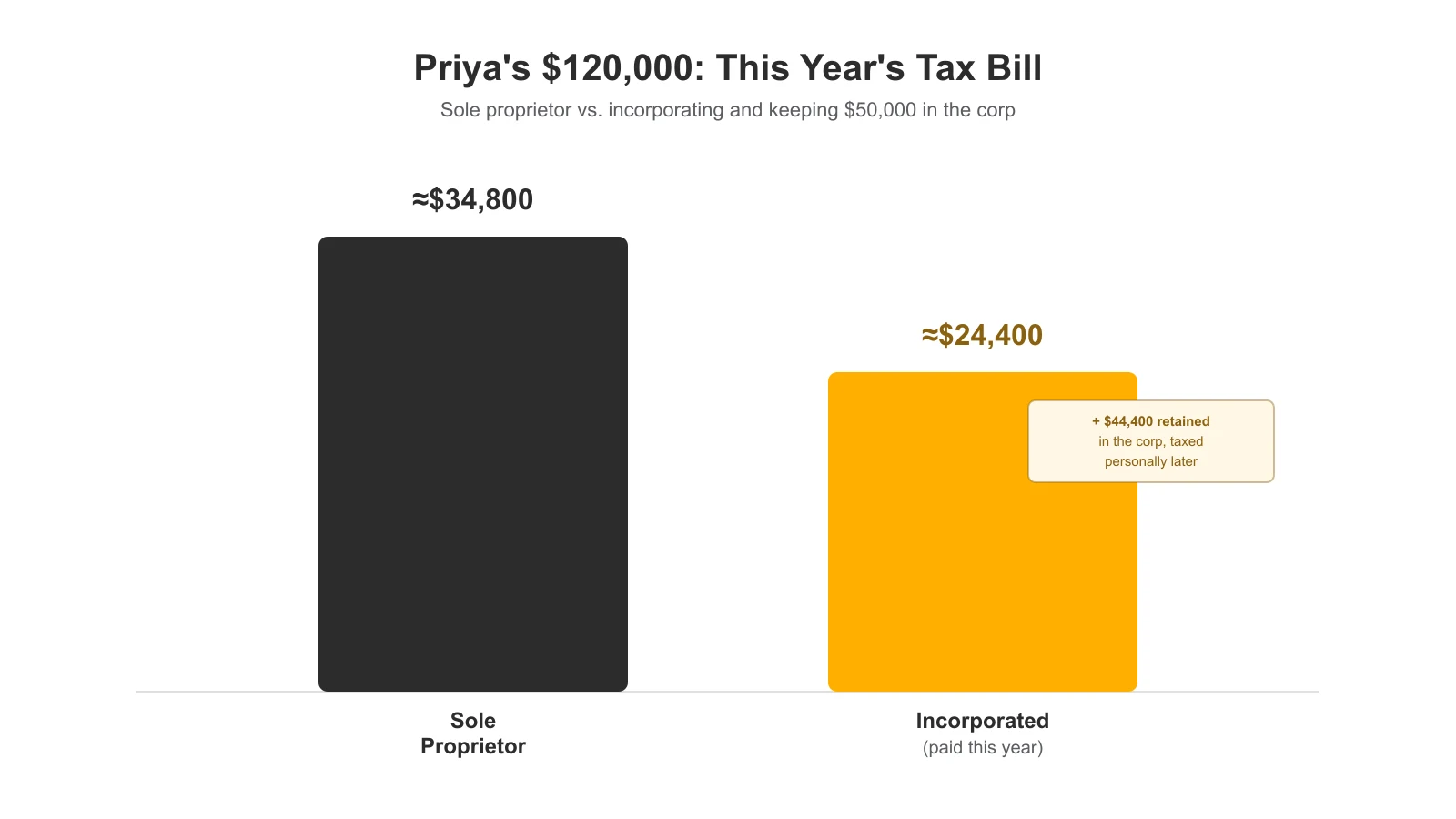 Corporate Tax
Should You Incorporate? What It Actually Changes About Your Taxes
Incorporating doesn't erase your tax bill, it defers it. A real worked example, using 2026's new small business rate, of what actually changes when you stop being a sole proprietor.
 Personal Tax
Self-Employed Tax Filing in Canada: What You Actually Owe, With Real Numbers
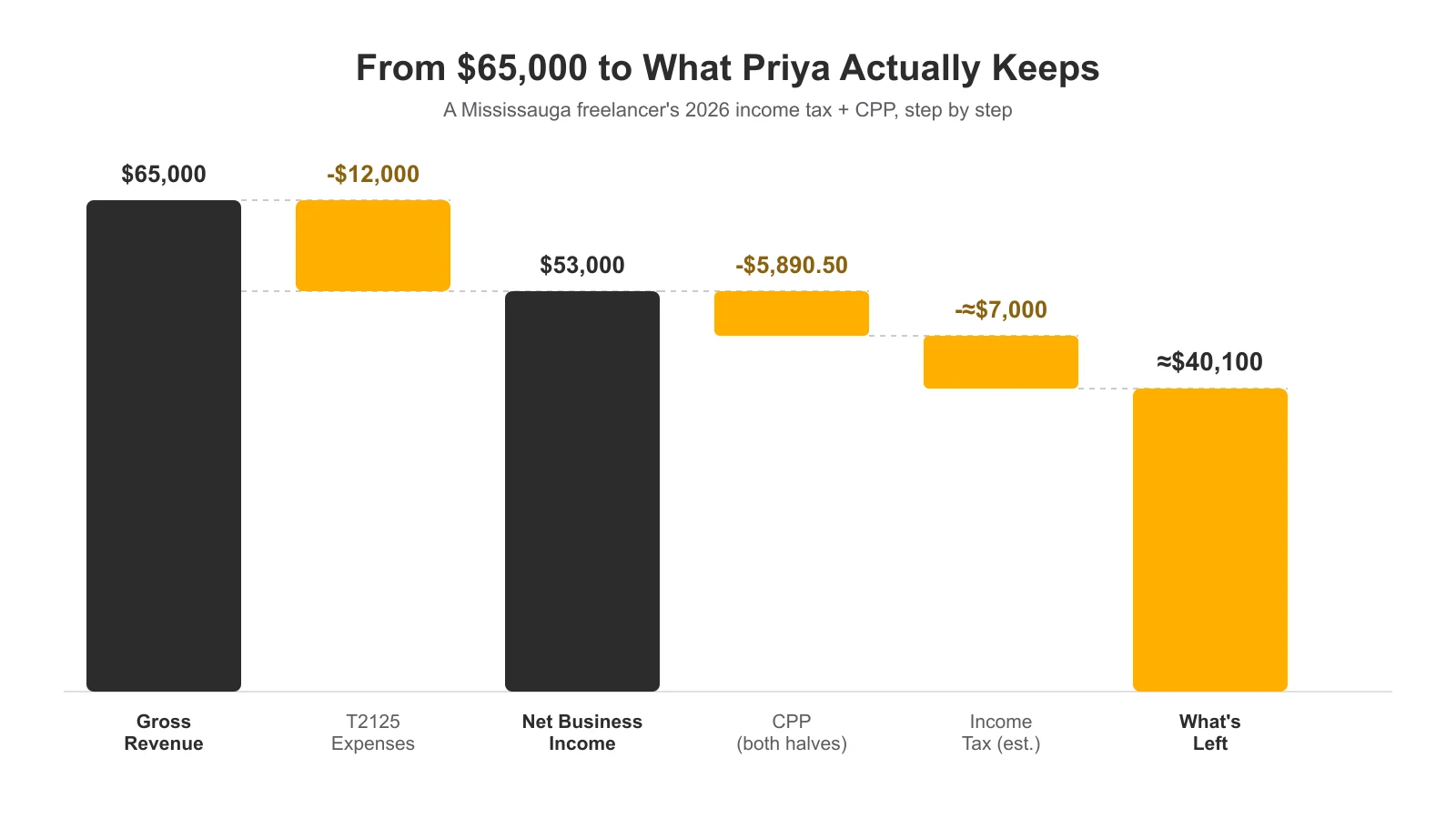
A Mississauga freelancer's $65,000 in revenue, walked through real 2026 numbers: T2125 deductions, CPP contributions, and the two tax deadlines almost everyone confuses.
Free Consultation
Tell Us What You Need. Get a Real Answer Back.
No sales script, no obligation. Describe your situation once and an accounting specialist will follow up with a straight answer and a flat quote.
- Flat-fee quote before any work starts
- Response within one business day
- Reviewed by an expert accountant, not just a bookkeeper