
Should You Incorporate? What It Actually Changes About Your Taxes
Incorporating doesn't erase your tax bill, it defers it. A real worked example, using 2026's new small business rate, of what actually changes when you stop being a sole proprietor.
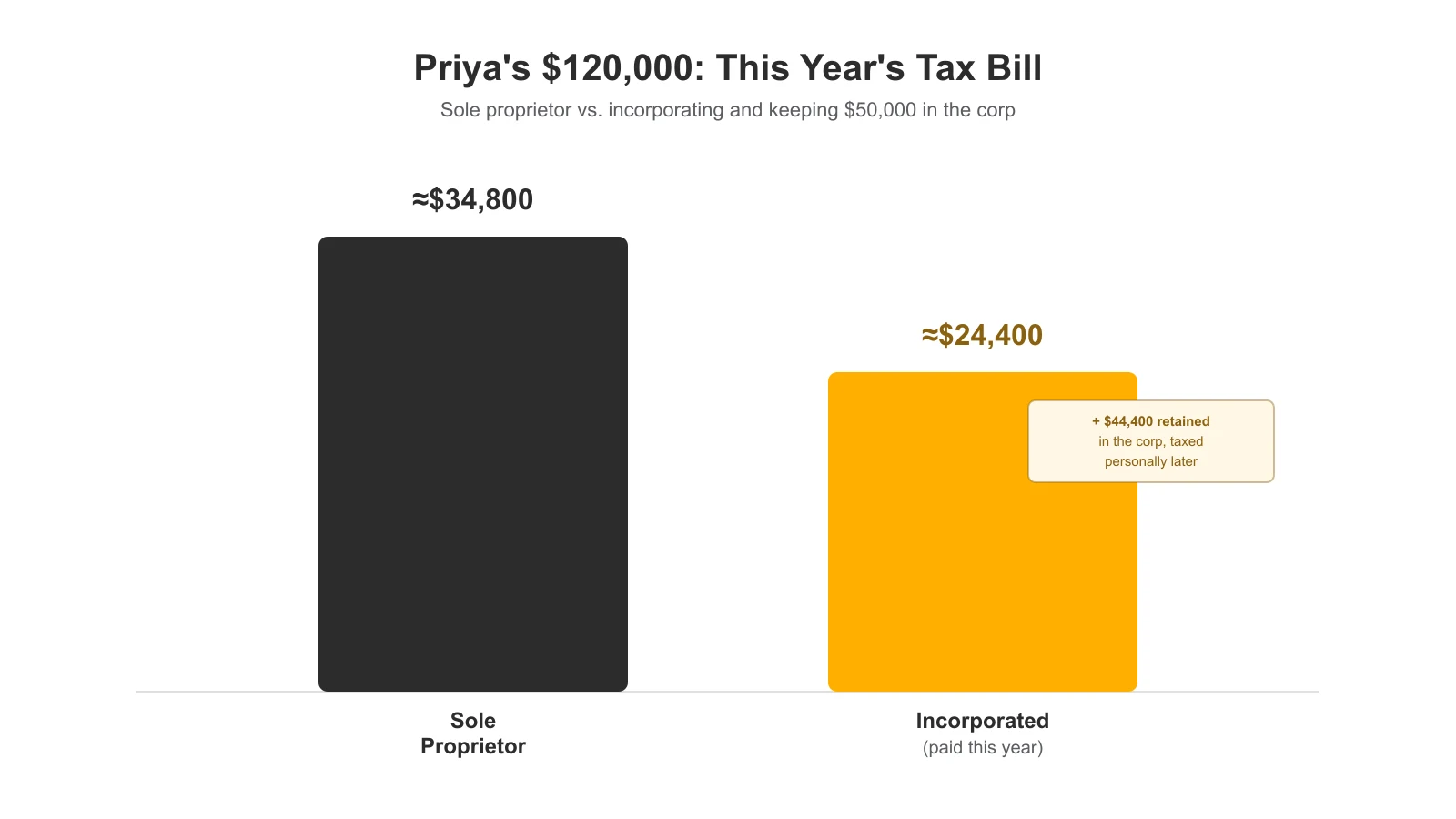
Priya, the freelance graphic designer from our self-employed tax filing guide, is doing well. Her business has grown from $65,000 to $120,000 in net income, and somewhere around the time her CRA bill crossed five figures, someone told her incorporating would "save her a ton in taxes." That's the sentence that sends more Ontario freelancers down an incorporation rabbit hole than almost anything else, and it's only half true.
Incorporating doesn't make tax disappear. It changes when you pay it, and sometimes how much, depending entirely on how much of your income you actually need to live on versus how much you can afford to leave in the business. This guide walks through the real mechanics using Priya's numbers, including the small business tax rate Ontario cut on July 1, 2026, a cut that most guides on this topic still haven't caught up to.
The Short Answer: Incorporating Defers Tax, It Doesn't Eliminate It
A sole proprietor pays personal income tax and CPP on their entire net income, every dollar, in the year they earn it. A corporation pays a much lower corporate tax rate first, and only the portion an owner actually draws out gets hit with personal tax, whenever that withdrawal happens. Leave money inside the corporation and it keeps compounding at the higher after-tax amount in the meantime; that gap is the entire benefit, and it only exists on income you don't need to spend.
Personally withdrawn this year
Sole Proprietor$120,000Incorporated$70,000 salaryKept inside the business
Sole Proprietor$0Incorporated$50,000, taxed at 11.2%CPP owed
Sole Proprietor$9,292.90Incorporated$7,913.50Personal income tax (est.)
Sole Proprietor≈$25,000 to $26,000Incorporated≈$10,500 to $11,300Corporate tax on retained $50,000
Sole Proprietorn/aIncorporated$5,600Total tax paid this year
Sole Proprietor≈$34,300 to $35,300Incorporated≈$24,000 to $24,800
| Sole Proprietor | Incorporated | |
|---|---|---|
| Personally withdrawn this year | $120,000 | $70,000 salary |
| Kept inside the business | $0 | $50,000, taxed at 11.2% |
| CPP owed | $9,292.90 | $7,913.50 |
| Personal income tax (est.) | ≈$25,000 to $26,000 | ≈$10,500 to $11,300 |
| Corporate tax on retained $50,000 | n/a | $5,600 |
| Total tax paid this year | ≈$34,300 to $35,300 | ≈$24,000 to $24,800 |
That roughly $10,000 gap is real, but it isn't free. The $44,400 left in the corporation after tax is still Priya's money, and when she eventually pays herself the rest, it faces personal tax then, just later, and often at a lower rate if she draws it down in a slower year. Everything below unpacks how each piece of that table actually works.
Ontario's Small Business Rate Just Dropped
A Canadian-controlled private corporation pays a federal rate of 9 percent on active business income, plus a provincial rate that varies by province, on the first $500,000 of active business income each year, a combined figure known as the small business deduction rate. Above that $500,000 business limit, the general corporate rate applies instead: 15 percent federal plus 11.5 percent Ontario, or 26.5 percent combined, more than double the small business rate.
Ontario cut its portion of the small business rate from 3.2 percent to 2.2 percent effective July 1, 2026, dropping the combined federal-and-Ontario small business rate from 12.2 percent to 11.2 percent. Corporations with a fiscal year straddling that date prorate the two rates by the number of days on each side of it. The $500,000 business limit itself didn't change.
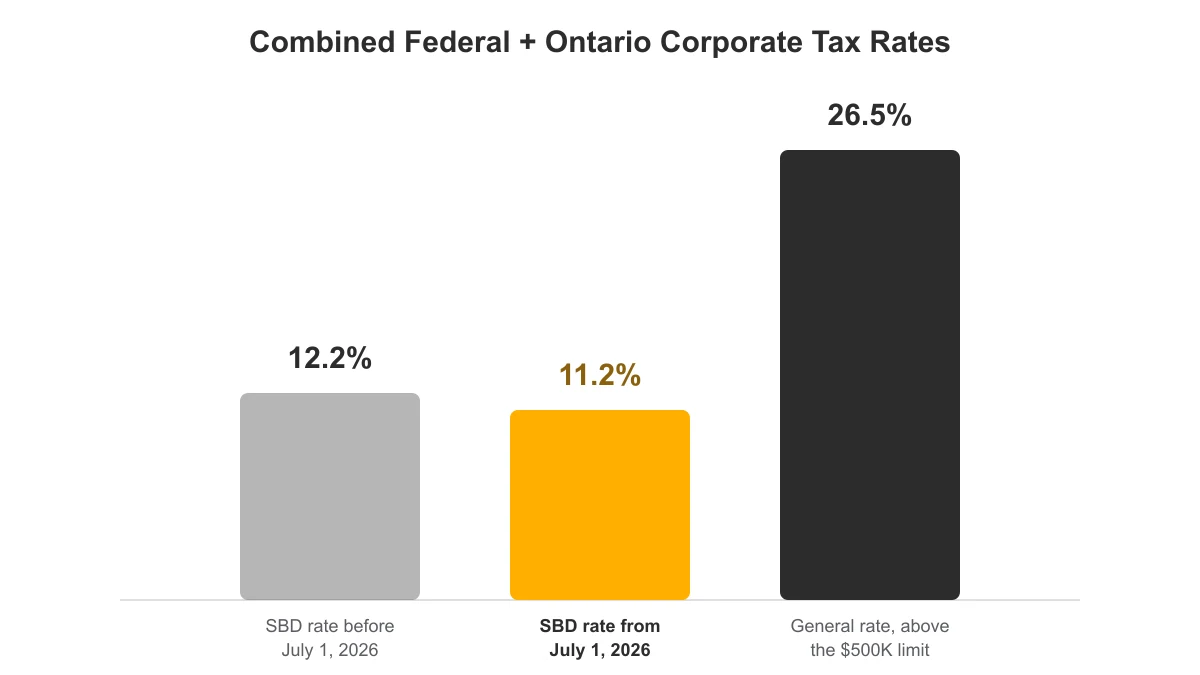
That 11.2 percent is the number that makes the deferral math work. A sole proprietor's income above roughly $102,000 or so already sits in Ontario's 9.15 to 11.16 percent provincial brackets before federal tax is even added, so once federal tax stacks on top, income kept inside a corporation at 11.2 percent total is taxed at well under half of what the same dollar would face personally in a good year.
Priya's Two Paths, With Real Numbers
Priya's $120,000 net income puts her well past the numbers in her self-employed guide, so her CPP is now capped at the 2026 maximum: $8,460.90 in base CPP on pensionable earnings up to the $74,600 ceiling, plus $832 in CPP2 on the slice between $74,600 and $85,000, for $9,292.90 total, the most any self-employed person owes in CPP for 2026, regardless of how much higher their income climbs.
Staying a sole proprietor, all $120,000 is taxed personally this year. After deducting the CPP portion that's deductible, her taxable income is roughly $114,940, which lands her combined federal and Ontario income tax before credits around $28,400, landing somewhere in the $25,000 to $26,000 range once typical personal credits are applied. Add CPP and she owes roughly $34,300 to $35,300 for the year, keeping somewhere around $84,700 to $85,700.
Incorporated, and only drawing the $70,000 she actually needs to live on as salary, the math splits in two. Personally, her CPP on a $70,000 salary works out to $7,913.50, the same 11.9 percent rate as before, just remitted through payroll instead of self-employed contributions; incorporating doesn't reduce CPP on salary income, a detail most incorporation guides skip entirely. Her personal income tax on that $70,000, after the CPP deduction, lands around $10,500 to $11,300. The remaining $50,000 stays inside the corporation, taxed at 11.2 percent, or $5,600, leaving $44,400 retained and available to reinvest, save, or draw out in a future year.
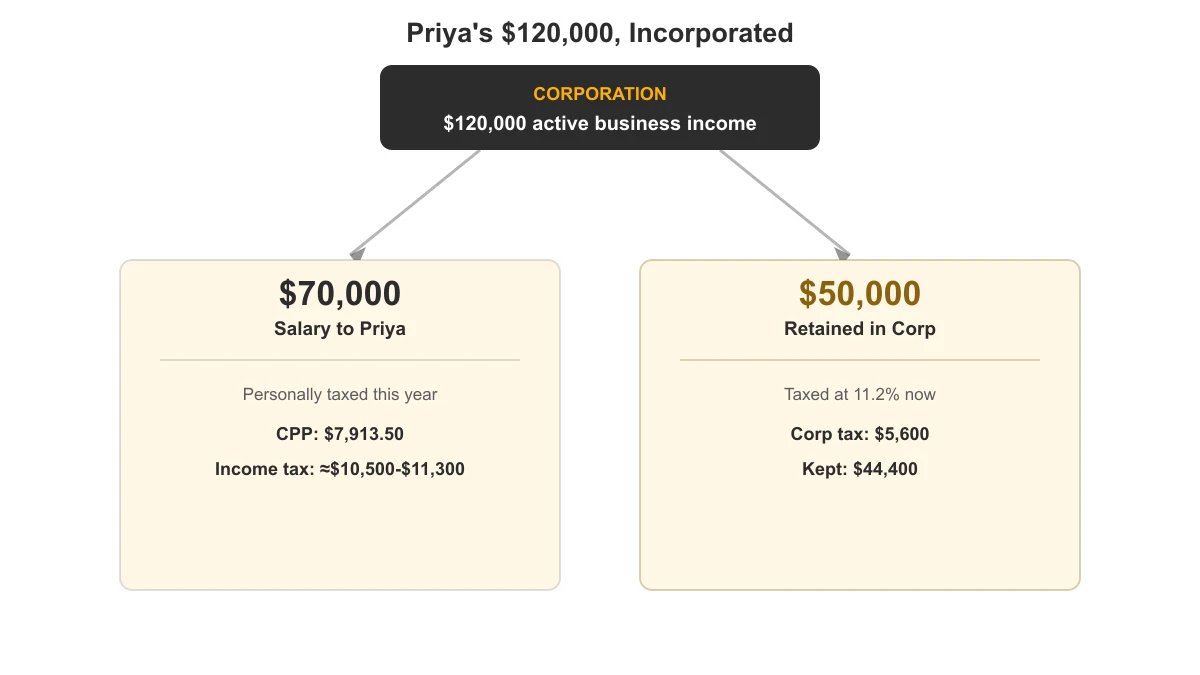
Total tax actually paid this year, incorporated: roughly $24,000 to $24,800, against $34,300 to $35,300 as a sole proprietor. That gap is deferral, not elimination. The $44,400 sitting in the corporation hasn't escaped personal tax, it's just postponed it to whenever Priya actually draws it out, typically as a dividend, at which point a gross-up and dividend tax credit apply specifically to account for the corporate tax already paid on it, so the same dollar isn't taxed twice at full rates, but it does eventually face personal tax too.
Salary vs. Dividends: The Choice Nobody Explains Well
Once incorporated, an owner-manager chooses how to pay themselves, and the two options aren't interchangeable the way they're often described. Salary is a deductible expense to the corporation, builds CPP contribution room the same way employment income does, and creates RRSP contribution room, worth 18 percent of earned income up to the annual limit. Dividends cost the corporation nothing in payroll remittances, but they aren't earned income: no CPP accrues on them, and they build zero RRSP room, a detail that quietly erodes retirement savings capacity for owners who pay themselves entirely in dividends year after year without realizing it.
Deductible to the corporation
SalaryYesDividendsNoCPP contributions required
SalaryYes, both halves (11.9%)DividendsNoBuilds RRSP room
SalaryYes, 18% of earned incomeDividendsNoPersonal tax treatment
SalaryTaxed as regular incomeDividendsGross-up + dividend tax credit
| Salary | Dividends | |
|---|---|---|
| Deductible to the corporation | Yes | No |
| CPP contributions required | Yes, both halves (11.9%) | No |
| Builds RRSP room | Yes, 18% of earned income | No |
| Personal tax treatment | Taxed as regular income | Gross-up + dividend tax credit |
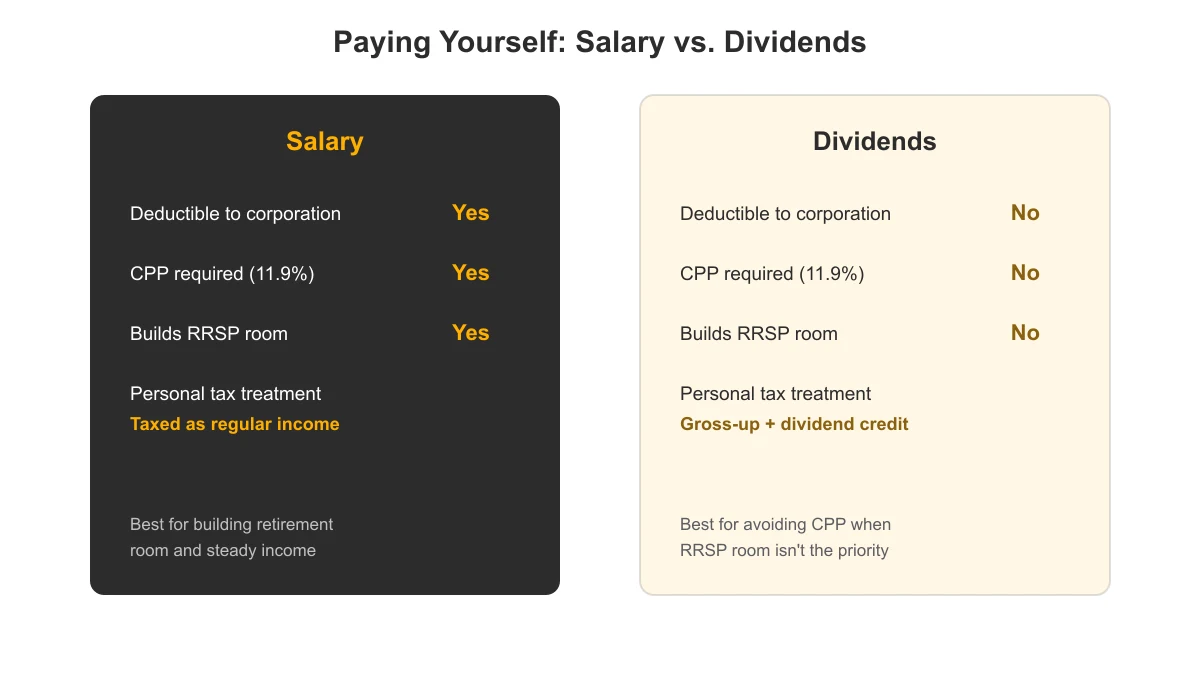
Most owner-managers who need real RRSP room end up on a blended approach: enough salary to build meaningful RRSP contribution room and satisfy any personal cash needs, with dividends layered on top if more is required. There's no universal split that's correct for everyone; it depends on retirement savings goals, current personal tax bracket, and how much the corporation can actually afford to pay out without starving its own working capital.
When Does Incorporating Actually Pay Off?
Guides that name a flat revenue number, commonly something like $100,000, are answering the wrong question. Revenue tells you almost nothing about whether incorporating helps, since a business grossing $100,000 with $90,000 in costs has a $10,000 surplus, nowhere near enough to make the deferral math meaningful once accounting and filing costs are counted. What actually matters is surplus: income left over after covering whatever a business owner needs to live on personally, since that's the only portion that can sit inside a corporation earning the lower rate instead of flowing out as personal income right away.
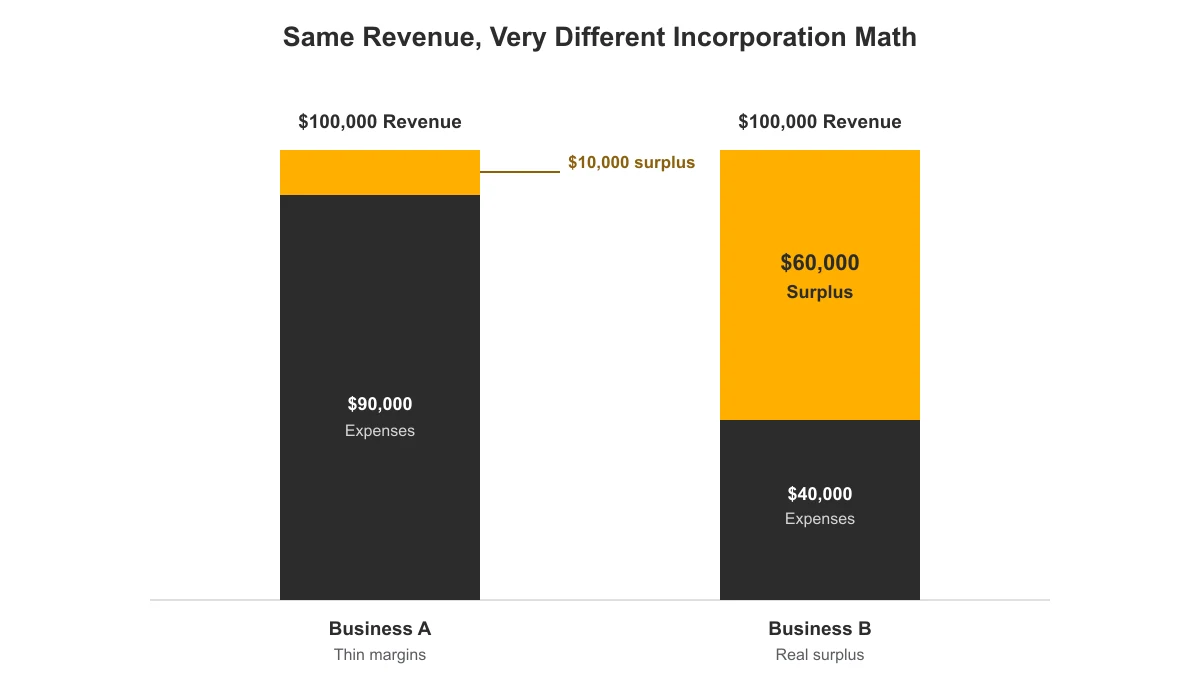
There's no single number that applies to everyone, and treating one as gospel is how a lot of business owners end up incorporating too early or too late. Many accountants start taking the conversation seriously somewhere around $20,000 to $40,000 or more in annual surplus retained beyond living expenses, since that's roughly where the tax deferral starts outweighing the cost and complexity of running a corporation, but the real answer depends on personal tax bracket, how long the money will actually sit retained, and what it's earmarked for. It's worth running actual numbers rather than pattern-matching to a number from a blog post, including this one.
What Incorporating Actually Costs in Ontario
Incorporation cost estimates online range wildly, mostly because they mix government filing fees with legal and accounting setup costs without separating the two. Here's what each piece actually runs in Ontario.
Ontario provincial incorporation filing
Typical Cost$300Federal incorporation filing (alternative to provincial)
Typical Cost$200 online, +$100 for same-dayNUANS name search (skip if using a numbered company)
Typical Cost$13.80 direct, $40 to $80 via a search houseLegal and accounting setup, all-in
Typical Cost$1,000 to $3,500Ongoing T2 corporate filing
Typical Cost$500 to $1,500 / year
| Item | Typical Cost |
|---|---|
| Ontario provincial incorporation filing | $300 |
| Federal incorporation filing (alternative to provincial) | $200 online, +$100 for same-day |
| NUANS name search (skip if using a numbered company) | $13.80 direct, $40 to $80 via a search house |
| Legal and accounting setup, all-in | $1,000 to $3,500 |
| Ongoing T2 corporate filing | $500 to $1,500 / year |
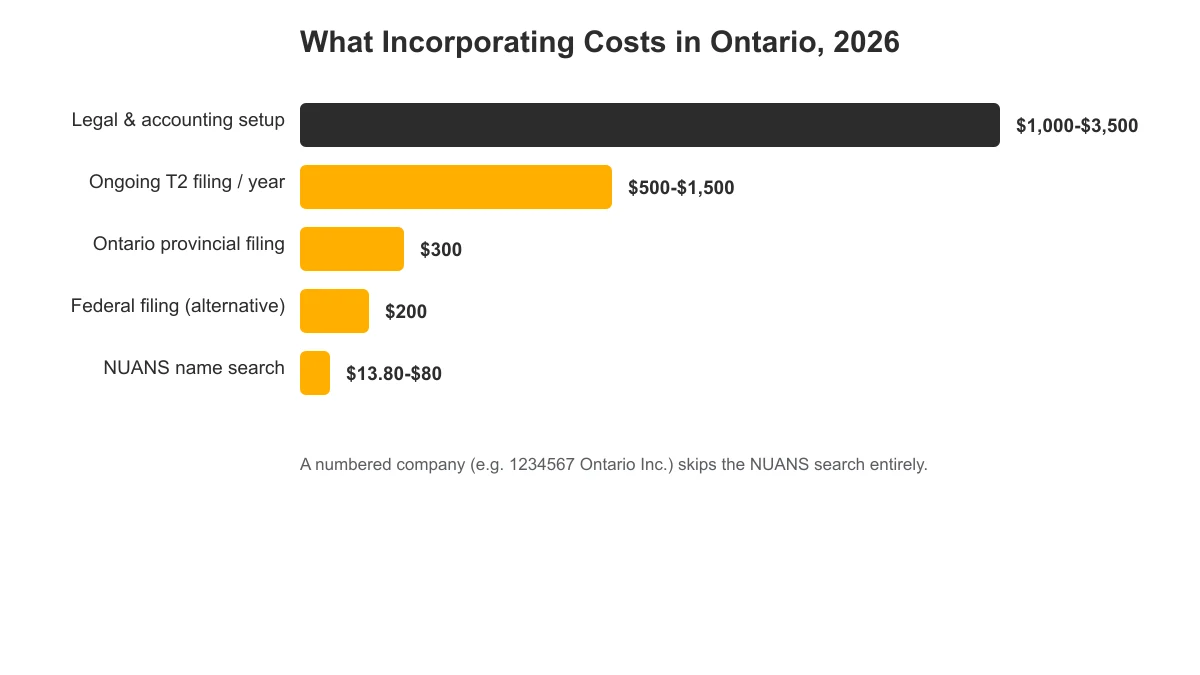
A numbered company, something like 1234567 Ontario Inc., skips the NUANS search entirely and is often the cheapest path for a business that doesn't need a specific trade name registered. Once incorporated, the corporation also owes its own T2 corporate return every year, on top of Priya's personal T1, a second filing obligation with its own deadline that a sole proprietor never has to think about.
What Incorporating Doesn't Fix
A corporation is a separate legal entity, which is the source of the liability protection incorporating is often sold on; a lawsuit against the business generally can't reach an owner's personal assets the way it can with a sole proprietorship. That protection is real but has limits, personal guarantees on loans and professional negligence claims both pierce it in common situations, and it's a legal question worth a conversation with a lawyer rather than an accountant.
On the tax side specifically, incorporating adds real, ongoing complexity: a second tax return, minute book upkeep, payroll remittances if paying salary, and accounting fees that a sole proprietorship simply doesn't carry. A business losing money also loses something by incorporating, since a sole proprietor's business losses flow through and offset other personal income directly, while a corporation's losses stay trapped inside the corporation until it has profit to offset them against.
Incorporating is a timing decision dressed up as a tax-saving one. Get the timing right and it's a real advantage. Get it backwards and it's just extra paperwork on a business that isn't ready for it yet.
Is It Worth It for You?
Priya's numbers are hers: her $120,000, her $70,000 living cost, her 15 percent home office split from her last guide. Someone with different income, different personal expenses, or a spouse also drawing income from the same business will land somewhere else entirely, sometimes far enough that incorporating isn't worth it yet at all. Our small business tax service starts with an actual review of your numbers, current structure, and what you need to live on, before recommending anything, since the wrong call in either direction costs more than the accounting fee to figure it out properly.
Book a free call and we'll tell you honestly whether incorporating helps at your numbers, not just at Priya's.
On this page
Never miss a deadline again
We track every filing date for our clients. Let us watch yours.
Book a free callAccounting Firm Mississauga Team
A practice of expert accountants filing returns for Mississauga businesses and individuals for close to a decade. We write these to answer the questions clients actually ask.
Frequently Asked Questions
Does incorporating actually save you money on taxes?
It defers tax on whatever portion of your income you leave inside the corporation rather than eliminating it. Money you draw out still faces personal tax eventually, typically as a dividend. The benefit is real but only applies to income you don't need to withdraw right away.
What is Ontario's small business tax rate in 2026?
The combined federal and Ontario small business rate is 11.2 percent on the first $500,000 of active business income, made up of a 9 percent federal rate and a 2.2 percent Ontario rate. Ontario cut its portion from 3.2 percent effective July 1, 2026.
Should I pay myself salary or dividends from my corporation?
Salary builds CPP contribution room and RRSP room and is deductible to the corporation, but requires CPP remittances at the same 11.9 percent rate a sole proprietor pays. Dividends avoid CPP entirely but build no RRSP room and aren't deductible to the corporation. Most owner-managers use a blend rather than committing fully to either.
How much does it cost to incorporate a business in Ontario?
Government filing fees run $300 for a provincial incorporation, or $200 online federally. Add legal and accounting setup, typically $1,000 to $3,500 all-in, plus an ongoing $500 to $1,500 a year for the corporation's T2 return, a separate filing obligation from the owner's personal T1.
At what income level should I incorporate?
There's no single number, despite guides that cite one. What matters is surplus income left over after covering personal living expenses, not gross revenue, since only that surplus benefits from the lower corporate rate. Many accountants start the conversation around $20,000 to $40,000 or more in annual retained surplus, but it depends on your personal tax bracket and how long the money will actually stay in the corporation.
Does incorporating protect my personal assets from business debts?
Generally yes, since a corporation is a separate legal entity from its owner, but the protection has real limits. Personal guarantees on loans and professional negligence claims can both bypass it. That liability question is a legal one worth discussing with a lawyer alongside the tax analysis.
Recent posts
View all →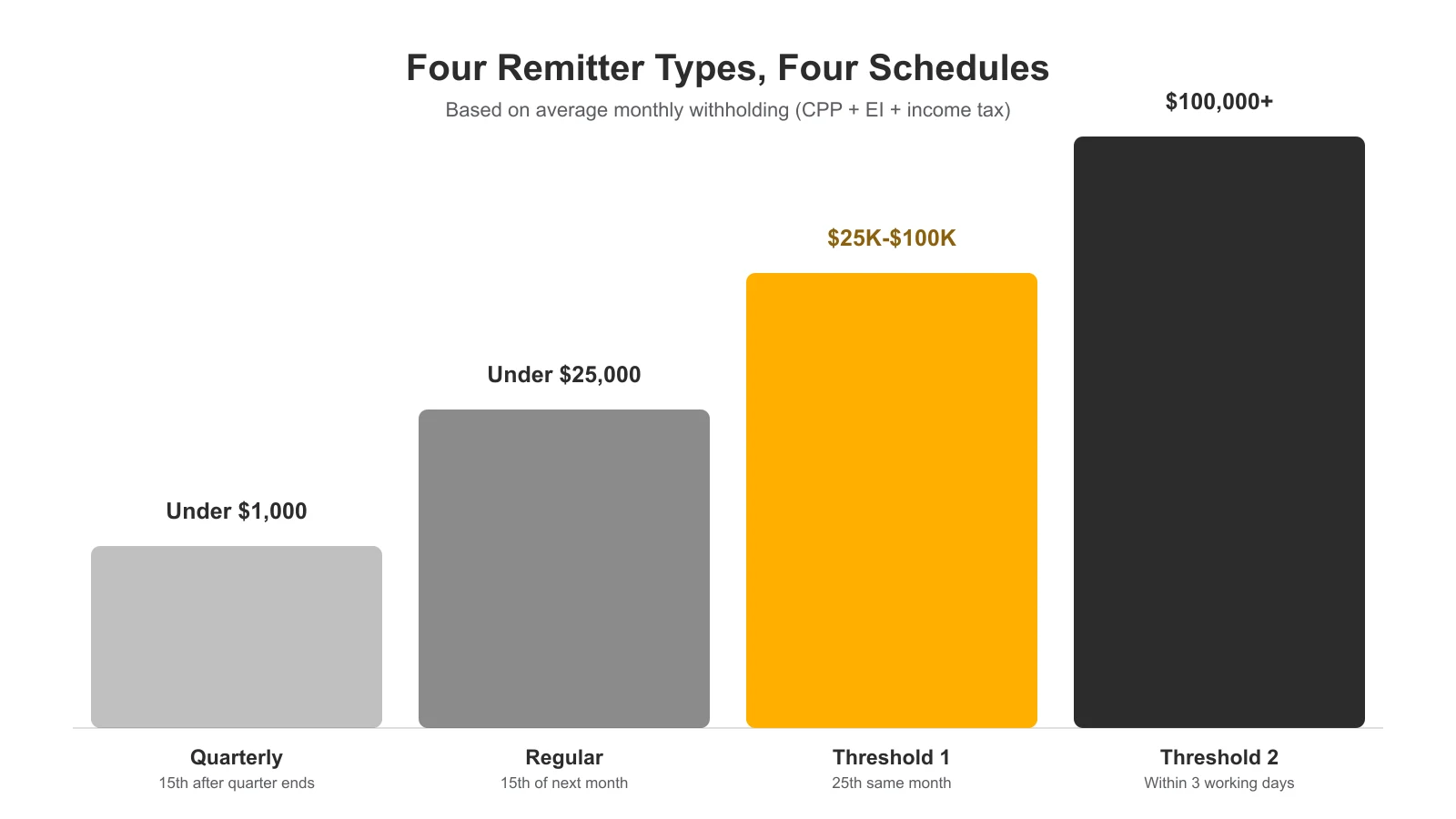 Payroll
Payroll Remittance Deadlines: What New Employers Actually Need to Know
Priya's corporation just became a remitter for the first time. Real 2026 numbers on remitter types, due dates, and the penalty rule most guides get wrong.
 Audit & Assurance
Audit vs. Review vs. Compilation: What Your Business Actually Needs
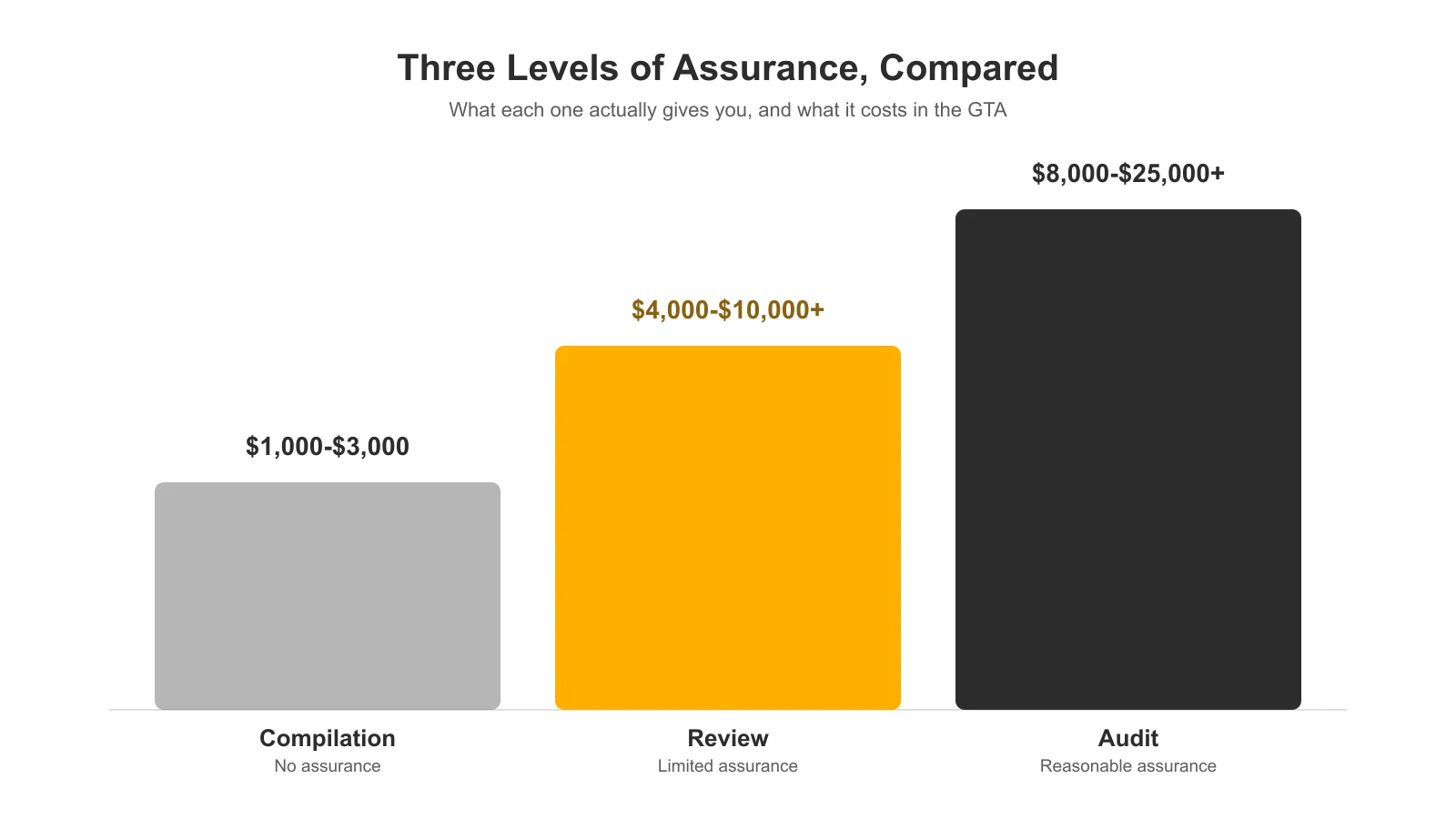
A bank, franchisor, or investor just asked for "reviewed" or "audited" statements. Here's what each assurance level actually means, what it costs in the GTA, and how to know which one applies to you.
 Personal Tax
Self-Employed Tax Filing in Canada: What You Actually Owe, With Real Numbers
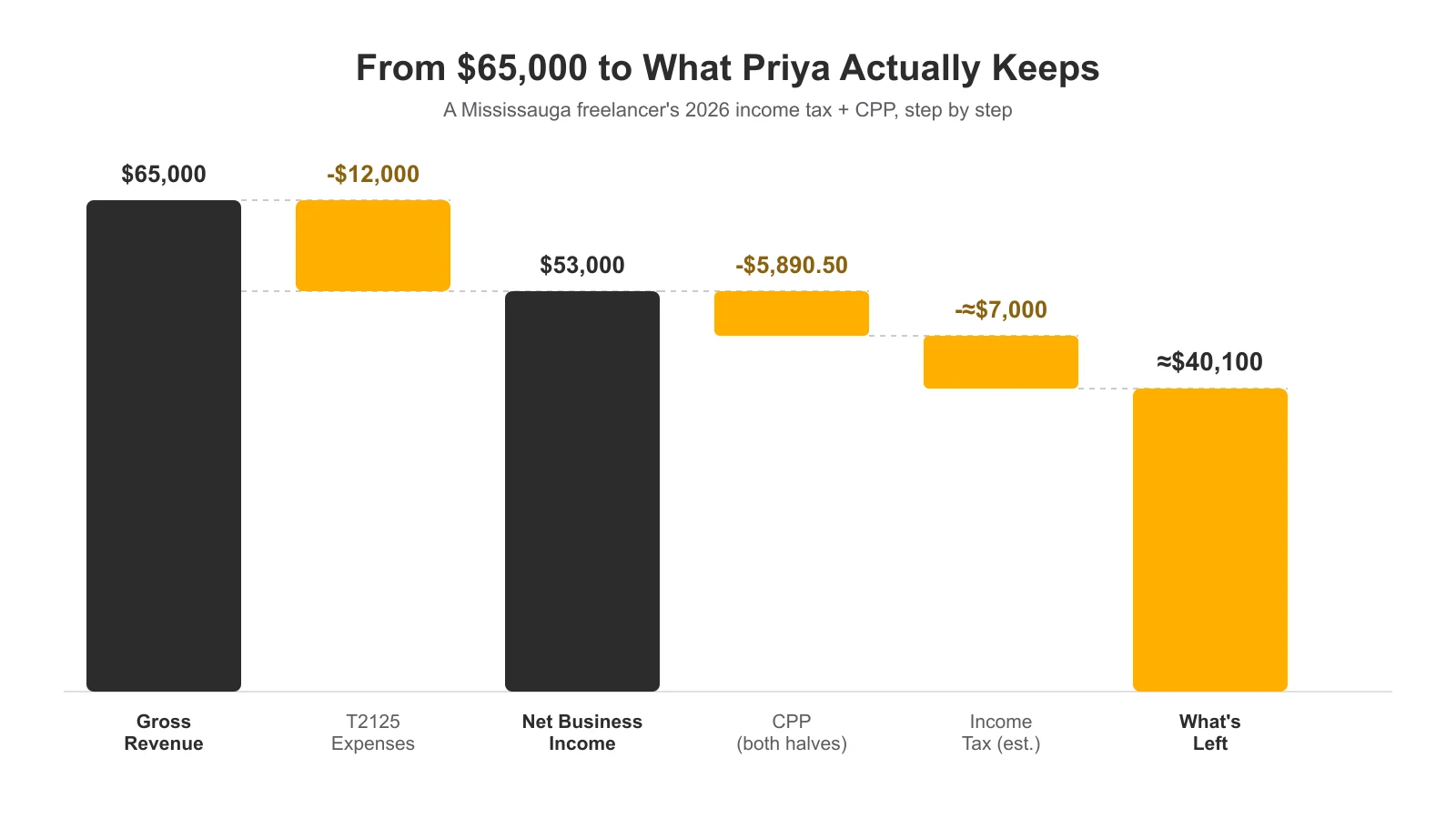
A Mississauga freelancer's $65,000 in revenue, walked through real 2026 numbers: T2125 deductions, CPP contributions, and the two tax deadlines almost everyone confuses.
Free Consultation
Tell Us What You Need. Get a Real Answer Back.
No sales script, no obligation. Describe your situation once and an accounting specialist will follow up with a straight answer and a flat quote.
- Flat-fee quote before any work starts
- Response within one business day
- Reviewed by an expert accountant, not just a bookkeeper