
Self-Employed Tax Filing in Canada: What You Actually Owe, With Real Numbers
A Mississauga freelancer's $65,000 in revenue, walked through real 2026 numbers: T2125 deductions, CPP contributions, and the two tax deadlines almost everyone confuses.
Your first invoice as a freelancer doesn't have tax withheld on it. Neither does your second, or your fifteenth. Every dollar a client pays a self-employed graphic designer, contractor, or rideshare driver in Mississauga lands in the bank account whole, which feels like a raise until the following spring, when the CRA wants its share back in one lump sum instead of the small biweekly bites an employer would normally take out.
Most guides to self-employed taxes in Canada explain the rules in isolation: here's the T2125, here's the CPP rate, here's the deadline, treated as three separate facts with no connection between them. That's not how the number on an actual tax bill gets built. This guide walks the whole chain through one real example, a Mississauga freelance graphic designer earning $65,000 in a year, from gross revenue down to what she actually owes and what she actually keeps, using verified 2026 CRA figures at every step.
The Short Answer: What a $65,000 Freelance Income Actually Costs
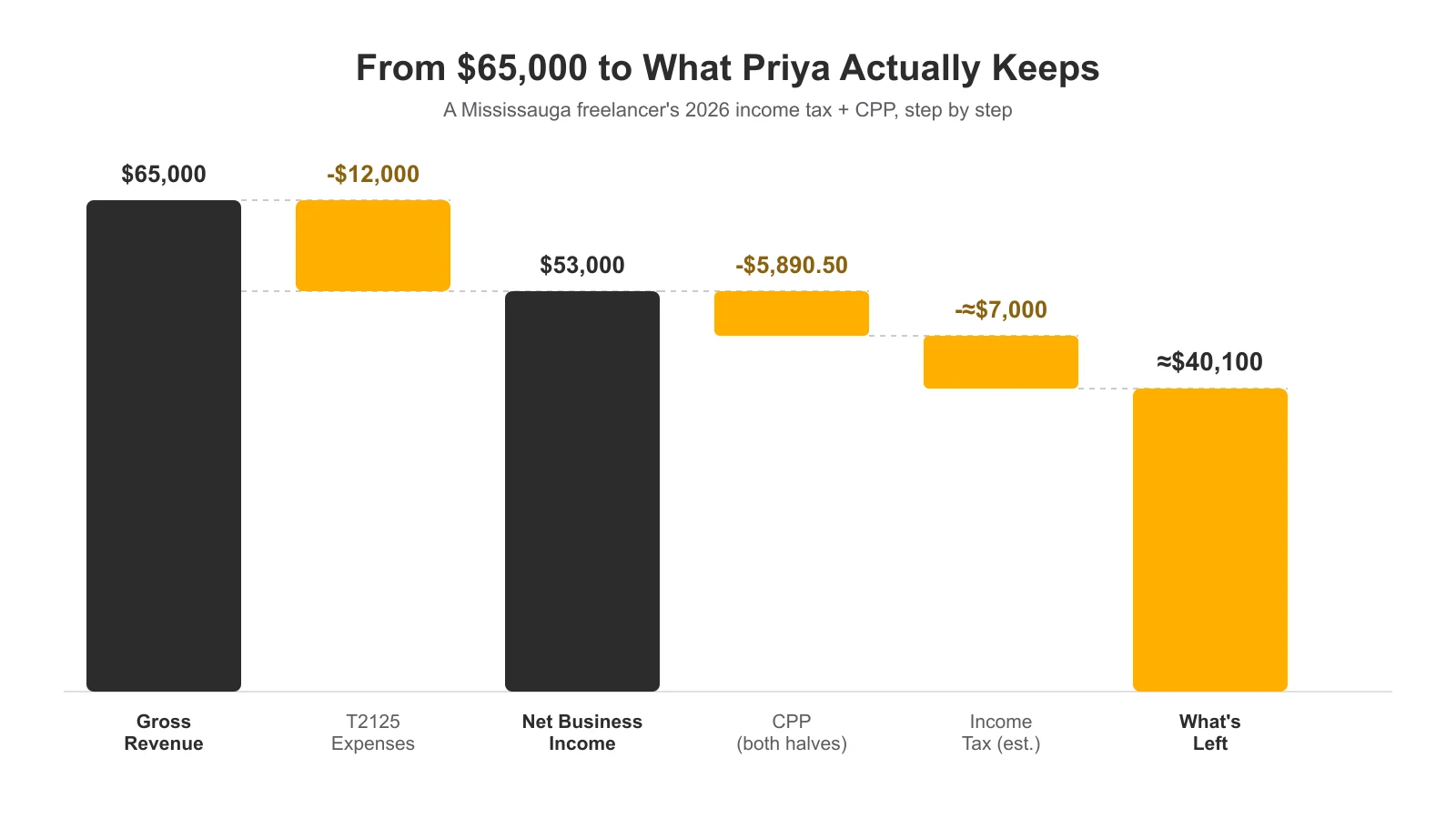
Self-employment income isn't taxed differently from a paycheque; it's taxed at the exact same federal and Ontario marginal rates as employment income, once business expenses are subtracted out. The real difference is CPP. An employee splits Canada Pension Plan contributions with their employer, each paying roughly half. A self-employed person is both sides of that transaction, which is the single biggest reason a $65,000 freelance income and a $65,000 salary land at noticeably different totals owed to the CRA. Here's how that plays out for Priya, our example freelancer, once every step is added up.
Gross revenue
Amount$65,000T2125 business expenses
Amount-$12,000Net business income (Line 13500)
Amount$53,000CPP owed (base, both halves)
Amount$5,890.50Estimated federal + Ontario income tax
Amount≈$6,500 to $7,500Total owed to the CRA
Amount≈$12,400 to $13,400Left after CPP + income tax
Amount≈$39,600 to $40,600
| Line Item | Amount |
|---|---|
| Gross revenue | $65,000 |
| T2125 business expenses | -$12,000 |
| Net business income (Line 13500) | $53,000 |
| CPP owed (base, both halves) | $5,890.50 |
| Estimated federal + Ontario income tax | ≈$6,500 to $7,500 |
| Total owed to the CRA | ≈$12,400 to $13,400 |
| Left after CPP + income tax | ≈$39,600 to $40,600 |
That's roughly 20 percent of gross revenue and about a quarter of net business income going to CPP and income tax combined, before counting anything else on Priya's personal return. Every number in that table is unpacked below, since the mechanics behind each line are exactly where most self-employed filers either overpay by missing a deduction or get blindsided by a bill they didn't budget for.
Are You Actually "Self-Employed" for Tax Purposes?
Freelancer, contractor, sole proprietor, and self-employed all describe the same tax status in Canada: running an unincorporated business, with no separate legal entity between you and the CRA. Registering a business name provincially is optional and mostly a branding decision; it doesn't change how the income is taxed. What actually matters is whether the CRA sees you as running a business or working a disguised job.
The line between the two isn't about a T4 versus an invoice, it's about control. Set your own hours, use your own equipment, work for more than one client, and carry the risk of a bad month, and you're self-employed. Show up on a fixed schedule, use the client's tools, take direction on how (not just what) to deliver, and answer to one company exclusively, and the CRA may reclassify the relationship as employment regardless of what the contract calls it, a distinction that gets more important the fewer clients you have and one worth a proper business structure review before it costs a year of deductions retroactively.
The T2125: Turning Revenue Into Net Business Income
Every self-employed person reports business income and expenses on Form T2125, Statement of Business or Professional Activities, filed alongside the regular T1. Running more than one distinct business or professional activity means filing a separate T2125 for each one; a graphic designer who also tutors math on the side files two. The number that actually matters flows from there to Line 13500 of the T1: net business income, gross revenue minus everything the CRA allows as a reasonable business expense.
Getting from gross revenue to that net figure honestly is mostly a record-keeping problem, not a tax problem, which is why freelancers who keep clean books month to month tend to claim meaningfully more than the ones reconstructing a year of receipts every April. Here's what Priya's $12,000 in deductions actually breaks down into.
Home office (calculated below)
Amount$4,500Subcontracted design help
Amount$2,500Vehicle, business-use portion
Amount$1,500Software and subscriptions
Amount$1,200Equipment (capital cost allowance)
Amount$1,000Marketing and website
Amount$800Bank fees and miscellaneous
Amount$300Professional association dues
Amount$200Total deductions
Amount$12,000
| Expense Category | Amount |
|---|---|
| Home office (calculated below) | $4,500 |
| Subcontracted design help | $2,500 |
| Vehicle, business-use portion | $1,500 |
| Software and subscriptions | $1,200 |
| Equipment (capital cost allowance) | $1,000 |
| Marketing and website | $800 |
| Bank fees and miscellaneous | $300 |
| Professional association dues | $200 |
| Total deductions | $12,000 |
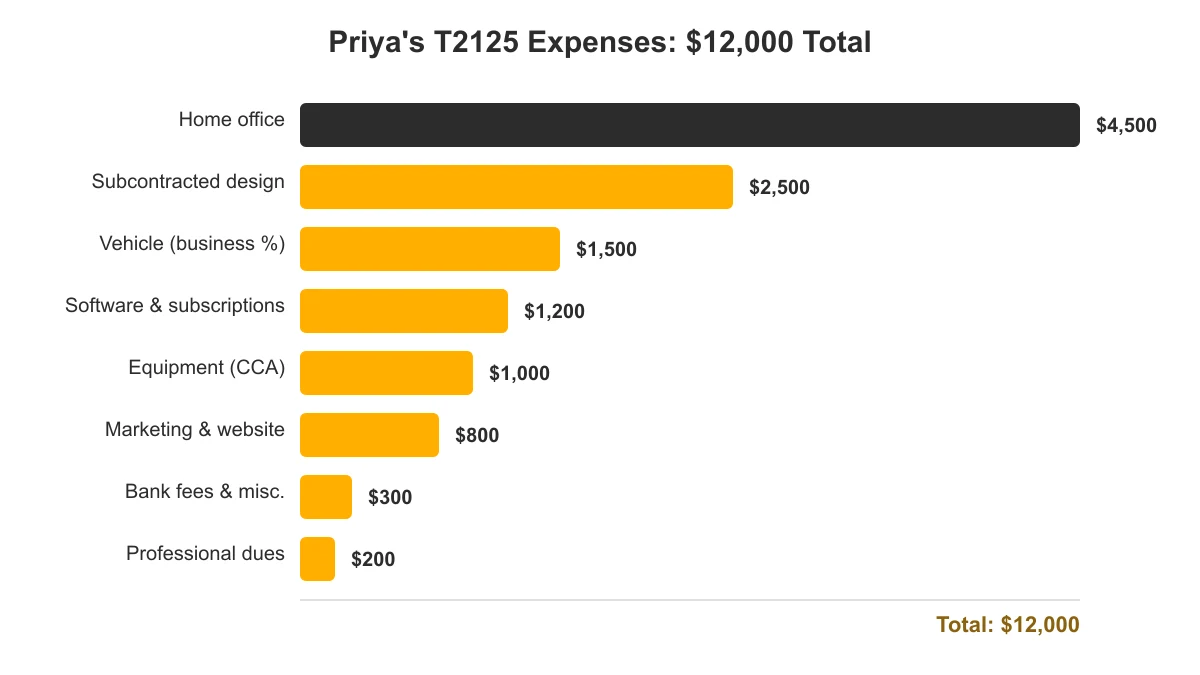
A few of these are worth flagging specifically, since they're the ones freelancers most often either miss entirely or claim wrong. Vehicle expenses are deductible only for the business-use portion, tracked against a mileage log, not the whole car payment. Equipment like a laptop or monitor over a few hundred dollars usually can't be written off in full the year it's purchased; it's depreciated over time through the Capital Cost Allowance system instead, which is why Priya's computer shows up as a smaller annual amount rather than its full purchase price. Subcontracting part of the work to another freelancer, common for designers who bring in an illustrator or copywriter for a specific project, is a fully deductible expense, not something that has to run through payroll.
The Home Office Deduction, Actually Calculated
Almost every guide to self-employed taxes mentions the home office deduction. Almost none of them show the actual math, which is a large part of why it's one of the more under-claimed deductions on the T2125. Two tests determine eligibility: the space has to be either the principal place of business, or used exclusively and on a regular, ongoing basis specifically to meet clients or customers. A spare bedroom Priya uses only for client design work clears the first test easily.
Once a workspace qualifies, the deduction is a percentage of actual home costs, rent, utilities, internet, and for owners, a portion of mortgage interest and property tax, based on the workspace's share of the home's total area. Priya's condo is 900 square feet; her dedicated office is 135 square feet, or 15 percent of the total. Applied against her $30,000 in annual rent and utilities, that works out to the $4,500 already sitting in her expense table above.
Office space
Amount135 sq ftTotal home area
Amount900 sq ftWorkspace share
Amount15%Annual rent + utilities
Amount$30,000Home office deduction
Amount$4,500
| Item | Amount |
|---|---|
| Office space | 135 sq ft |
| Total home area | 900 sq ft |
| Workspace share | 15% |
| Annual rent + utilities | $30,000 |
| Home office deduction | $4,500 |
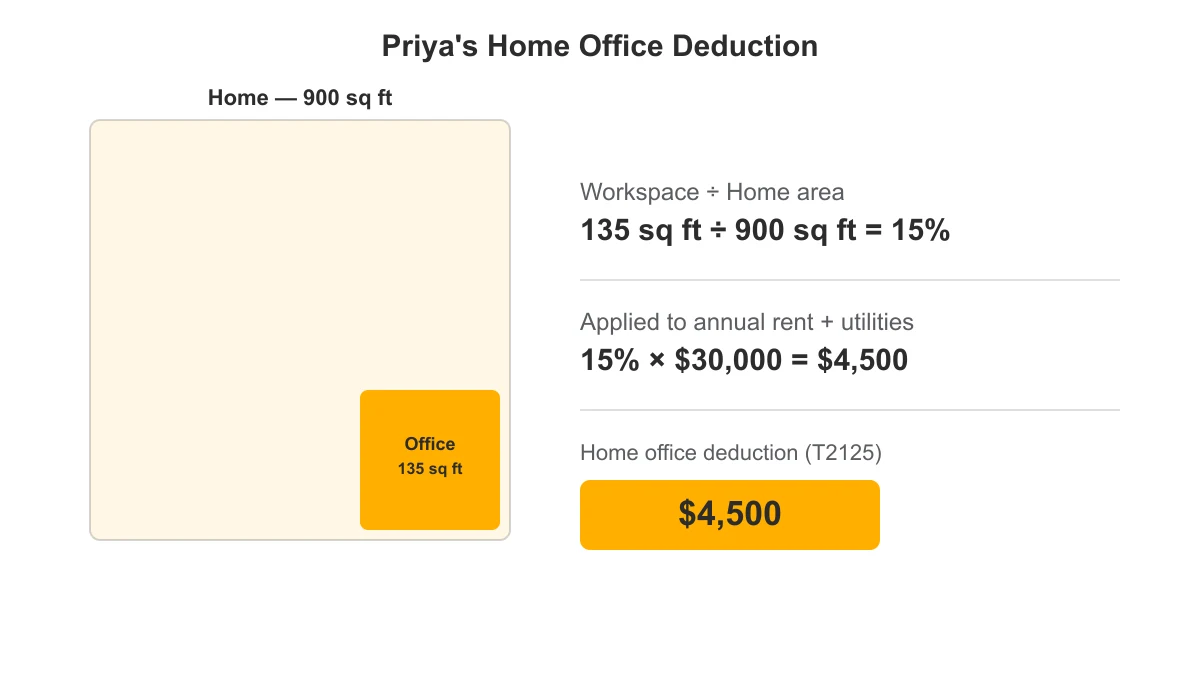
One rule catches people every year: the home office deduction can't create or increase a business loss. If Priya's other expenses had already pushed her net income to zero, none of the $4,500 would be usable that year. It isn't lost, though. The unused portion carries forward and can be applied against home office space in a future year once there's income to offset, worth remembering in a slow first year when skipping the claim entirely feels like the simpler option.
CPP: The Cost Employees Don't Think About
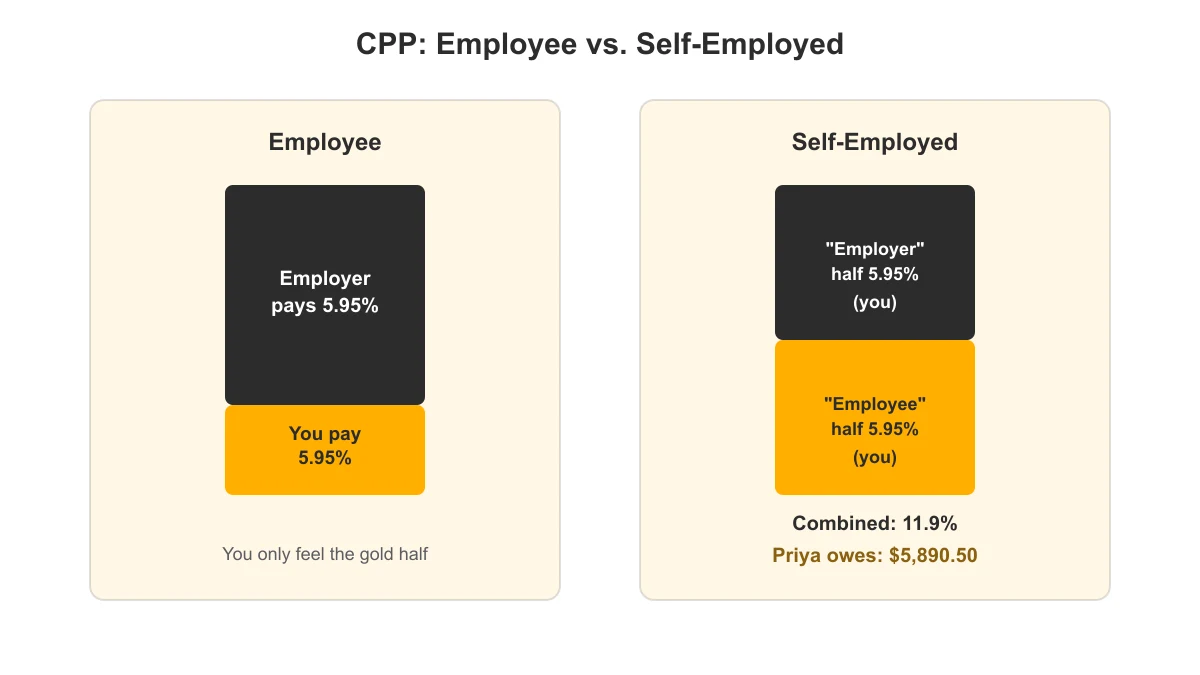
Here's the mechanic almost no guide actually shows in dollars. An employee and their employer each contribute 5.95 percent of pensionable earnings to CPP; the employee only feels their half come off a paycheque. A self-employed person is legally both the employee and the employer, so the full 11.9 percent combined rate lands on one person.
For 2026, CPP applies to net self-employment income between a $3,500 basic exemption and the Year's Maximum Pensionable Earnings of $74,600. Priya's $53,000 net income sits inside that range, so her pensionable earnings are $53,000 minus $3,500, or $49,500. At 11.9 percent, that's $5,890.50 owed for the year, the single largest line item on her tax bill after income tax itself.
Priya doesn't owe anything beyond that, because CPP2, the second additional CPP contribution introduced in 2024, only applies to net income above the $74,600 ceiling, up to a second ceiling of $85,000, at a combined 8 percent for self-employed filers. A freelancer clearing $90,000 in net income would owe the full $5,890.50 in base CPP plus $832 in CPP2, for a combined maximum CPP bill of $9,292.90, the most any self-employed person can owe in CPP for 2026 regardless of how much higher their income climbs.
There's a small offset worth knowing about. Half of base CPP contributions, $2,945.25 in Priya's case, is deducted from income before tax is calculated, the same way an employer's half never counts as taxable income for an employee. The other half becomes a non-refundable tax credit instead. It doesn't erase the bill, but it does mean the full $5,890.50 isn't taxed on top of being owed, more relief than most self-employed filers realize they're getting.
What You'll Actually Owe in Income Tax
Net business income doesn't get its own tax rate. It lands on Line 13500 of the T1 and gets taxed exactly like employment income would, combined with anything else earned that year, at the federal and Ontario brackets that apply to total income. There's no separate "self-employment tax" the way some other countries structure it, just the regular marginal rate applied to a number that's now $12,000 lower than gross revenue because of the T2125.
For 2026, the federal rate on income up to $58,523 is 14 percent, and Ontario's first bracket runs 5.05 percent up to roughly $51,000, stepping to 9.15 percent above that. Applied to Priya's net income, after subtracting the deductible half of her CPP contribution, that works out to roughly $9,500 in combined federal and Ontario tax before any personal credits are applied. Once the basic personal amount and whatever other credits apply to her specific return are factored in, that number typically lands somewhere in the $6,500 to $7,500 range; the exact figure depends on credits unique to a full return, which is the one part of this calculation nobody can give a single universal number for.
Add the $5,890.50 in CPP to that estimate and Priya owes somewhere around $12,400 to $13,400 for the year, roughly a fifth of her original $65,000 in gross revenue. That's the number a T4 employee never sees calculated in one place, because their employer is quietly withholding pieces of it from every paycheque all year long. A self-employed person sees the whole thing at once, which is exactly why setting money aside as it comes in, rather than discovering the total in April, matters more than almost any other habit in this guide.
The Two Deadlines: June 15 Filing vs. April 30 Payment
This is the single most confused rule in self-employed tax filing, and it trips up first-year freelancers almost every time. Self-employed individuals, and their spouse or common-law partner even if that spouse isn't self-employed, get until June 15, 2026 to file. Any balance owing, though, is still due April 30, 2026. The extra six weeks is a filing extension, not a payment extension, and interest starts accruing on unpaid tax from May 1 regardless of when the return actually gets filed.
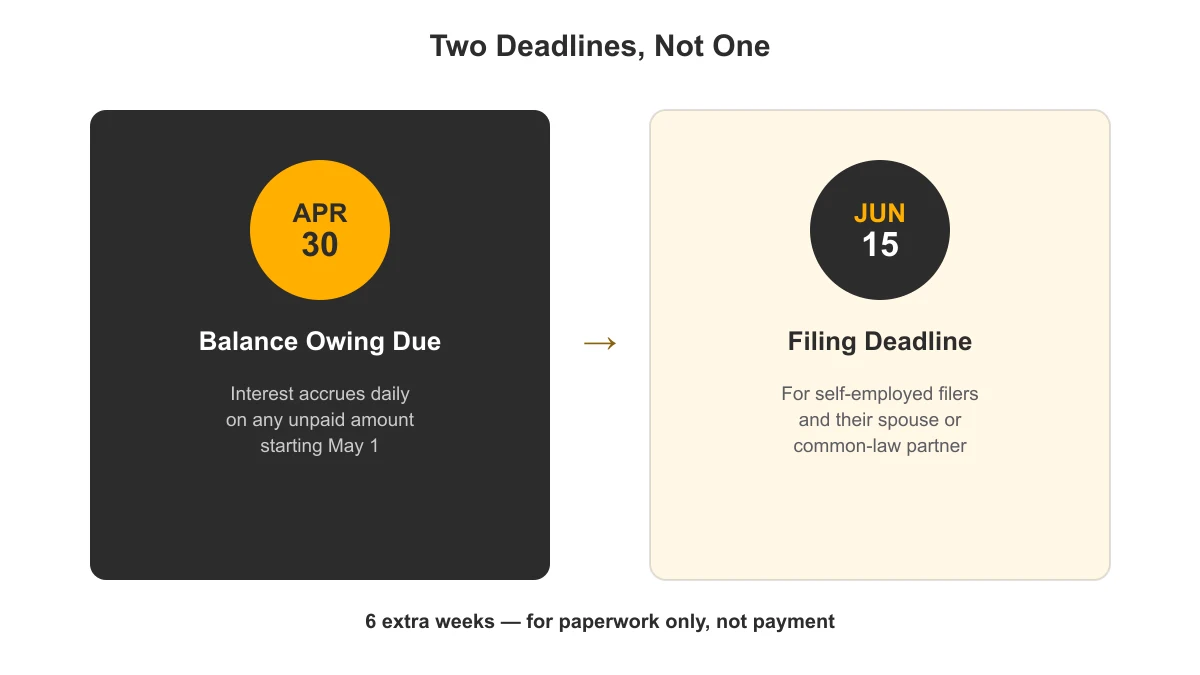
Practically, that means Priya can file her return any time up to June 15 without a late-filing penalty, but if she waits until then to pay the roughly $13,000 she owes, she's paying daily compound interest on it going back to May 1. The smarter sequence, and the one worth building into a habit every year, is to calculate the balance owing as early as possible, pay it by April 30, and use the extra weeks for the paperwork itself if they're genuinely needed, not the other way around.
Do You Need to Pay Tax Instalments?
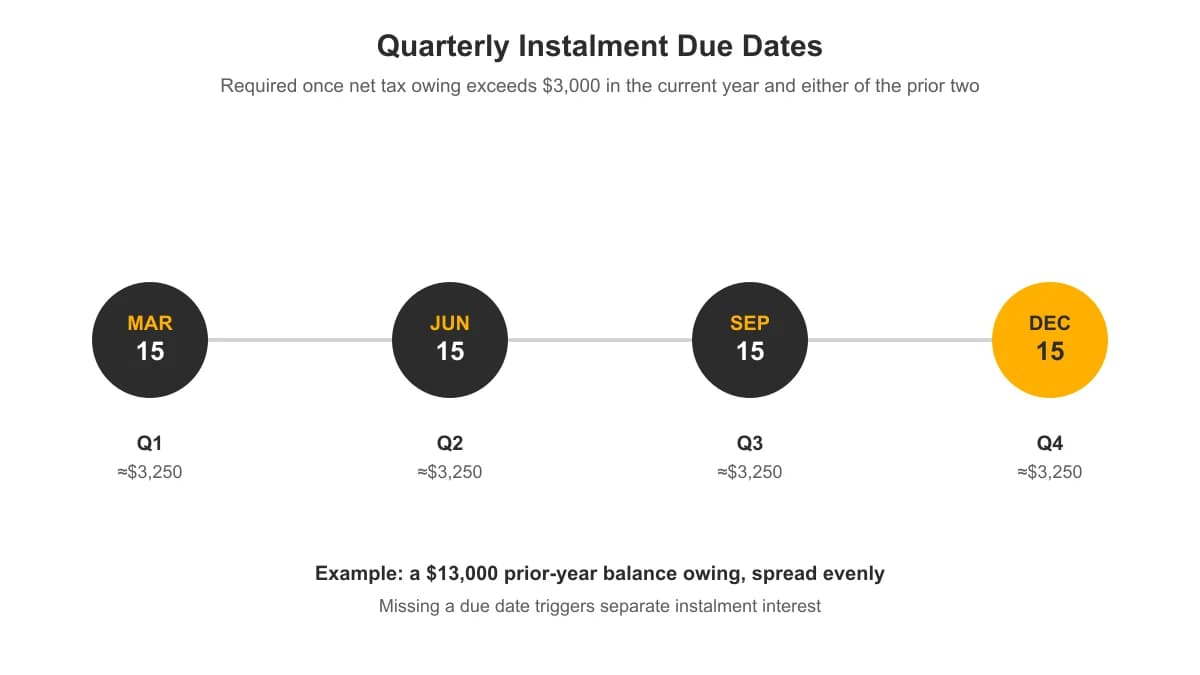
Instalments are quarterly prepayments toward next year's tax bill, required once net tax owing exceeds $3,000 ($1,800 in Quebec) in the current year and in either of the two immediately preceding tax years. The dates are fixed: March 15, June 15, September 15, and December 15.
This is why most freelancers don't owe instalments in year one. The CRA looks backward, so a first-year self-employed filer with no prior owing simply pays the full balance by April 30 and moves on. Priya's roughly $13,000 owing this year changes that going forward: since it clears the $3,000 threshold, the CRA will likely require instalments for next year, spreading a similar total across four payments instead of one lump sum. Missing instalments once they're required triggers instalment interest, calculated separately from regular late-payment interest, so it's worth planning ahead the moment a first big balance owing shows up.
Freelancing on the Side of a Full-Time Job
A T4 job with self-employment income on the side changes more of this math than most guides acknowledge. Both incomes get reported on the same T1, combined into one taxable income figure, which usually pushes the self-employment portion into a higher marginal bracket than it would sit in on its own, since it's stacked on top of the T4 salary rather than starting fresh at zero.
CPP works differently here, and in the employee's favour. An employer already withholds and matches CPP on T4 wages up to the same $74,600 ceiling, reported through Schedule 8 on the T1. A freelancer earning $40,000 from a full-time job and another $20,000 self-employed only owes the full 11.9 percent self-employed CPP rate on whatever pensionable room is left under the ceiling after the T4 income is counted, not on the full $20,000 in isolation. That coordination is exactly why a side hustler's actual CPP bill is almost always lower than treating the two incomes as separate calculations would suggest.
The same logic softens the instalment question. An employer's regular withholding on the T4 portion is already chipping away at the year's total tax liability all year long, which means a side-hustle freelancer often clears the $3,000 instalment threshold on paper without actually owing that much more once withholding is credited. It's worth running the actual numbers before assuming instalments apply just because gross self-employment income looks big enough to trigger them on its own.
What About HST/GST?
Income tax and CPP are separate from HST/GST, and freelancers commonly conflate the two. Registration for HST/GST only becomes mandatory once taxable revenue crosses $30,000, a completely different threshold and filing obligation from anything covered in this guide. We've written a full breakdown of exactly how that threshold works, including the two tests that trigger it and the 29-day registration window most guides get wrong, worth a read if Priya's $65,000 has you wondering whether you're already required to register and charge tax on top of everything else here.
Five Mistakes That Cost Self-Employed Filers Money
- Mixing personal and business spending in one account, which turns every March into a forensic reconstruction project and quietly loses deductions nobody can prove after the fact.
- Skipping the home office deduction in a slow year because it looks unusable, instead of claiming it anyway and carrying the unused portion forward against a stronger year later.
- Claiming a full vehicle payment instead of the business-use percentage, with no mileage log to back the number up if the CRA asks.
- Getting blindsided by instalments in year two, after a first-year balance owing over $3,000 quietly triggers a requirement nobody flagged in advance.
- Working exclusively for one client under their schedule and direction while still filing as fully self-employed, risking a Personal Services Business reclassification that disallows most of the deductions in this guide entirely.
The freelancers who come out ahead aren't the ones who find one clever deduction. They're the ones who know which number is coming six months before it's due.
Getting It Right the First Time
Every number in Priya's example came from real 2026 CRA figures, but expense mix, home office percentage, and income level are specific to each filer. Yours won't match exactly, and the difference between an estimate and an accurate return usually runs a few hundred dollars in either direction, sometimes more once instalments or a Personal Services Business question enter the picture. Our personal tax filing service handles the T2125, the CPP calculation, and the instalment planning together, so the number that shows up in April isn't a surprise. If staying a sole proprietor still makes sense at a given income level is an open question, that's worth a direct conversation too, since incorporating changes some of this math entirely once revenue climbs high enough.
Book a free call and we'll go through actual numbers, not a hypothetical freelancer's.
On this page
Never miss a deadline again
We track every filing date for our clients. Let us watch yours.
Book a free callAccounting Firm Mississauga Team
A practice of expert accountants filing returns for Mississauga businesses and individuals for close to a decade. We write these to answer the questions clients actually ask.
Frequently Asked Questions
Do I need to register a business to be considered self-employed for tax purposes?
No. Sole proprietorship is the default status the moment self-employment income starts coming in, whether or not a business name gets registered provincially. The income and expenses get reported on Form T2125 alongside the regular T1; no separate corporate structure or registration is required unless you choose to incorporate.
How much CPP do I have to pay if I'm self-employed in 2026?
The base CPP rate for self-employed individuals is 11.9 percent combined on net income between the $3,500 exemption and the $74,600 Year's Maximum Pensionable Earnings, since both the employee and employer portions are paid by the same person. If net income exceeds $74,600, an additional CPP2 contribution of 8 percent applies on income up to $85,000. The maximum any self-employed person can owe in CPP for 2026 is $9,292.90.
What's the actual deadline to file self-employed taxes in Canada?
Self-employed individuals and their spouse or common-law partner have until June 15, 2026 to file. Any balance owing, though, is still due April 30, 2026, and interest starts accruing on the unpaid amount from May 1 regardless of when the return is actually filed, so the June 15 date only extends the paperwork deadline, not the payment one.
Can I claim a home office deduction if I rent instead of own?
Yes. Renters calculate the deduction the same way owners do, as the workspace's percentage of total home area applied against rent and utilities instead of mortgage interest and property tax. The space still has to qualify as either the principal place of business or somewhere used exclusively and regularly to meet clients.
Do I have to pay tax instalments in my first year of freelancing?
Usually not. Instalments only become mandatory once net tax owing exceeds $3,000 ($1,800 in Quebec) in the current year and in either of the two immediately preceding tax years, so a first-year self-employed filer with no prior balance owing typically just pays the full amount by April 30. A large first-year balance owing, though, often triggers the requirement for the following year.
How does freelancing on the side of a full-time job affect my taxes?
Both incomes combine on one T1, which usually pushes self-employment earnings into a higher marginal bracket since they stack on top of the T4 salary. CPP is coordinated through Schedule 8 against the shared $74,600 ceiling, so the self-employed CPP bill generally ends up lower than treating the two incomes separately would suggest, and an employer's regular withholding on the T4 portion often covers more of the total liability than expected.
Recent posts
View all → Payroll
Payroll Remittance Deadlines: What New Employers Actually Need to Know
Priya's corporation just became a remitter for the first time. Real 2026 numbers on remitter types, due dates, and the penalty rule most guides get wrong.
 Audit & Assurance
Audit vs. Review vs. Compilation: What Your Business Actually Needs
A bank, franchisor, or investor just asked for "reviewed" or "audited" statements. Here's what each assurance level actually means, what it costs in the GTA, and how to know which one applies to you.
 Corporate Tax
Should You Incorporate? What It Actually Changes About Your Taxes
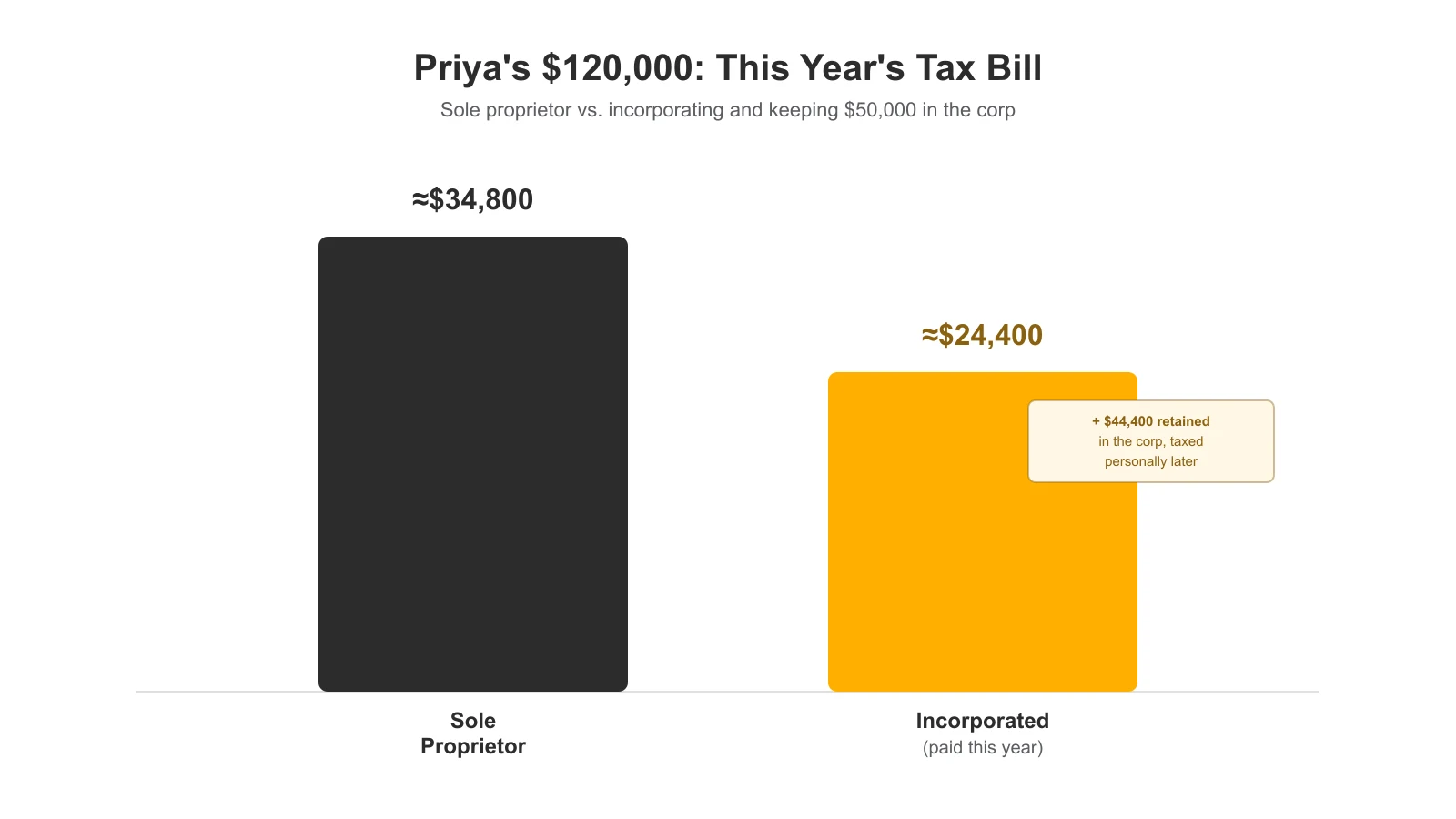
Incorporating doesn't erase your tax bill, it defers it. A real worked example, using 2026's new small business rate, of what actually changes when you stop being a sole proprietor.
Free Consultation
Tell Us What You Need. Get a Real Answer Back.
No sales script, no obligation. Describe your situation once and an accounting specialist will follow up with a straight answer and a flat quote.
- Flat-fee quote before any work starts
- Response within one business day
- Reviewed by an expert accountant, not just a bookkeeper