
Do You Need to Register for HST/GST in Ontario? The $30,000 Threshold Explained
The CRA's $30,000 small-supplier threshold actually hides two separate tests and two different deadlines. Real worked examples for Ontario businesses.
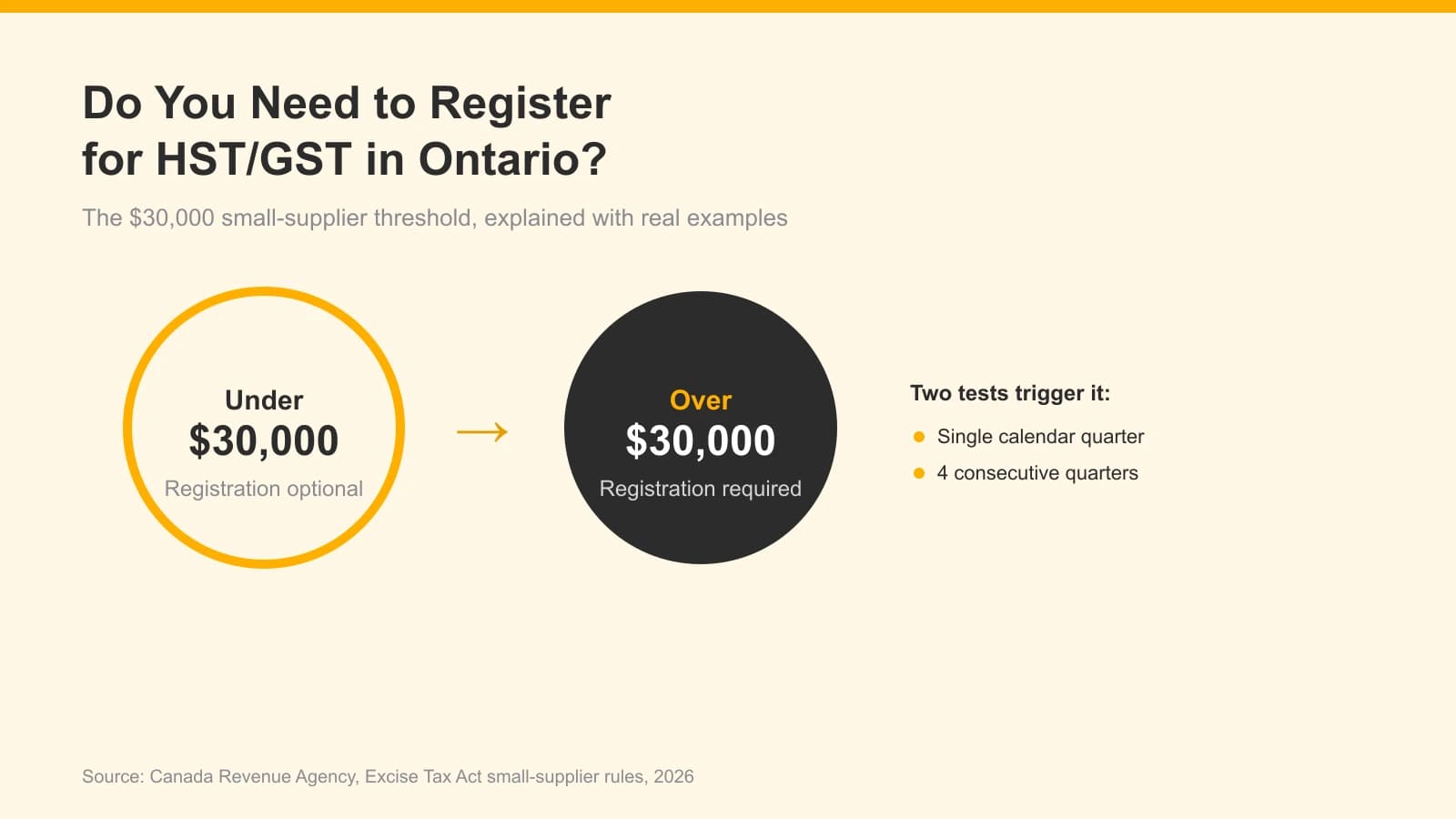
You need to register for HST/GST in Ontario once your worldwide taxable revenue crosses $30,000, either in a single calendar quarter or added up across the last four consecutive quarters, whichever happens first. Below that line, registration is optional. Above it, the CRA doesn't ask, it requires it, and the clock on your obligation starts the day you cross the number, not the day you get around to registering.
That one sentence hides two separate tests, two different effective dates, and a paperwork deadline that doesn't line up with either of them, which is where most business owners get tripped up. This guide walks through both thresholds with real numbers, what actually counts toward the $30,000, why some Mississauga businesses register long before they have to, and the one category of driver who has to register from day one regardless of revenue.
The Short Answer: When Registration Is Required
The $30,000 figure comes from the Excise Tax Act's small-supplier rule and it hasn't moved since 1991. It isn't indexed to inflation, which is part of why more Mississauga freelancers, consultants, and small retailers cross it today than would have thirty years ago on the same real income. Below $30,000 in worldwide taxable supplies, you're a small supplier and registration is optional. Cross it, by either of two tests, and registration becomes mandatory.
Taxable revenue under $30,000 (both tests)
Registration Required?No, optionalOver $30,000 in one calendar quarter
Registration Required?Yes, effective that same dayOver $30,000 across 4 consecutive quarters
Registration Required?Yes, from the following monthTaxi or commercial ride-share driver (any revenue)
Registration Required?Yes, from day one
| Situation | Registration Required? |
|---|---|
| Taxable revenue under $30,000 (both tests) | No, optional |
| Over $30,000 in one calendar quarter | Yes, effective that same day |
| Over $30,000 across 4 consecutive quarters | Yes, from the following month |
| Taxi or commercial ride-share driver (any revenue) | Yes, from day one |
The Two Tests That Actually Trigger Registration
The CRA doesn't measure the $30,000 one way. It runs two separate tests at the same time, and either one crossing the line ends your small-supplier status, even if the other test never would have.
Test 1: The single calendar-quarter test
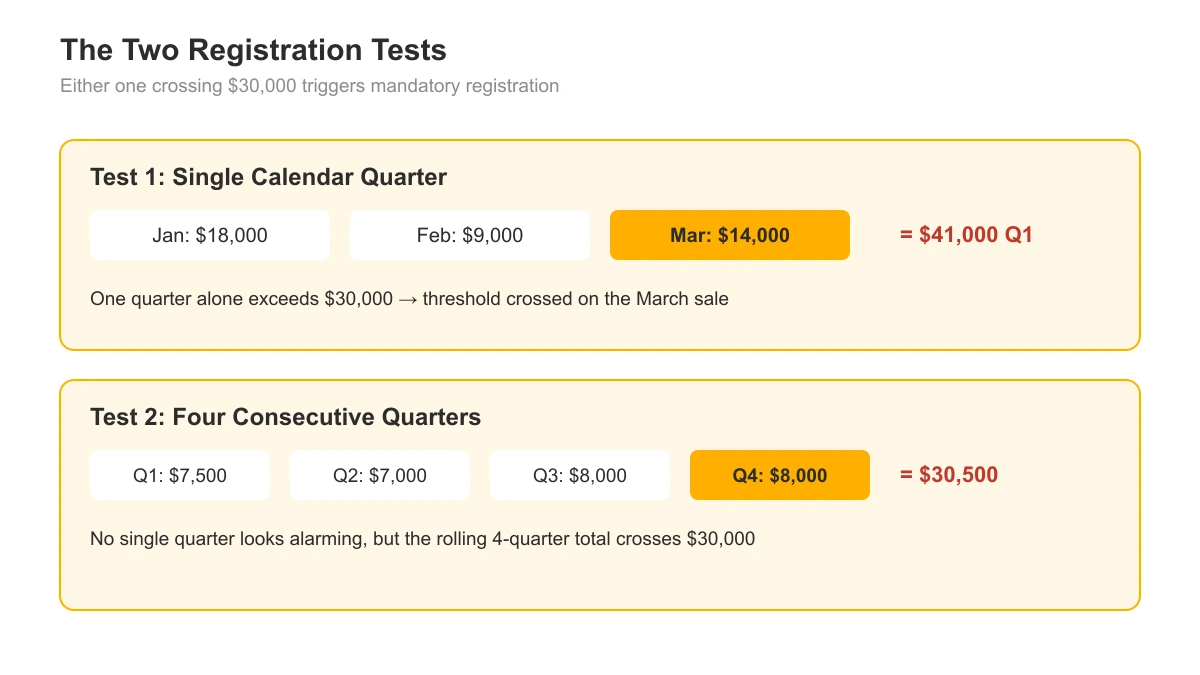
If your taxable revenue in one calendar quarter (Jan–Mar, Apr–Jun, Jul–Sep, or Oct–Dec) alone exceeds $30,000, you cross the threshold immediately, on the transaction that pushed you over. A Mississauga renovation contractor who invoices $18,000 in January and $9,000 in February is still under the line. If a $14,000 kitchen project closes in March, that quarter's total hits $41,000, and the single-quarter test trips on that March sale specifically, not at year-end and not retroactively for January or February.
Test 2: The four-consecutive-quarter test
This one catches steady, gradual growth that never spikes in any single quarter. The CRA adds up your taxable revenue across the trailing four calendar quarters at the end of every quarter. A freelance marketing consultant billing $7,500, $7,000, $8,000, and $8,000 across four consecutive quarters never crosses $30,000 in any one quarter, but the four added together total $30,500, so the four-quarter test is the one that trips, not the single-quarter test.
Q1
Revenue$7,500Trailing 4-Quarter Totaln/a (fewer than 4 quarters)Q2
Revenue$7,000Trailing 4-Quarter Totaln/a (fewer than 4 quarters)Q3
Revenue$8,000Trailing 4-Quarter Totaln/a (fewer than 4 quarters)Q4
Revenue$8,000Trailing 4-Quarter Total$30,500 — threshold crossed
| Quarter | Revenue | Trailing 4-Quarter Total |
|---|---|---|
| Q1 | $7,500 | n/a (fewer than 4 quarters) |
| Q2 | $7,000 | n/a (fewer than 4 quarters) |
| Q3 | $8,000 | n/a (fewer than 4 quarters) |
| Q4 | $8,000 | $30,500 — threshold crossed |
What Counts Toward the $30,000 (and What Doesn't)
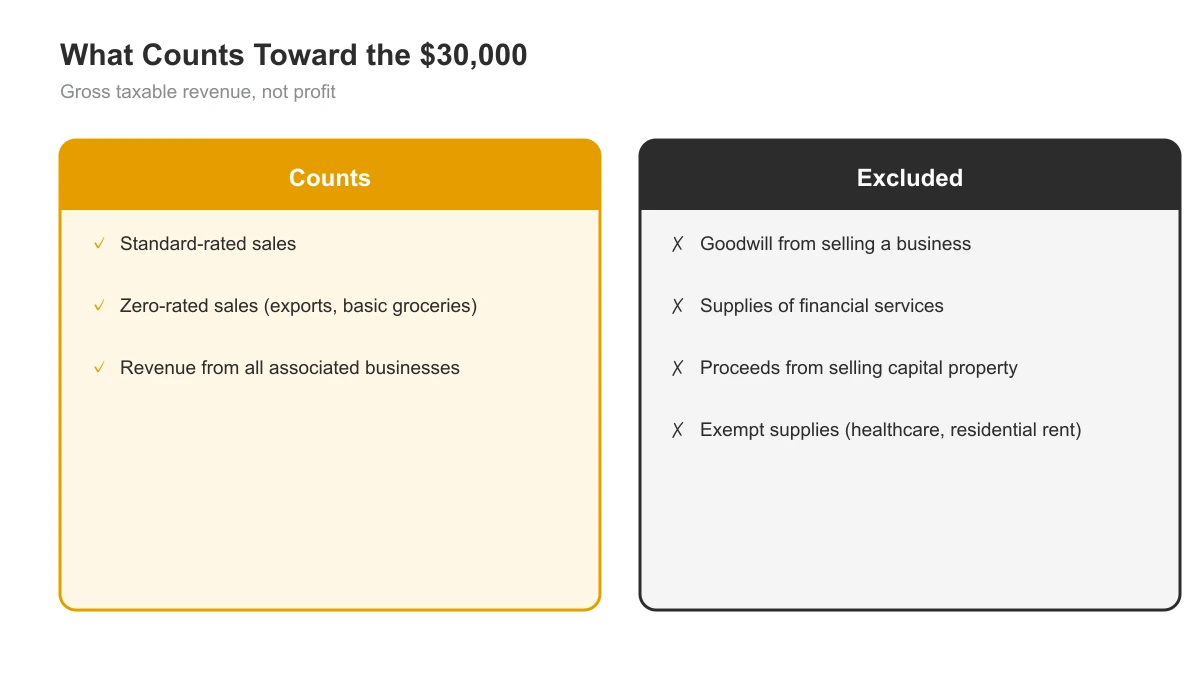
The $30,000 is gross taxable revenue, not profit, and it includes revenue from every business you're "associated" with under the Income Tax Act's association rules, not just the one you're asking about. A few categories are specifically excluded, and most competitor guides skip them entirely.
- Counts: standard-rated sales, zero-rated sales (including exports and basic groceries, taxed at 0% but still counted), and revenue from every associated business combined.
- Excluded: goodwill from the sale of a business.
- Excluded: supplies of financial services.
- Excluded: proceeds from selling capital property (equipment or real estate you owned for use in the business, not inventory).
- Excluded entirely: revenue from exempt supplies, like most healthcare services, residential rent, and daycare, since these were never taxable to begin with.
Why the "associated businesses" rule catches people off guard
If you own more than one business, the CRA doesn't look at each one in isolation. Businesses count as associated under the same rules used for the Income Tax Act, generally meaning common ownership or control, and their revenue gets combined for the $30,000 test. A Mississauga owner running a small consulting practice and a separate side business selling products online might each individually sit under $30,000, but if the two are associated, their combined revenue is what actually gets tested. Missing this is one of the more common ways businesses end up registering later than they should have.
Why zero-rated and exempt aren't the same thing
This distinction trips up more business owners than almost anything else in the small-supplier rules. Zero-rated supplies, like basic groceries, prescription drugs, and most exports, are still taxable supplies, just taxed at a rate of 0 percent, which means they still count toward your $30,000. Exempt supplies, like most healthcare services, residential rent, and daycare, aren't taxable at all, which means they never counted toward the threshold in the first place and never will, no matter how much revenue they generate. A Mississauga business selling a mix of zero-rated and standard-rated goods needs to count both; a business providing purely exempt services, like a massage therapist or a residential landlord, may never trip the threshold on that revenue alone.
The Day You Cross the Threshold vs. The Day You Must Register
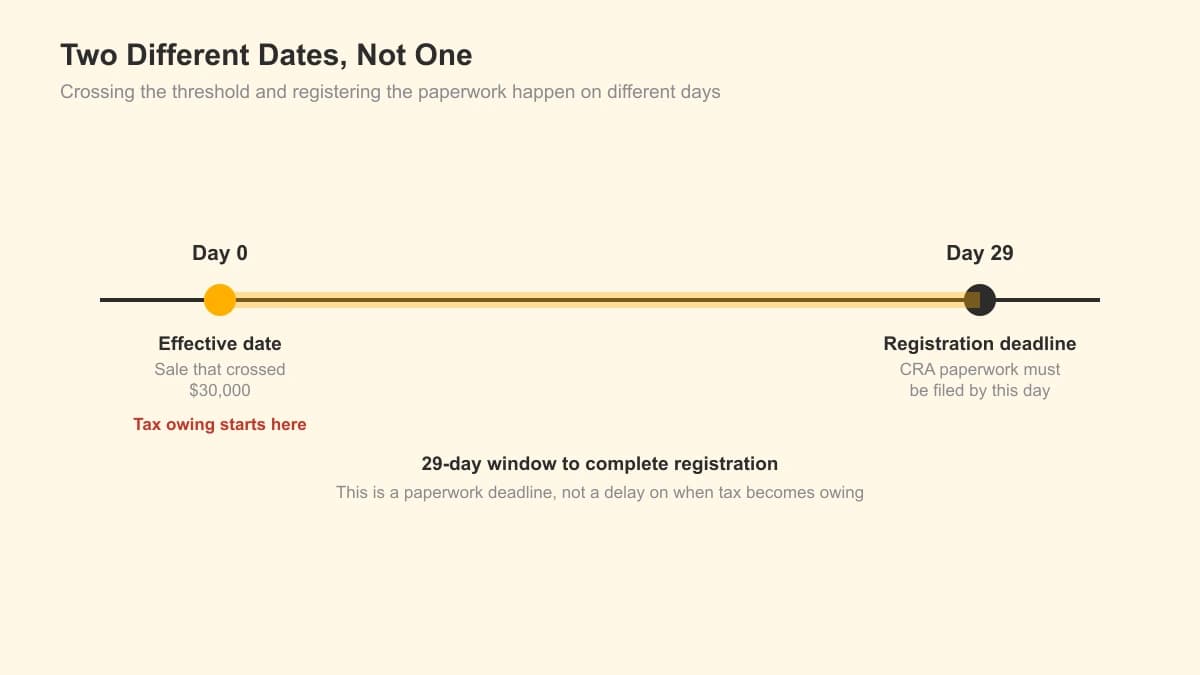
Almost every competing guide blurs two dates that are actually separate, and it's the single most common point of confusion. The first date is your effective date of registration: the day you become legally required to start charging HST/GST. The second is your registration deadline: the day you must have the paperwork filed with the CRA. They are not the same day, and the gap between them is exactly 29 days.
For the single-quarter test, your effective date is the day of the sale that pushed you over $30,000, which means you were technically required to charge tax on that very sale, even before you'd registered. For the four-quarter test, your effective date is the first sale you make after the quarter in which your trailing total crossed $30,000. In both cases, you then have 29 days from that effective date to actually complete registration with the CRA. The 29 days is a paperwork window, not a grace period on when tax becomes owing.
Should You Register Voluntarily Before You Hit $30,000?
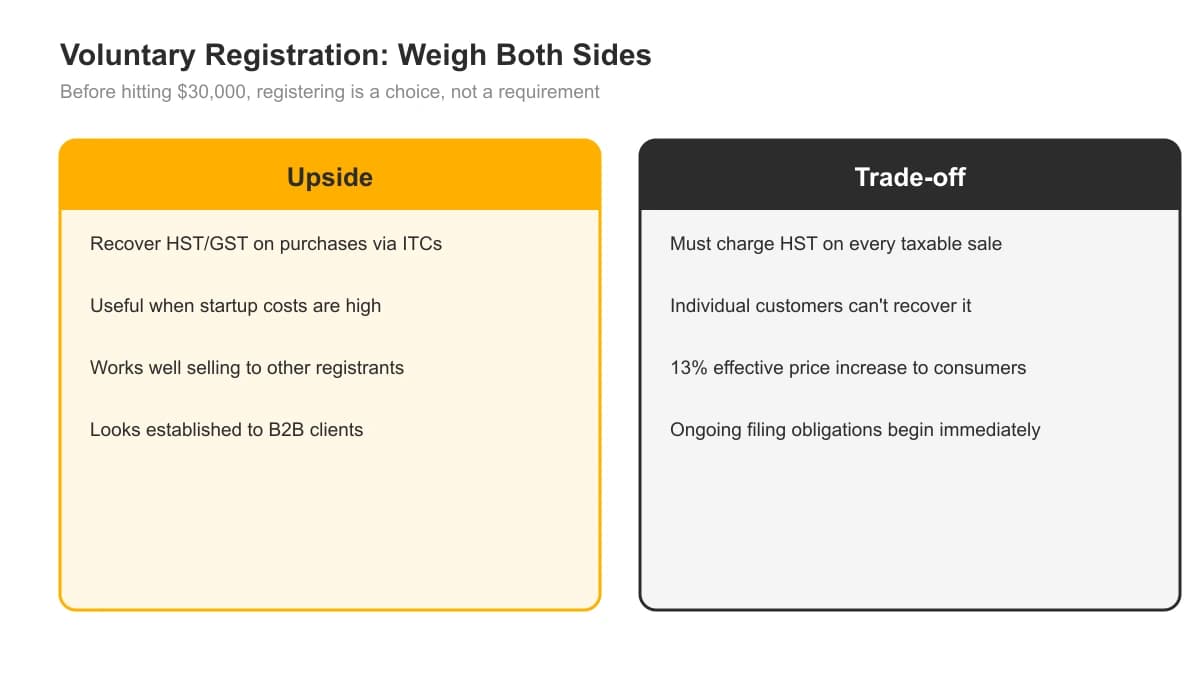
Anyone making taxable supplies in Canada can register before they're required to, and plenty of Mississauga businesses do. The main reason is Input Tax Credits: once registered, you can recover the HST/GST you pay on business purchases, equipment, software, office space, professional fees, instead of absorbing it as a cost. For a new business with high startup spending, or one that sells mostly to other registered businesses (who can recover the tax themselves and won't feel the increase), that recovery can be worth more than the compliance work.
Voluntary registration isn't free money. Once you register, you charge HST on every taxable sale, including to individual customers who can't recover a cent of it.
That's the downside most guides leave out. A small supplier selling directly to consumers, a home-based craft business, a solo tutor, a personal trainer, is effectively adding 13 percent to every invoice the moment they register, with no offsetting benefit to the customer. Unless your input costs are genuinely high or your client base is mostly other GST/HST registrants, staying unregistered below $30,000 often keeps you more price-competitive, not less compliant.
A concrete comparison makes the trade-off clearer. A new Mississauga consultant spending $8,000 on a laptop, software subscriptions, and office setup in year one, billing mostly other registered businesses, could recover roughly $920 in HST through Input Tax Credits by registering early (13 percent of $8,000, spread across those purchases), while adding 13 percent to invoices that clients can recover anyway. A solo craft-business owner selling finished goods directly to individuals at markets and online, by contrast, would gain the same input recovery on materials but lose it back the moment every customer sees prices jump 13 percent with no way to claim it themselves. Same rule, opposite outcome, depending entirely on who's actually paying the tax at the end of the chain.
Taxi and Rideshare Drivers: No Threshold At All
One category skips the $30,000 test entirely. Self-employed taxi drivers and commercial ride-share drivers must register for HST/GST from the day they start driving, regardless of how little they earn. Since July 1, 2017, the CRA's definition of a taxi business was expanded specifically to capture drivers working through an app-based platform like Uber or Lyft, whether they own the vehicle, lease it, or work for a percentage of fares. A driver earning $4,000 in their first month has the exact same registration obligation as one earning $40,000.
This matters more in Mississauga than most cities realize, given how much ride-share activity runs through the Square One and Pearson Airport corridors. Anyone starting rideshare driving alongside a day job, thinking they'll deal with taxes once it becomes a real income source, is already required to register before their first fare. If you're catching up on registration you should have filed months ago, our backlog accounting service and a records review is usually the fastest way to get current without guessing at what you owe.
What Happens If You Don't Register When You Should
Missing a mandatory registration date doesn't erase the obligation, it just means the CRA calculates what you owed retroactively. You generally can't go back to customers after the fact and add HST to invoices they've already paid, so an unregistered business that should have been charging tax usually ends up remitting it out of its own margin once the CRA catches up.
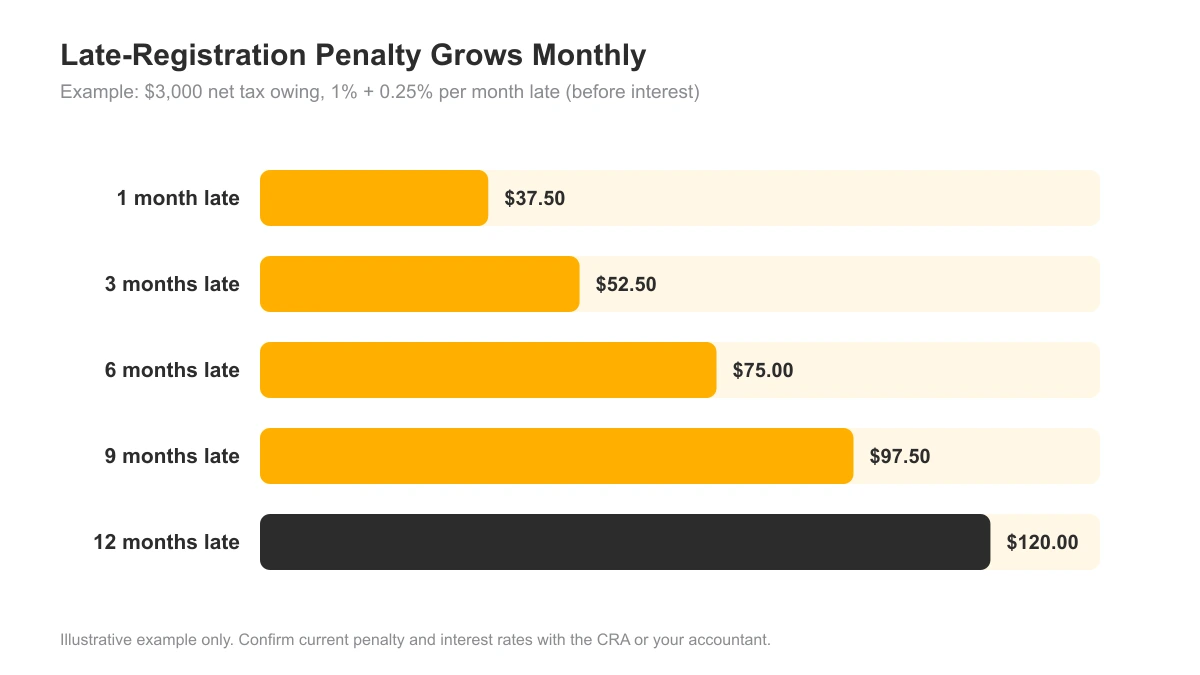
On top of the retroactive tax itself, a late-filing penalty typically applies: commonly cited as 1 percent of the net tax owing, plus 0.25 percent for every full month you're late, up to a maximum of 12 months, with steeper penalties for repeat non-compliance within the prior three years. Interest also compounds daily on the unpaid amount from the original due date. Penalty and interest rates are reviewed periodically, so confirm the current figures with the CRA or your accountant before assuming an exact number applies to your situation. Businesses that come forward before the CRA contacts them may qualify for the Voluntary Disclosures Program, which can reduce penalties and interest on a retroactive registration, generally covering up to a 10-year lookback.
Put real numbers on that formula and it's easy to see how fast it adds up. A business that owed $3,000 in net tax and registered six months late would face a base penalty of 1 percent of $3,000 ($30), plus 0.25 percent of $3,000 for each of those six months ($7.50 x 6, or $45), for a combined penalty of roughly $75, before interest is even added on top. That's before the retroactive tax itself, the $3,000 that likely has to come out of the business's own margin since it was never collected from customers in the first place. The penalty is rarely the biggest number in the equation; the uncollected tax is.
How to Register: The Practical Steps
Registering for HST/GST attaches a program account to your Business Number: a 9-digit BN plus an "RT" program identifier plus a 4-digit reference, formatted like 123456789 RT 0001. Most businesses register through the CRA's Business Registration Online system, which is fast and often confirms the account immediately; businesses in situations BRO can't handle file a paper Form RC1 instead. If you'd rather not navigate the forms yourself, our HST/GST registration service handles the account setup directly, and once you're registered, ongoing GST/HST return filing keeps the remittance schedule on track without it landing back on your desk every quarter.
Once registered, the CRA assigns a default filing frequency, annually, quarterly, or monthly, based mainly on your annual taxable revenue, with higher-revenue businesses filing more often. You can request a more frequent filing period than the default even if you don't have to, which some businesses do specifically to get refunds back faster when their Input Tax Credits regularly exceed the tax they collect.
What This Looks Like for Mississauga Businesses
The two tests play out differently depending on what kind of business is running them. A retailer near Square One or along Erin Mills with a strong holiday season can blow past $30,000 in a single Q4 while sitting comfortably under it every other quarter, tripping the single-quarter test even though their annual revenue looks modest spread across the year. A contractor or trades business billing steadily across the Mississauga-Toronto-Oakville corridor is more likely to creep over gradually and trip the four-quarter test instead, often without a single quarter that looks alarming on its own.
An online seller shipping out of a Mississauga warehouse or fulfillment space adds another wrinkle worth flagging early: worldwide taxable supplies means exactly that, and a growing share of e-commerce revenue can push a seller over $30,000 well before their Ontario-only sales alone would. Waiting until the business feels big enough to worry about tax is usually how the threshold gets crossed without anyone noticing until the quarterly numbers get added up after the fact.
Either pattern is easy to miss if nobody's tracking taxable revenue on a rolling quarterly basis, which is exactly the kind of thing that falls through the cracks once bookkeeping is behind. If you're not sure which side of $30,000 your business actually sits on right now, that's worth a direct answer rather than a guess. Book a free call and we'll look at your actual numbers with you.
On this page
Never miss a deadline again
We track every filing date for our clients. Let us watch yours.
Book a free callAccounting Firm Mississauga Team
A practice of expert accountants filing returns for Mississauga businesses and individuals for close to a decade. We write these to answer the questions clients actually ask.
Frequently Asked Questions
Do I need to register for HST/GST if I'm a sole proprietor?
Yes. The $30,000 threshold and both registration tests apply the same way regardless of whether you operate as a sole proprietor, partnership, or corporation. Business structure doesn't change the small-supplier rules.
What happens if I go over $30,000 by accident, mid-quarter?
You're still required to register. If a single sale pushes your quarterly revenue past $30,000, the CRA considers you registered effective that transaction, whether you meant to cross the line or not, and you have 29 days from that date to complete the paperwork.
Does the $30,000 threshold apply to gross revenue or profit?
Gross revenue from worldwide taxable supplies, not net income or profit. Expenses, cost of goods sold, and overhead don't reduce the number used for the threshold test.
What's excluded from the $30,000 calculation?
Goodwill from selling a business, supplies of financial services, and proceeds from selling capital property (like equipment or real estate used in the business) are all excluded. Revenue from exempt supplies, such as most healthcare services and residential rent, was never taxable and doesn't count either.
Do Uber and Lyft drivers have to register for HST/GST?
Yes, from the day they start driving, regardless of revenue. Self-employed taxi and commercial ride-share drivers are exempt from the $30,000 small-supplier threshold entirely under CRA rules that have applied to app-based platforms since July 1, 2017.
Can I register for HST/GST voluntarily before I hit $30,000?
Yes, and many businesses do, mainly to recover HST/GST paid on business purchases through Input Tax Credits. The trade-off is that once registered, you must charge HST/GST on every taxable sale going forward, including to individual customers who can't recover it, so it's worth weighing against your actual client mix first.
Recent posts
View all → Payroll
Payroll Remittance Deadlines: What New Employers Actually Need to Know
Priya's corporation just became a remitter for the first time. Real 2026 numbers on remitter types, due dates, and the penalty rule most guides get wrong.
 Audit & Assurance
Audit vs. Review vs. Compilation: What Your Business Actually Needs
A bank, franchisor, or investor just asked for "reviewed" or "audited" statements. Here's what each assurance level actually means, what it costs in the GTA, and how to know which one applies to you.
 Corporate Tax
Should You Incorporate? What It Actually Changes About Your Taxes
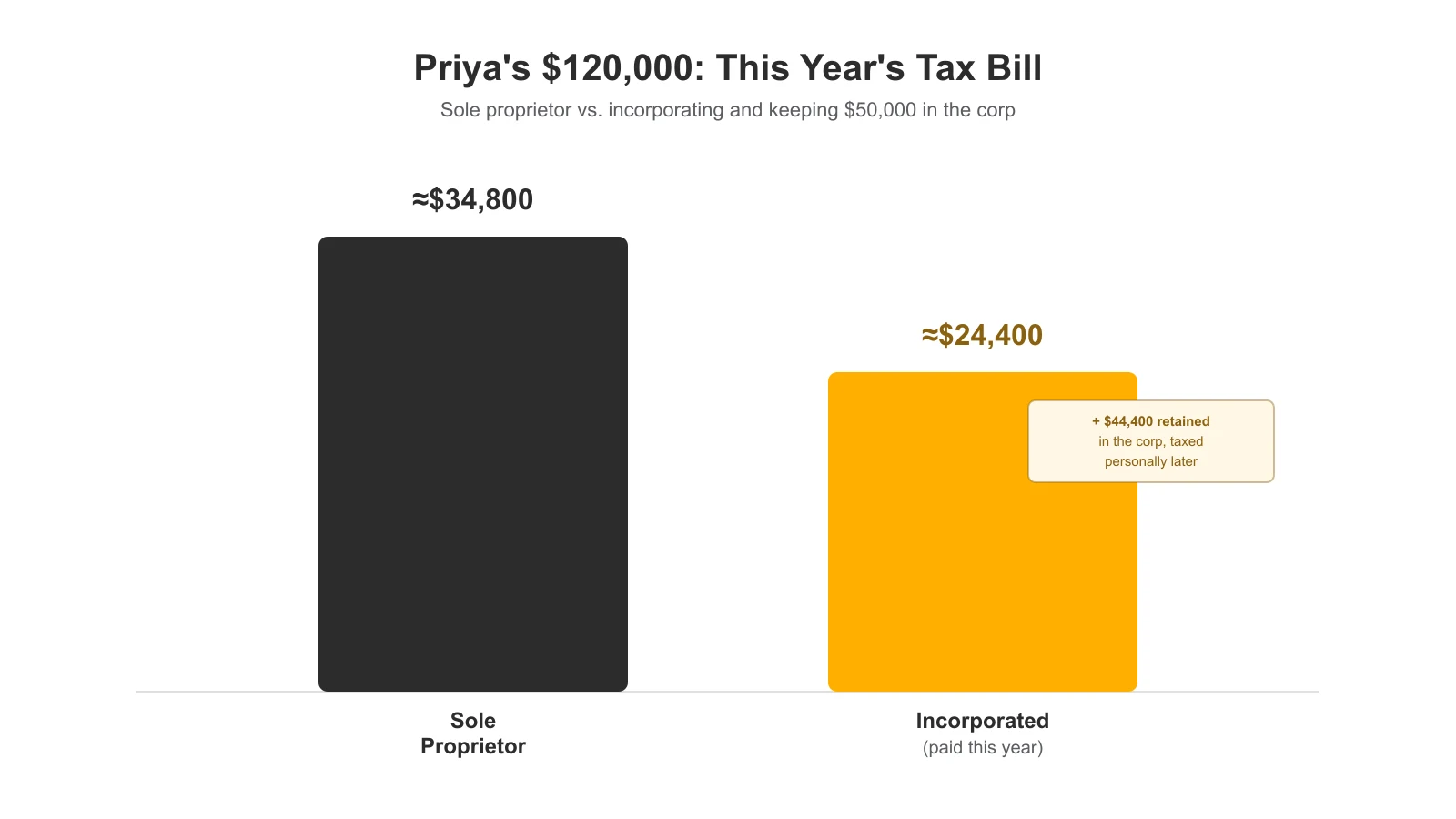
Incorporating doesn't erase your tax bill, it defers it. A real worked example, using 2026's new small business rate, of what actually changes when you stop being a sole proprietor.
Free Consultation
Tell Us What You Need. Get a Real Answer Back.
No sales script, no obligation. Describe your situation once and an accounting specialist will follow up with a straight answer and a flat quote.
- Flat-fee quote before any work starts
- Response within one business day
- Reviewed by an expert accountant, not just a bookkeeper